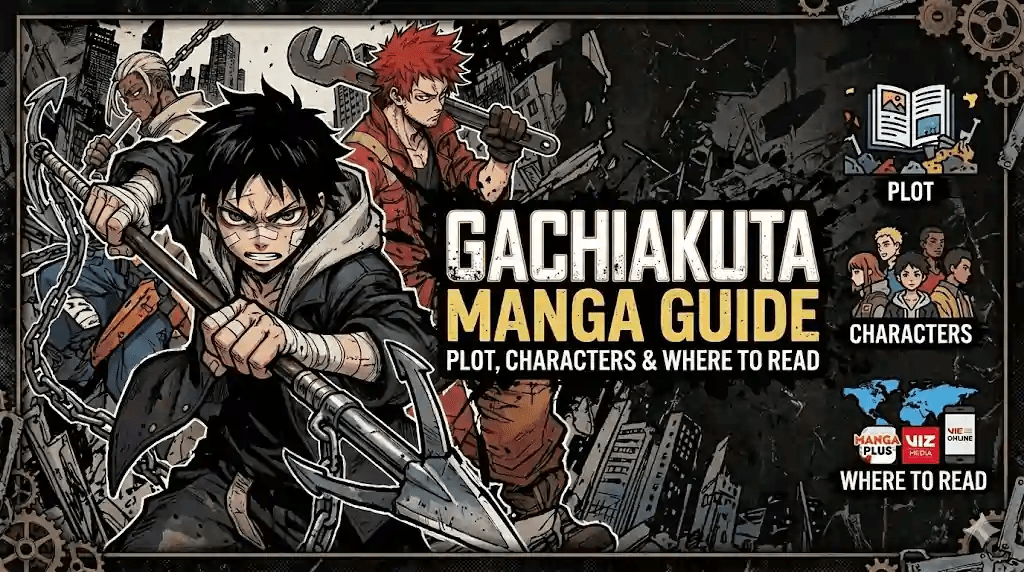
Gachiakuta Manga
You open a new manga. The first page shows a boy falling. Not into adventure. Not into power. Into a pit of garbage so deep the world above forgot it exists. That fall changes everything. That fall is where the Gachiakuta manga begins, and it never lets you catch your breath.
The Gachiakuta manga grabs readers by the throat and refuses to let go. Kei Urana created something raw here. Something that smells like rust and burning oil. A shonen battle series where trash becomes power, anger becomes fuel, and the people society threw away become the most dangerous warriors alive.
Most shonen stories hand power to the hero. A devil fruit. A quirk. A legendary sword. The Gachiakuta manga flips that script hard. The protagonist, Rudo, gets nothing. He loses everything. His home. His name. His future. Then the abyss gives him gloves made of hate, and suddenly the trash beneath his feet becomes a weapon no one saw coming.
The series started serialization in Kodansha’s Weekly Shonen Magazine in February 2022. Since then, it has built a dedicated following that grows louder with every volume. English readers got official access through Kodansha USA, and the print editions started hitting shelves in 2024. The Gachiakuta manga stands as one of the strongest new-gen titles in the magazine’s lineup.
The World of the Gachiakuta Manga: Heaven Above, Hell Below
The setting hits you like a punch to the chest.
There are two worlds in the Gachiakuta manga. The Sphere floats above. Clean. Bright. Sterile. The wealthy live there, sealed away from filth and struggle. They look down at the sky below them—yes, below—and never think about what falls through.
Then there is the Pit. A sprawling wasteland of garbage. Endless mountains of discarded furniture, broken tools, rotting cloth, rusted metal. Everything the Sphere throws away ends up here. Including people.
The Gachiakuta manga builds its entire conflict on this divide. The Sphere calls criminals “trespassers” and dumps them into the Pit like broken appliances. No trial worth the name. No way back. Just a trapdoor and a long fall into stench and darkness.
This setup does more than create a cool dystopia. It gives every fight meaning. Every character motivation connects back to this injustice. The Gachiakuta manga never lets you forget that the heroes aren’t chosen ones. They are survivors of a system designed to erase them.
Rudo: The Angry Heart of the Gachiakuta Manga
Let’s talk about the boy who falls.
Rudo lives in a border settlement. He scavenges trash from the Sphere’s discards to survive. The locals label him a criminal for his heritage—his father was executed as a trespasser. Rudo spends his days talking to a guardian figure named Regto, the only person who treats him like a human being.
Then Regto is murdered.
The authorities pin the murder on Rudo. No investigation. No defense. Just a rope around his wrists and a long drop into the Pit. The boy who loved collecting discarded things now becomes one himself. This is where the Gachiakuta manga transforms from a tragedy into a revenge story with teeth.
What makes Rudo work as a protagonist is his fury. Not the cool, controlled anger of an avenger. The messy, screaming, can’t-breathe rage of a kid who lost everything in five minutes. When Rudo lands in the Pit and discovers his ability—turning objects he values into powerful weapons—it doesn’t feel like a gift. It feels like his grief crystallized into something sharp.
The Gachiakuta manga lets Rudo be unlikable sometimes. He yells. He lashes out. He makes choices that hurt people who want to help him. But that’s what makes his growth real. You watch him learn that survival alone isn’t enough. You watch him figure out what kind of person he wants to become inside the hell that swallowed him.
The Jinki Power System: Trash Becomes Treasure
Every great shonen needs a power system that sparks imagination. The Gachiakuta manga delivers one of the most thematically rich ones in recent memory.
The ability is called Jinki. The word roughly translates to “instrument” or “tool.” Here’s how it works: certain people in the Pit can channel their emotional attachment to specific objects and transform them into weapons. A treasured pair of gloves becomes an extension of the user’s body. A beloved pair of scissors grows into something monstrous and precise. The object’s form shifts based on the wielder’s feelings, memories, and will.
This matters because it ties power directly to meaning. You cannot pick up any random piece of garbage and fight with it. The object must carry personal significance. The Gachiakuta manga turns every fight into a flashback. Every weapon tells you something about the person holding it. Their history. Their pain. Their love.
Rudo’s gloves are the clearest example. He cherished them in his old life. They were proof that he could still create value in a world that called him worthless. When he awakens his Jinki, those gloves let him enhance any object he touches—turning broken pipes into devastating spears, shards of glass into slicing storms. The trash around him stops being trash. It becomes an arsenal built on memory.
This system also creates natural limits. A weapon breaks if the emotional connection weakens. A fighter loses power if they lose the meaning behind their object. The Gachiakuta manga uses this to raise stakes constantly. Victory isn’t just about strength. It’s about holding onto what made you strong in the first place.
The Cleaners: Guardians of the Wasteland
Rudo doesn’t survive the Pit alone. The Gachiakuta manga introduces a faction called the Cleaners. They live in the wasteland by choice—or by circumstance—and protect the people who fall through the cracks.
The Cleaners hunt trash beasts. These are monstrous creatures born from discarded objects that absorbed too much negative emotion. A pile of abandoned dolls might fuse into something that screams with a hundred tiny voices. A mound of broken clocks becomes a beast that stops time in pulses. Every Cleaner mission involves facing the literal embodiment of the Sphere’s waste.
Key figures in the Cleaner organization include Engine, a powerhouse with a mechanical arm and a no-nonsense attitude; Zanka, whose Jinki manifests through a staff and a calm exterior hiding ferocity; and Riyou, a sharp-tongued fighter who commands fabric-based attacks. The Gachiakuta manga builds each Cleaner as a full person with their own reasons for staying in the Pit. Nobody is just a sidekick here.
What stands out is how the Cleaners operate as a found family. They take in Rudo not because he’s special, but because he needs them. The organization runs on a code that values survival and dignity over hierarchy. The Gachiakuta manga shows this through small moments—shared meals cooked over scrap-metal fires, quiet conversations on trash heaps under a starless sky, arguments that resolve into laughter.
Kei Urana’s Art: Grit That Breathes
The Gachiakuta manga looks like nothing else currently running in Weekly Shonen Magazine.
Kei Urana’s art style carries graffiti DNA. Thick, aggressive lines. Splatter effects that feel like spray paint. Character designs that blend street fashion with apocalyptic survival gear. Rudo’s orange jacket pops against the muted browns and grays of the Pit like a flare in darkness.
The page layouts deserve special attention. Urana breaks panels constantly. Action sequences spill across spreads with jagged borders. Impact moments use negative space to make you feel the silence after a hit lands. The Gachiakuta manga never lets your eye get comfortable, and that restlessness matches Rudo’s emotional state perfectly.
Backgrounds in the Pit feel lived-in. You see the layers of trash. The way newer garbage piles on top of older settlements. Graffiti tags from forgotten residents. Makeshift structures held together by wire and spite. The environmental storytelling in the Gachiakuta manga communicates decades of history without a single exposition dump.
Urana’s monster designs also shine. The trash beasts twist everyday objects into nightmare fuel. A creature made of discarded umbrellas scuttles like an insect. A beast formed from broken mirrors reflects distorted versions of whoever looks at it. These designs turn the central theme—discarded things have power—into a visual language that sticks in your memory.
| Character | Role | Jinki Ability | Key Trait |
| Rudo | Protagonist | Gloves that enhance touched objects | Fierce loyalty, uncontrolled rage |
| Engine | Cleaner leader | Mechanical arm weaponization | Protective, battle-hardened |
| Zanka | Cleaner | Staff-based combat Jinki | Calm, analytical |
| Riyou | Cleaner | Fabric manipulation | Sharp-tongued, resourceful |
| Regto | Rudo’s guardian | None | Kind, tragic |
| Amo | Mysterious ally | Undisclosed | Enigmatic, connected to Rudo’s past |
Where to Read the Gachiakuta Manga Legally
Supporting the official release matters. The Gachiakuta manga succeeds or fails based on reader support, especially for English-language publication.
Kodansha USA publishes the series digitally through K-Manga and other partner platforms. New chapters arrive alongside the Japanese release schedule. Print volumes started releasing in 2024, with Volume 1 dropping in January. The collected editions feature clean translations, bonus content, and higher-quality art reproduction than scanlation sites can provide.
The Gachiakuta manga also runs in Weekly Shonen Magazine in Japan, with simultaneous digital chapters available through various legitimate services. Check Kodansha’s official website for the most current reading options in your region. Avoid pirate sites. Every view on an unofficial platform tells publishers the series isn’t worth investing in.
Anime Adaptation Status
As of mid-2026, no official anime adaptation has been announced for the Gachiakuta manga. The series has the momentum and fanbase to support one, and industry insiders have speculated about potential studio interest. Weekly Shonen Magazine titles with strong volume sales and international readership tend to get adaptation offers around the 2-3 year mark.
The Gachiakuta manga reached that threshold in 2024-2025. Fan demand remains high. Social media campaigns push for announcements regularly. When an anime eventually materializes, the art style presents an exciting challenge for any studio—capturing Urana’s graffiti aesthetic in motion could produce something visually groundbreaking.
The Gachiakuta Manga’s Place in Modern Shonen
The current shonen landscape is crowded. Chainsaw Man broke brains. Jujutsu Kaisen raised the bar for choreography. Kagurabachi captured lightning in a bottle. Where does the Gachiakuta manga fit?
It carves out space with theme-driven storytelling. The series isn’t just about fighting. It’s about what happens to people after society decides they have no value. Every arc in the Gachiakuta manga circles back to this question: what do you do with your pain? Do you let it consume you? Do you turn it into something that protects others? Do you aim it at the people who hurt you?
This emotional core separates the Gachiakuta manga from titles that prioritize spectacle over substance. The fights are excellent. The art is stunning. But the reason readers stick around is Rudo’s journey from lost boy to someone who might actually change the system that broke him.
The Gachiakuta manga also stands out for its economic storytelling. Urana and her team waste zero pages. Flashbacks arrive exactly when they matter. Character backstories unfold through action rather than monologue. Information about the world emerges through environmental details and natural dialogue. This density rewards rereading.
Gachiakuta Manga Volume Sales and Reception
The numbers tell a positive story. Early volumes of the Gachiakuta manga performed well in Japanese markets, with print runs increasing to meet demand. English volume 1 debuted to strong pre-order numbers, and subsequent volumes maintained momentum.
Critics praise the series for its unique visual identity and emotional authenticity. Fan communities on platforms like Reddit and TikTok generate consistent discussion, fan art, and theory crafting. The Gachiakuta manga has not yet reached the explosive popularity of a My Hero Academia or Demon Slayer, but its growth trajectory points upward.
For readers burned out on formulaic shonen, the Gachiakuta manga offers something genuine. A story about trash that treats nothing—and no one—as disposable.
Reading Order and Collecting Guide
Starting a new series can feel overwhelming. Here’s the simplest path into the Gachiakuta manga:
- Read Chapter 1 online through Kodansha’s official platforms to sample the tone and art.
- Purchase Volume 1 in print or digital to experience the first arc in collected format.
- Continue with subsequent volumes as your budget and interest allow.
- Follow weekly chapters once caught up to join the active community discussion.
The Gachiakuta manga currently spans over 100 chapters, with multiple arcs completed and a larger narrative still unfolding. New readers can catch up within a few weeks of casual reading.
FAQs About the Gachiakuta Manga
What is the Gachiakuta manga about?
Rudo, a boy falsely accused of murder, gets thrown into a massive garbage pit beneath a floating city. He awakens the ability to turn cherished objects into weapons and joins a group called the Cleaners to survive and seek revenge.
Who created the Gachiakuta manga?
Kei Urana writes and illustrates the series. Urana previously worked as an assistant on other manga titles before launching Gachiakuta in Weekly Shonen Magazine in February 2022.
Is the Gachiakuta manga available in English?
Yes. Kodansha USA publishes the official English translation digitally and in print. The first print volume released in January 2024.
Does the Gachiakuta manga have an anime?
No official anime adaptation has been announced as of mid-2026, though fan demand and the series’ popularity make an adaptation likely in the future.
How many volumes does the Gachiakuta manga have?
The series has published 10+ volumes in Japan, with English releases following behind. Exact counts change as new volumes release regularly.
What makes the Gachiakuta manga different from other shonen?
The graffiti-inspired art style, the emotion-based Jinki power system, and the central theme of discarded people finding strength in what society threw away set it apart from conventional battle shonen.
Why the Gachiakuta Manga Deserves Your Attention
Pick up the first chapter. Read the first five pages. Watch Rudo fall.
The Gachiakuta manga earns its place in the modern shonen conversation through sheer craft. Urana’s art alone justifies the read. But stay for the story. Stay for a protagonist who feels real enough to bleed, rage, and slowly learn what it means to trust again.
This series builds a world out of garbage and fills it with people you will root for. It asks uncomfortable questions about who gets labeled disposable and what happens when the disposed fight back. The Gachiakuta manga doesn’t offer easy answers. It offers sharp gloves, loyal friends, and a long climb upward.
Find it legally. Read it carefully. Share it with someone who needs a story about turning trash into power. The Pit is waiting. The Cleaners are recruiting. And Rudo’s war has only just begun.
Primary Sources Referenced:
- Kodansha USA official Gachiakuta manga page
- Weekly Shonen Magazine official serialization records
- Kei Urana author commentary from Volume 1 extras
- Kodansha Comics licensing announcements (2023-2024)
- Official English volume release schedules via Penguin Random House distribution