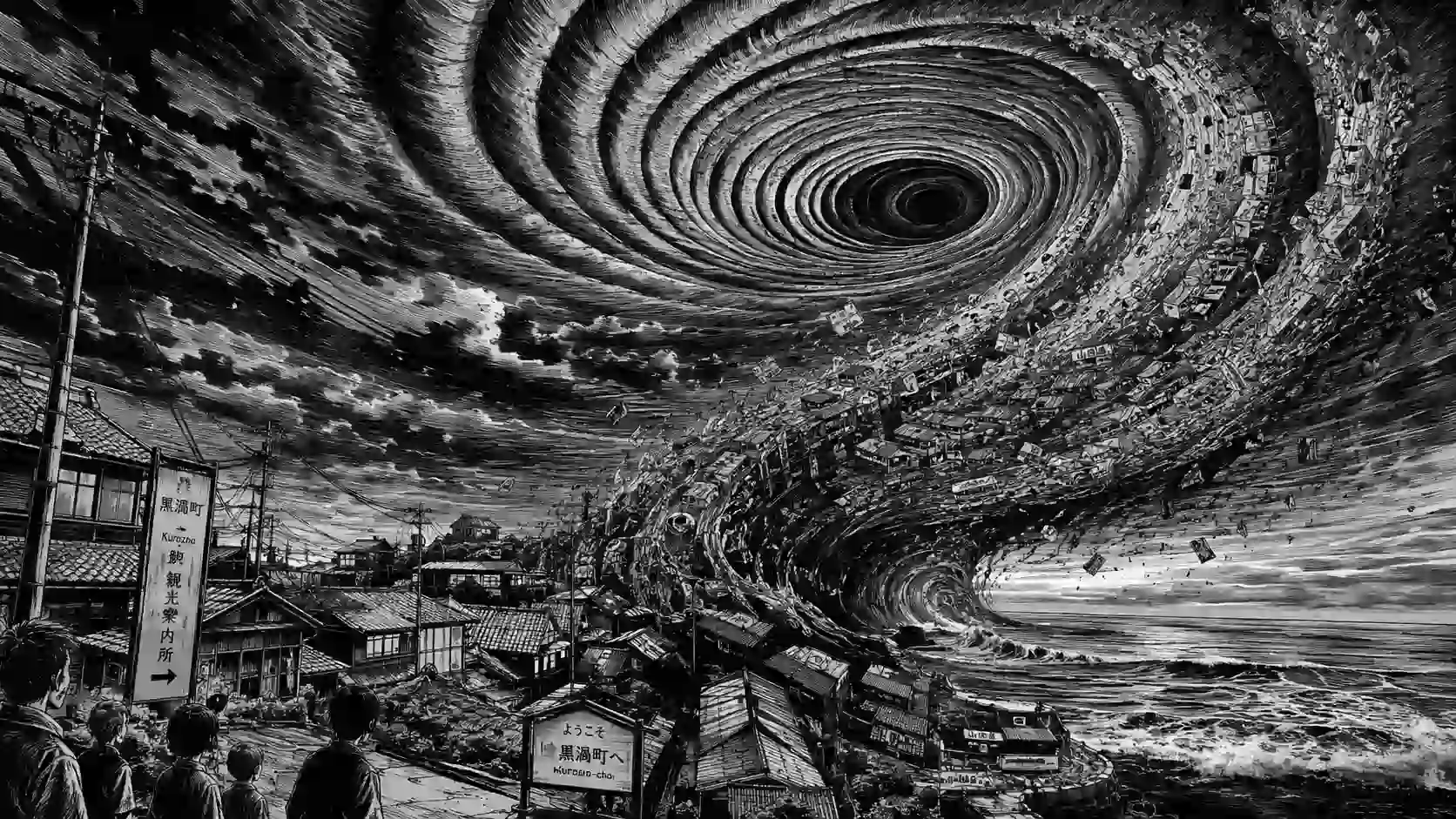
Junji Ito’s inkwork doesn’t just depict horror. It traps your eyes in a suffocating vortex. When discussing any junji ito manga, Uzumaki stands as his undisputed masterpiece. This series abandons traditional ghosts for something far worse. It weaponizes a simple geometric shape.
We are breaking down the terrifying arcs of Kurozu-cho. We will dissect Ito’s insane paneling and mature themes. You will discover exactly why this spiral obsession will shatter your sanity.
What is Uzumaki? The Pinnacle of Junji Ito Manga
Uzumaki translates to “Spiral” in Japanese. It is a three-volume seinen horror series. The story centers on the fictional town of Kurozu-cho. This town is cursed by spirals.
The curse infects everything. It twists minds, bodies, and the very environment. People become obsessed with the shape. Then, they horrifically transform into it.
The Premise: A Town Possessed by a Shape
Most horror relies on monsters or spirits. Ito defies this trope completely. The antagonist is a concept. It is the mathematical spiral.
This abstract threat makes the terror inescapable. You cannot punch a vector. You cannot exorcise a geometric ratio. The town fights a losing battle against pure mathematics.
Story Outline: The Spiral Descent into Madness
The narrative unfolds through Kirie Goshima. Her boyfriend, Shuichi Saito, notices the curse first. His father becomes fatally obsessed with spiral patterns.
The story escalates from psychological unease. It rapidly descends into apocalyptic body horror. Each chapter introduces a new, bizarre symptom of the spiral infection.
H3: Volume 1: The Subtle Creep of Everyday Spirals
The first volume establishes the domestic terror. Shuichi’s father turns his entire house into spirals. He ultimately coils his own body into a terrifying snail shell.
Kirie’s classmates also fall victim. One girl grows spiral hair that dominates her mind. Another student creates deadly whirlpools in the water. The horror feels uncomfortably close to reality.
Volume 2: Body Horror Ascends
The second volume ramps up the grotesque transformations. The cursed townspeople begin mating with mosquitoes. They use their hollow, needle-like mouths to suck blood.
Pregnant women fall under the spiral’s spell. They crave blood and give birth to demonic, blood-sucking infants. The hospital becomes a nightmare of twisted medical horror.
Volume 3: Cosmic Annihilation
The final volume abandons all restraint. Kurozu-cho is hit by devastating hurricanes. These storms are massive, destructive spirals.
The town’s architecture warps. Buildings twist into impossible spiral labyrinths. People lose their humanity entirely. They merge into a massive, rotating hive mind. The ending is bleak, beautiful, and inevitable.
Arc Breakdown: The Most Disturbing Chapters
Ito masterfully pacing the dread. He isolates specific aspects of the spiral curse. Each chapter acts as a standalone nightmare.
Together, they form a cohesive descent into hell. Let’s examine the most unforgettable, traumatizing arcs.
The Snail People (Mollusk Mutation)
The spiral curse mutates humans into giant snails. The transformation is agonizingly slow. Victims lose their limbs. Their eyes retract on spiral stalks.
They ooze slime and move at a crawling pace. The social commentary here is stark. It reflects the horror of contagious disease and social ostracization.
The Mosquitoes (Blood-Borne Spirals)
This arc is pure visceral terror. Infected humans sprout mosquito-like appendages. They fly through the night.
They impale their victims with their mouths. The pregnant women arc ties directly into this. It creates a horrifying ecosystem of blood and parasites. It is deeply unsettling for any reader.
The Hurricanes (Weather Gone Wrong)
Nature itself turns against Kurozu-cho. Massive hurricanes batter the town. The storms are undeniable spirals.
They destroy homes and families. Shuichi loses his mother to the wind. The sheer scale of this arc shifts the story. It moves from personal horror to cosmic disaster.
The Ruins (Ancient Spiral City)
The survivors seek shelter in ancient ruins. They discover a subterranean city. This city is a massive, carved spiral.
The ruins are not a sanctuary. They are the source of the curse. The victims are drawn into the earth. They become part of the eternal, rotating architecture.
Art Style & Paneling: A Masterclass in Visual Dread
The junji ito manga experience relies heavily on visuals. Ito’s art is legendary. His technical skill is unmatched in the horror genre.
He uses extreme detail to create overwhelming dread. Every line serves the terror. His paneling controls the reader’s eye like a hypnotic spiral.
Negative Space and Silence
Ito understands pacing. He frequently uses negative space. A blank white panel forces the reader to pause.
It creates a moment of silence before the scream. This technique builds incredible tension. You know the horror is coming. The quiet makes the reveal far more devastating.
Intricate Linework and Body Distortion
When the horror strikes, Ito floods the page with ink. His cross-hatching is obsessively detailed. Veins bulge. Flesh tears. Eyes bulge inhumanely.
He draws the impossible beautifully. A man twisted into a spring looks structurally plausible. This dedication to anatomical distortion makes the gore deeply effective.
The Spiral Paneling Technique
Ito breaks traditional manga paneling. He uses spiral panel layouts. The borders twist and curve.
This forces your eye to move in a circular motion. You feel the curse while reading. It is a brilliant, immersive meta-horror trick. You are not just reading about the spiral. You are experiencing it.
Mature Themes Review: Why This Isn’t for Kids
Uzumaki is unmistakably seinen manga. It is not for younger audiences. The horror transcends simple jump scares.
It digs into profound, mature psychological themes. The existential dread lingers long after you close the book.
Unrelenting Cosmic Horror
This series embodies cosmic horror. Humanity is completely powerless. The spiral is anEldritch concept.
It exists beyond human comprehension. The characters cannot defeat it. They can only witness their own destruction. This nihilism is a core adult theme.
The Fragility of the Human Form
Body horror is a staple of the junji ito manga catalog. Uzumaki pushes this to the absolute limit. Our bodies are bound by physical rules.
The spiral breaks these rules. Skin stretches. Bones liquefy. People merge into grotesque masses. It exploits our deep-seated fear of losing physical autonomy.
Genetic and Infectious Dread
The manga plays heavily on infection. The spiral curse spreads like a virus. It mirrors real-world anxieties about pandemics.
The snail arc and mosquito arc are prime examples. They show the terror of watching a community rot from within. The fear of contaminated blood is a powerful, mature motif.
Featured Snippet Optimization: Common Fan Question
Why is Uzumaki considered the best Junji Ito manga?
Uzumaki is considered the best junji ito manga because it elevates a simple geometric shape into a vector for cosmic dread. Unlike his creature-feature works like Gyo, Uzumaki relies on abstract, inescapable madness that infects reality itself, making it his most psychologically terrifying and conceptually pure masterpiece.
How Uzumaki Compares to Other Junji Ito Manga
Junji Ito has a massive, terrifying bibliography. How does Uzumaki stack up against his other heavy hitters?
It stands tall. While others rely on monsters, Uzumaki relies on pure concept. Let’s compare it to his other iconic works.
Tomie: The Horror of Immortal Beauty
Tomie is Ito’s other long-form masterpiece. It focuses on a beautiful, immortal girl. She drives men to murderous insanity.
Tomie is grounded in human jealousy and lust. Uzumaki completely abandons human motivations. It is colder, stranger, and far more alien.
Gyo: The Horror of Mobilized Decay
Gyo features fish with mechanical legs. They invade the land, spreading a horrific stench.
Gyo is action-packed and gross. It moves at a frantic pace. Uzumaki is slower, more methodical, and more psychologically damaging. Gyo shocks the stomach. Uzumaki breaks the mind.
Hellstar Remina: Sci-Fi Cosmic Terror
Hellstar Remina is Ito’s take on sci-fi horror. A rogue planet consumes our solar system.
It shares Uzumaki’s cosmic scale. However, Remina features a tangible enemy. You can see the planet coming. The spiral in Uzumaki is invisible until it is too late.
Character Dynamics: Kirie and Shuichi
The emotional core of Uzumaki relies on two teenagers. Kirie Goshima and Shuichi Saito are the focal points.
They are the only sane people in a dying town. Their relationship anchors the chaos.
Kirie Goshima: The Helpless Witness
Kirie is the protagonist. She narrates the nightmare. She is frustratingly passive at times.
This passivity is intentional. She represents normalcy. Her inability to fight back highlights the curse’s absolute power. She can only observe the horror.
Shuichi Saito: The Broken Prophet
Shuichi is the cursed oracle. He senses the spiral before anyone else. His sensitivity drives him insane.
His physical deterioration is heartbreaking. He loses his parents. His eyes sink into his skull. He begs Kirie to leave, but the trap is already sprung.
The Symbolism of the Spiral in Japanese Culture
The spiral is not a random choice. It holds deep cultural significance in Japan. Ito exploits this cultural familiarity.
He twists a comforting symbol into a weapon of mass destruction.
Uzumaki in Shinto and Nature
Spirals appear constantly in nature. Whirlpools, seashells, and galaxies all spiral. Shinto shrines use a spiral symbol called tomoe.
It represents the cycle of life and harmony. Ito perverts this harmony. His spirals represent inevitable decay and destructive cycles.
The Double-Edged Sword of the Vortex
Vortexes pull things in. They destroy whatever they capture. Kurozu-cho is a black hole.
The town cannot escape its gravitational pull. Ito masterfully uses physics as a horror element. The spiral is a force of nature, turned evil.
How to Read Junji Ito Manga for Maximum Impact
Reading horror manga requires the right atmosphere. You want the dread to linger.
Do not rush through Uzumaki. Savor the psychological deterioration.
- Read at Night: Darkness amplifies the paranoia.
- Read Alone: Shared reading breaks the tense immersion.
- Study the Art: Do not speed-read. Let your eyes trace the intricate linework.
- Notice the Panel Flow: Follow the invisible spirals Ito draws with his borders.
- Pause Between Arcs: Let each bizarre transformation settle in your mind.
The Legacy of Uzumaki: Anime and Live-Action
Uzumaki has influenced countless creators. Its legacy extends beyond the printed page.
Adaptations have tried to capture its unique terror. Results have been mixed, but the impact is undeniable.
The 2024 Adult Swim Anime
An anime adaptation aired on Adult Swim. It was highly anticipated. It promised to use Ito’s exact art style.
The black-and-white aesthetic was stunning initially. Unfortunately, production issues marred later episodes. Still, it proved the demand for mature junji ito manga adaptations.
The Live-Action Film
A Japanese live-action film exists. It was released in 2000.
It captures some bizarre body horror. However, it struggles with the cosmic scale. The budget cannot match Ito’s imagination. It remains a cult curiosity for hardcore fans.
Why Uzumaki Remains a Must-Read Masterpiece
Uzumaki transcends the horror genre. It is a work of existential art. It takes the simplest concept and drills it into your psyche.
The junji ito manga catalog is full of nightmares. None are quite as elegant or as devastating as this. The spiral is infinite. The dread is eternal.
What is the most disturbing spiral mutation that haunted your dreams? Let us know in the comments below, and bookmark our website for more uncensored guides to the best mature manga and webtoons!