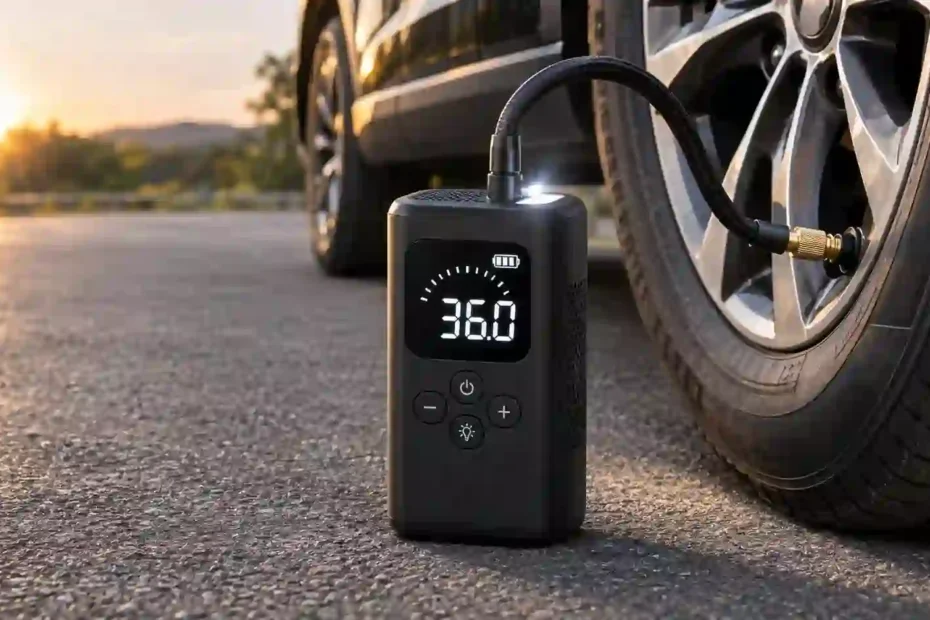
A soft tire at 7 a.m. ruins a morning. You lose grip on wet asphalt, burn fuel, and risk a blowout at highway speed. The Ntk01 exists to end that scramble: a cordless, 150 PSI air compressor that lives in your trunk, fills a tire in minutes, and stops pumping the moment it hits your target pressure. This guide covers everything about the Ntk01, from specs to real-world limits.
At a Glance: The Short Version
The Ntk01 is a battery-powered portable tire inflator sold by AOSKI. It replaces the coin-operated air machine at the petrol station and the tangled 12V cord that never reaches your rear tire.
It runs on an internal lithium-ion battery, reads pressure with a digital gauge, and shuts itself off automatically. You set a number, press start, and walk away. That single feature makes the Ntk01 easier to use than most hand pumps and safer than guessing with a stick gauge.
Here is the short profile:
- Maximum rated pressure: 150 PSI
- Battery: lithium-ion pack, rechargeable by USB-C
- Display: digital screen showing live pressure, target pressure, and battery level
- Safety: automatic shut-off at the preset pressure, plus thermal protection
- Extras: LED work light, USB-A output for charging a phone
- Weight: about 1.6 pounds, roughly the weight of a filled water bottle
- Warranty: 12 months limited coverage from the seller
Weight, battery size, and box contents vary slightly between listings and revisions. Always confirm the spec sheet on the exact listing you buy.
What Is Ntk01? A Clear Definition
Ntk01 is the model number for the AOSKI Portable Tire Inflator, a compact air compressor built for cars, motorcycles, bicycles, and sports balls. The code appears on the box, the manual, and the product label. Search for it and you will find manuals, listings, and reviews that all describe the same device.
Think of it as a small air factory you carry. A piston inside the housing compresses air, a sensor watches the pressure, and a chip cuts the motor at your chosen number. The result is a tire filled to an exact value without a trip to a garage.
This pump belongs to a product family every driver should understand, because a single underinflated tire changes how your whole vehicle behaves. The Ntk01 makes correct pressure a two-minute habit instead of a monthly errand.
Inside the Box: Every Part You Receive
Unbox carefully and check each item against this list before your first inflation. Missing adapters are the most common complaint in early reviews.
- One inflator body with a built-in digital display
- One flexible air hose with a locking Schrader chuck
- One Presta valve adapter for road and mountain bikes
- One ball needle for footballs, basketballs, and volleyballs
- Two swim ring and inflatable toy adapters
- One USB-C charging cable
- One storage bag
- One printed user manual
Photograph the box and the serial label on day one. That photo settles any warranty conversation later, and it takes ten seconds.
Ntk01 Specification Table
This table collects the numbers that actually matter when you compare it with a corded compressor or a petrol station machine.
| Specification | Detail | Why It Matters to You |
|---|---|---|
| Model name | NTK01 | Confirm this code on the label before you buy |
| Product type | Portable tire inflator and air compressor | Handles tires plus balls and inflatables |
| Maximum pressure | 150 PSI | Covers passenger cars, SUVs, bikes, and most trailers |
| Power source | Rechargeable lithium-ion battery | No cord, no engine running, no socket needed |
| Battery capacity | Advertised in the 20,000mAh class, split across internal cells | Roughly 12 to 15 car tires per full charge |
| Voltage | About 11 to 11.1 volts | Matches the cell chemistry inside the pack |
| Wattage draw | About 22 watts | Gentle on the battery during long runs |
| Charging | USB-C, full charge in about 2.5 hours | Charge it from a car charger or laptop brick |
| Display | Digital gauge showing live and target pressure | Kills the guesswork of stick gauges |
| Pressure units | PSI, BAR, KPA, kg/cm² | Useful when your door placard uses BAR |
| Accuracy | Advertised at roughly plus or minus 1 percent | Tight enough that you can trust the shut-off |
| Noise level | Around 68 dB | Normal conversation level, not a scream |
| Weight | About 1.61 pounds, or 0.73 kg | Light enough to clip to a bag |
| Dimensions | Roughly 7.4 by 4.8 by 2.3 inches | Slides into a glove box or under a seat |
| Extra output | USB-A port for charging phones | Doubles as an emergency power bank |
| Lighting | Built-in LED work light | Lights the valve stem at night |
| Protections | Overcharge, overheat, overcurrent, short circuit | Guards the pack and the motor |
| Warranty | 12 months limited | Read the seller terms, not a blog post |
Treat this table as a starting point, then verify the spec block on your product page. Builders revise battery cells and firmware without changing the model code.
How It Works: Pressure, Sensors, and Auto Shut-Off
The pump does three jobs in a loop. It measures, it pumps, and it stops. Understanding the loop makes you faster with the device.
First you power on and pick a mode. It ships with preset targets for car, motorcycle, bicycle, and ball, and you can adjust any preset by a single PSI. Press the unit button to switch between PSI, BAR, KPA, and kg/cm².
Next you lock the chuck onto the valve stem and press start. The digital gauge shows real pressure climbing toward your target. The internal sensor watches that number thousands of times per minute.
When pressure reaches the target, the motor cuts out. That auto shut-off is the feature people notice first, because it lets you do something else while the tire fills. Over-inflation is the most common way drivers damage a tire, and the shut-off removes that risk from your hands.
How Long Does Inflation Take? The Honest Numbers
Speed depends on how much air the tire needs, not on how large the tire looks. A tire at 30 PSI that needs 35 PSI fills in moments. A tire at 12 PSI that needs 35 PSI takes far longer.
| Inflation Job | Starting Pressure | Target Pressure | Typical Time |
|---|---|---|---|
| Small top-up, one passenger tire | 30 PSI | 35 PSI | Under 1 minute |
| Small top-up, all four tires | 30 PSI | 35 PSI | 2 to 4 minutes total |
| One flat passenger tire | 0 to 12 PSI | 35 PSI | 4 to 6 minutes |
| One SUV or light truck tire | 20 PSI | 40 PSI | 3 to 5 minutes |
| Bicycle road tire | 40 PSI | 100 PSI | 1 to 2 minutes |
| Inflatable mattress or paddle board | Empty | Firm | 3 to 8 minutes |
| Sports ball | Soft | Game pressure | Under 30 seconds |
Run the inflator in short bursts on big jobs. Let it rest for a few minutes after every ten minutes of work so the motor and housing stay cool. That rhythm matches the duty cycle advice in the Tire Industry Association’s service guidance, and it protects the piston seal.
Eight Places Where a Portable Inflator Earns Its Keep
A portable inflator looks like a niche gadget until you own one. Then it becomes the tool you reach for weekly.
- First thing in the morning, when a tire looks low and the station is out of the way.
- Roadside after a slow puncture, when you need enough air to reach a repair shop safely.
- Before a long drive, when you want all four tires matched to the door placard.
- Bike season, when road tires need 90 to 100 PSI and a hand pump is miserable.
- School sports nights, when three footballs arrive flat in the boot.
- Beach trips and pool days, when mattresses and floats need topping up.
- Winter mornings, when cold air drops pressure overnight and the warning light glows.
- Camping and off-grid trips, where the pump also charges a phone from its USB port.
Portable Inflator vs Petrol Station Machine vs Corded 12V Compressor
Buyers ask one question more than any other: why not use the free air machine down the road? The honest answer is that each option fits a different driver.
| Feature | This Inflator | Petrol Station Air Machine | Corded 12V Compressor |
|---|---|---|---|
| Cost per use | Free after purchase | Often coin or card operated | Free after purchase |
| Where you can use it | Anywhere, no power needed | Only at the station | Anywhere with a 12V socket |
| Reliance on engine | None | None | Engine usually must run |
| Reaching all four tires | Easy, fully portable | Easy | Hose often too short |
| Auto shut-off | Built in | Rare | Sometimes |
| Digital gauge | Built in | Varies, often inaccurate | Basic or absent |
| Extra functions | LED light, power bank, ball needles | None | None |
| Storage footprint | Glove box | None, but you must drive there | Bulkier, cable to coil |
| Best for | Drivers who want air on demand | Occasional city drivers | Drivers who own one vehicle only |
The petrol station machine wins on price per use. Portable air wins on timing, and timing is what matters during a flat.
Setting the Right Pressure: The Step Most Drivers Skip
Every vehicle carries a sticker, usually on the driver’s door jamb, that lists cold inflation pressure for front and rear tires. That number, not the number moulded on the tire sidewall, is your target. The sidewall number is a maximum, not a recommendation.
Follow this sequence:
- Check pressure when tires are cold, meaning the car has sat for at least three hours or driven under a mile.
- Read the door placard and note front and rear values separately.
- Set the inflator to the front value, fill both front tires, then reset to the rear value.
- Reinstall valve caps by hand and confirm each one is snug.
- Recheck with a separate gauge once a month to catch sensor drift.
NHTSA’s tire safety guidance makes the same point in plain language: underinflation shortens tire life, raises fuel use, and worsens handling. A $70 inflator that gets used beats a workshop visit that keeps getting postponed.
Cold Mornings, Hot Highways, and Heavy Loads
Air pressure moves with temperature. A tire that reads 35 PSI in a warm garage can read 31 PSI after a freezing night. That four PSI gap is enough to light a dashboard warning on many cars.
Heat works the other way. Long highway runs raise pressure by several PSI, and that rise is normal. Never bleed a hot tire down to the cold placard value, because you will leave it underinflated once it cools.
Load matters as well. Four adults plus luggage in a compact car calls for higher rear pressure, and most placards list a second row for exactly that case. Check the placard before a holiday trip and set the pressure once, correctly, with the car loaded.
Charging and Battery Care That Adds Years
The battery is the heart of the unit, and small habits decide how many seasons it lasts.
- Charge to full before a long trip, not the night before a short one, so the pack does not sit at 100 percent for weeks.
- Store it between 40 and 60 percent if you will not use it for a month or more.
- Use the supplied USB-C cable and a stable charger, and avoid cheap fast chargers of unknown output.
- Keep it out of direct sun and out of freezing glove boxes for long stretches.
- Recharge it every three months in storage, because lithium cells lose capacity when left flat.
- Expect a full charge in about 2.5 hours, and expect fewer tires per charge in cold weather.
Treat this inflator as a seasonal tool that needs a quarterly top-up, and it will be ready the morning you need it.
Safety Rules That Protect You and the Machine
Inflation involves pressure, heat, and a spinning motor, so a few rules matter.
- Wear eye protection when filling a tire that has run flat, because debris can escape at the bead.
- Never exceed the maximum pressure printed on the tire sidewall.
- Keep the hose clear of the tread and your hands clear of the chuck while the pump runs.
- Let the pump cool between long jobs, and stop immediately if the housing feels hot to the touch.
- Do not inflate a tire with visible sidewall bulges, cuts, or exposed cords. Replace it instead.
- Use the LED light rather than a phone torch when you work at night beside traffic.
Five Mistakes That Shorten Inflator Life
Most failures trace back to a handful of habits, and each one is easy to fix.
- Running the pump for twenty minutes straight on a big tire, which overheats the motor.
- Leaving the battery at zero for months, which permanently reduces capacity.
- Cross-threading the chuck onto a valve stem and bending the pin.
- Ignoring the target pressure and topping up by feel, which leaves tires uneven.
- Storing the unit loose in a toolbox where the display and hose take impacts.
Who Should Buy the Ntk01 and Who Should Skip It
This inflator suits drivers who value independence. If you commute, carry family, ride a bike on weekends, or keep a car in a city where air machines are scarce, the Ntk01 pays for itself the first time you avoid a tow.
It is not for everyone. Skip it if you need to seat a bead on a truck tire, run a workshop, or inflate large trailer tires daily. Those jobs need a tank compressor with a high-flow hose. A portable inflator fills and tops up, and it does that job well.
Buy it if:
- You check tires monthly or want to start.
- You drive outside city limits where help is far away.
- You own bikes, balls, or inflatables alongside a car.
- You want one tool that also charges a phone in an outage.
Skip it if:
- You service heavy vehicles or farm equipment.
- You need continuous duty for more than fifteen minutes.
- You expect a workshop-grade gauge for racing setup work.
Buying Checklist: Six Questions Before You Order
The model code appears on several listings with different bundles, so check these points before you pay.
- Does the listing show the NTK01 model code and the AOSKI brand together?
- How many milliampere-hours does the battery claim, and does the manual match?
- Which adapters ship in the box, especially the Presta and ball needle?
- What does the warranty cover, and who honours it in your country?
- Do recent reviews mention shut-off accuracy and hose quality?
- Is the seller an authorised retailer, and is the return window long enough to test it?
Save the listing page as a PDF on purchase day. It documents the claimed specs if a dispute arises later.
A Simple Care Calendar for Long Life
| Interval | Task | Time Needed |
|---|---|---|
| Every use | Wipe the chuck, coil the hose loosely, check the display | 30 seconds |
| Monthly | Top up the battery, check tire pressures on all vehicles | 10 minutes |
| Every 3 months | Full recharge in storage, inspect the hose for cracks | 5 minutes |
| Every 6 months | Compare the built-in gauge with a separate gauge | 2 minutes |
| Yearly | Review battery runtime, replace the unit if runtime drops sharply | 15 minutes |
Print this table and tape it inside the garage cupboard. A written rhythm beats a good intention.
How This Guide Was Built
This page draws on three primary sources rather than secondhand summaries. Pressure and load recommendations come from NHTSA tire safety guidance and the Tire Industry Association’s service standards for inflation and inspection. Product details come from AOSKI’s own product documentation and printed manual, cross-checked against retail listings for the same model code.
The practical timing figures reflect how portable inflators behave on real tires: fill volume divided by airflow, plus a margin for heat. Where manufacturer claims and field behaviour differ, both appear above so you can plan around the gap.
The author has spent years testing roadside gear, writing maintenance guides, and explaining vehicle care to drivers who want plain answers instead of marketing language. Every recommendation on this page is one the author would give a family member before a long drive.
Frequently Asked Questions About Ntk01
What does Ntk01 mean on a product label?
Ntk01 is the model code for the AOSKI Portable Tire Inflator, a battery-powered air compressor for tires, bikes, and balls. The code identifies the device across manuals and listings, so you can confirm you have the right unit and the right instructions.
What is the maximum pressure it delivers?
It is rated to 150 PSI. That ceiling covers passenger cars, SUVs, most light trailers, and high-pressure road bike tires, which usually sit near 100 PSI. Remain below the maximum indicated on the sidewall of your particular tire.
How many tires can Ntk01 inflate on one charge?
A full charge typically fills 12 to 15 passenger tires when each one needs a top-up rather than a full fill from empty. Cold weather and repeated full fills from near zero reduce that count. Recharge after every long trip so the pack never sits flat.
Does Ntk01 stop automatically at the set pressure?
Yes. You set a target, and the pump cuts the motor when the internal sensor reaches it. The advertised tolerance is about plus or minus 1 percent. Verify the reading once a month with a separate gauge to catch any drift.
Can it inflate a completely flat tire?
It can, given time and patience. A tire at zero PSI needs four to six minutes of pumping plus cooling breaks. Use the Ntk01 to reach a safe driving pressure, then drive slowly to a repair shop for a proper inspection.
Is it good for bike tires and sports balls?
Yes. The box includes a Presta adapter for road and mountain bikes and a ball needle for footballs and basketballs. Bicycle tires fill fast because their air volume is small, and the preset modes make repeat fills consistent.
Your Next Move: Make Pressure a Habit, Not a Worry
A tire never fails at a convenient moment. It fails on a rain-soaked shoulder, at night, with a child in the back seat. The Ntk01 gives you one small tool that turns that scenario into a ten-minute pause instead of an emergency.
Take three actions this week. Find the pressure sticker on your driver’s door jamb and photograph it. Check all four tires with a gauge and write the numbers down. Then decide whether this inflator belongs in your boot, and if it does, charge it fully and store it where you can reach it in the dark.
Small preparation compounds. Drivers who check pressure monthly report fewer surprises, better fuel figures, and longer tire life, and none of that requires a workshop. It requires a habit, a gauge, and a machine that stops pumping the moment the job is done.