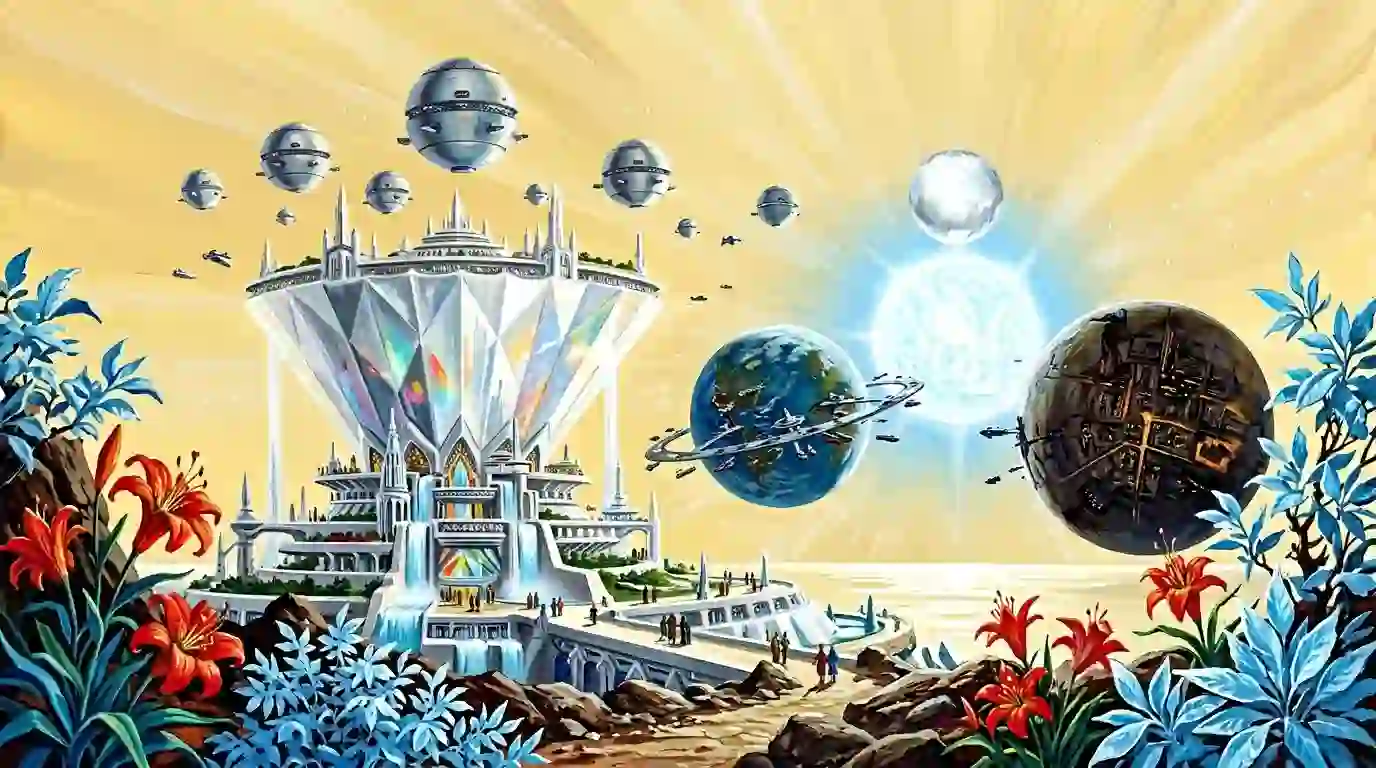
Science fiction fans stumble onto Arkon imagery every day and feel its pull without knowing why. Crystal spires pierce alien skies. Funnel-shaped cities dwarf human figures. Spaceships shaped like perfect spheres hang above tri-planet sunrises. If you have ever stared at a Perry Rhodan cover and felt transported, you were looking at perry rhodan arkon system art. This guide breaks down what makes that visual language unforgettable.
What Exactly Defines Perry Rhodan Arkon System Art?
Perry rhodan arkon system art describes the specific visual vocabulary developed over 60+ years to depict the Arkon star system and its inhabitants within the Perry Rhodan universe. The Perry Rhodan serial launched in Germany in 1961 under authors K. H. Scheer and Clark Darlton (Walter Ernsting). It quickly became the longest-running science fiction series in history, surpassing 3,300 weekly issues as of 2026.
Artists for the series did not merely draw aliens and rockets. They built an entire visual civilization from scratch. Every funnel building, every crystal tower, every red-eyed Arkonide noble carries consistent design rules that readers instantly recognize. Those rules form the backbone of perry rhodan arkon system art.
Three elements anchor every piece: the tri-planet arrangement known as Tiga Ranton, the inverted-funnel architecture called Khasurn, and a strict color palette that favors crystal whites, royal blues, molten reds, and burnished golds. When artists honor these elements, the work reads as authentically Arkonide. When they deviate, long-time fans notice instantly.
The Arkon System: A Cosmic Canvas of Three Worlds
Before you can understand the art, you must understand the place it depicts. The Arkon system sits near the exact center of globular cluster M-13, which the Arkonides call Thantur-Lok. A hot blue-white A8V star with a diameter of 1.25 million kilometers burns at its heart. The system originally held 27 planets and 159 moons, but war and cosmic catastrophe reshaped it many times.
The artistic centerpiece remains Tiga Ranton—three worlds locked in an artificial equilateral triangle around a single shared orbit. This configuration is not natural. Around the year 6320 da Ark (the Arkonide calendar), Imperator Gonozal III ordered engineers to move the second and fourth planets into orbit alongside the original homeworld using gigantic impulse engines. The project took 3,000 years to complete.
Each world serves a dedicated role, and artists render each with distinct visual traits:
- Arkon I (Gos’Ranton, the Crystal World): The residential and governmental planet. Artists paint it as a paradise of white crystal, green parkland, and geometric precision. The Crystal Palace (Gos’Khasurn), seat of the Imperator, anchors its skyline.
- Arkon II: The trade and commerce world. Visual depictions emphasize orbital docks, merchant vessels, and bustling sky traffic. The famed Blue Chalice (Bmerasath-Trichter) of the Fleet Command rises from its surface.
- Arkon III: The industrial and military world. Early illustrations showed it as a soot-choked forge planet; later storylines depict it overgrown with the Technogeflecht techno-organic mesh after its destruction by the Blues in 2329 and subsequent reconstruction.
The triangle formation itself appears constantly in Arkon-themed illustration. Three orbs arranged in a triangular constellation mark everything from official Imperial seals to clothing patterns, architecture, and starship insignia. This geometric rigor distinguishes Arkon illustration from the looser, more chaotic space art of competing franchises.
Crystal World Imagery: Gos’Ranton in Visual Form
Arkon I—Gos’Ranton the Crystal World—draws the most artistic attention in perry rhodan arkon system art. The planet has zero axial tilt and a perfectly circularized orbit. Its weather is fully controlled. Seasons do not exist. A constant temperature of roughly 34 degrees Celsius (93 Fahrenheit) blankets the surface year-round.
Artists translate these facts into visual language. Skies glow with a pale, steady light. Shadows fall with mathematical precision. No clouds mar the horizon unless plot-driven. Gardens sprawl in symmetrical geometric patterns. The natural landscape is intentionally erased and replaced with artful parkland to signal Arkonide dominance over nature itself.
The Crystal Palace dominates every skyline painting of Gos’Ranton. It is the largest funnel building on the planet, over one kilometer tall with a 500-meter-wide stem extending 200 meters above ground and 500 meters below. Its central courtyard, the Dol’Khapor or “Garden of Encounter,” contains gardens, waterfalls, and floating platforms. Interior illustrations show tiered balconies, tapestries made from Rushna parchment, and furniture carved from Gallatash wood.
Laktranor, the largest continent, appears in most maps and wide shots. It holds the Hill of the Sages with the Crystal Palace and the Grotto of the Star Gods. Mapmaker Volkmar Hoppe produced definitive cylindrical-projection maps of Laktranor for issue PR #2050, which later illustrators adopted as canonical reference.
Funnel Buildings (Khasurne): Architecture as Art
No visual motif defines perry rhodan arkon system art more powerfully than the Khasurn—the inverted-funnel building. These structures resemble giant trumpets planted stem-first into the earth, flaring outward into a wide bowl at the top. The Crystal Palace is the supreme example, but thousands of smaller Khasurne dot Arkon I.
The design carries deep social meaning. A 500-meter-diameter interior courtyard opens at the top, ringed with stepped balconies, gardens, and luxury apartments for every citizen. Every noble family maintains a Khasurn on Arkon I. The architecture is uniquely and unmistakably Arkonide; no other star nation in the Perryverse builds this way.
Scholars of science fiction art have noted the Khasurn’s striking resemblance to Walter Jonas’s 1958 “Intrapolis” concept—a funnel-shaped city design proposed for real-world urban planning. Whether series authors drew direct inspiration remains debated within fan circles, but the visual parallel is unmistakable. Arkonide architects in the stories treat natural terrain as raw material to be reshaped, and every Khasurn represents that philosophy made concrete.
Illustrators face a particular challenge drawing Khasurne. The structures must convey impossible scale while remaining elegant rather than brutalist. Johnny Bruck mastered this by populating his funnel buildings with tiny figures, drifting pleasure craft, and cascading artificial waterfalls. Later artists such as Alfred Kelsner and Dirk Schulz added crystalline refraction effects, making the flared rims glow as if lit from within.
The Artists Behind Perry Rhodan Arkon System Art
Understanding perry rhodan arkon system art means knowing the hands that shaped it. Three artists stand above all others in defining how generations of readers picture Arkon.
Johnny Bruck (1921–1995) painted covers and interior illustrations for the first 1,800 German episodes, producing over 4,000 pieces of original artwork for the Perry Rhodan universe. He worked primarily in gouache and tempera on illustration board at sizes ranging from 14×20 inches upward. His Arkon scenes blended classical landscape composition with unapologetically futuristic elements—crystal spires rising behind alien foliage, spherical battleships eclipsing triple suns, Arkonide nobles in flowing robes standing on terraces above kilometer-deep courtyards. Collectors and fellow artists regard him as the grandmaster of Arkon illustration. Original Bruck paintings today command prices from $1,500 to $4,000 and higher on the collector market.
Gray Morrow (1934–2001) painted the majority of covers for the U.S. Ace Books editions during the 1970s, including Arkon-centered issues such as #76 “Recruits for Arkon” and #30/31 “To Arkon!” and “Realm of the Tri-Planets.” His acrylic-on-board works brought a distinctly American pulp sensibility to the Arkon system—dramatic lighting, heroic figure poses, and vivid planetary atmospheres. Morrow’s originals measure up to 24×40 inches, and auction results tracked by Comic Art Tracker show realized prices between $777 and $2,400 depending on issue number and condition.
Alfred Kelsner represents the modern era. He is the last cover artist still painting original physical art (rather than digital graphics) for the German weekly series. His Arkon scenes carry forward Bruck’s compositional language while incorporating contemporary digital coloring techniques and updated ship designs.
Additional contributors include George Wilson, who painted U.S. double editions #104/#105 and #111/#112; Peter Elson and Angus McKie for British Futura editions; Dirk Schulz and Horst Gotta for the PR Neo reboot series starting in 2014; and Sven Sauer, whose concept art for the 2008 Perry Rhodan video game envisioned Arkon City in three dimensions for the first time.
Arkonide Symbolism: Fire, Ice, and Cosmic Motifs
Every visual tradition carries symbolic meaning, and perry rhodan arkon system art is rich with recurring motifs that trace back to Arkonide philosophy. The pairing of “Fire and Ice” sits at the center of Arkonide visual rhetoric. The deity Zhygor appears in artworks through this duality, with fire represented by the Zhym lily (Zhymlilie) and ice represented by the Thos bush (Thosstrauch).
The triangle appears constantly—not only because of Tiga Ranton’s three-planet formation, but because the number three carries sacred weight in Arkonide culture. Triangles frame Imperial crests, floor mosaics, starship wing configurations, and even the arrangement of columns within the Crystal Palace.
Color choices carry coded meaning as well. Crystal white signals governmental authority and nobility. Royal blue marks the Fleet. Molten red and gold reference the Zhym’ranton—the fire planet Arkon A, closest to the system’s sun—and appear in artworks depicting Imperial proclamations or military ceremony. Pale skin historically marked high-ranking Arkonide nobles, while a sun-browned complexion identified the working class or Fleet personnel; illustrators signal rank through skin tone and costume richness.
Crafts and materials featured in Arkon scenes also carry symbolic weight. Rushna parchment—made from the hides of exotic Rushna animals—appears in illustrations of ancient scrolls and legal documents. Gallatash wood, harvested from specially cultivated plants, forms fine furniture and paneling in noble Khasurne. These details reward close readers and ground the art in a material culture that feels lived-in.
The Evolution of Arkon Cover Art Across Six Decades
Visual depictions of Arkon have shifted dramatically across 60 years of publishing. Tracking those changes tells a story about science fiction illustration itself.
The 1960s: Pulp Origins. Johnny Bruck established the template in PR #39, the first novel to depict Arkon directly (published 1962). His early Arkon covers carry a distinctly 1960s raypunk aesthetic—smooth surfaces, saturated primary colors, and atomic-age optimism. Funnel buildings appear sleek and almost playful. Arkonides resemble refined human aristocrats with high foreheads and red or albino eyes.
The 1970s: Expansion and Detail. As the series passed issue #500, Bruck’s renderings grew more complex. Shadows deepened. Crystal surfaces gained refractive detail. The U.S. Ace editions introduced Gray Morrow’s grittier, more naturalistic style to American readers. PR #585 “The Double Game of the Arkonide” (1972) shows Bruck at his peak—an idyllic alien landscape crowned by a crescent moon, with native figures evoking desert nomads before such imagery became common in Star Wars.
The 1980s–1990s: Scale and Darkness. Story cycles such as “The Endless Armada” and the confrontation with TRAITOR forced artists to depict Arkon under siege and in decline. Color palettes darkened. The Technogeflecht—an encroaching techno-organic mesh—began to overgrow Arkon III in illustrations, giving artists a visual metaphor for decay and loss.
The 2000s–Present: Digital and Neo. PR Neo launched in 2011 as a continuity reboot retelling the early stories from 1971 onward. Artists Dirk Schulz and Horst Gotta reimagined Arkon for a new generation with sharper lines, cinematic lighting, and digital finishing. Video game concept work by Sven Sauer’s studio (for the 2008 Perry Rhodan game) introduced full 3D environments of Arkon City and Crystal Palace interiors that fed back into printed cover art.
Throughout every era, the signature elements of perry rhodan arkon system art remain: triangles, crystals, funnels, spheres, and that specific tension between paradise and technological overreach.
Arkon Art in U.S. ACE Editions vs. German Originals
American readers first encountered Arkon not through Johnny Bruck but through Gray Morrow’s interpretations. This created a fascinating split in how fans picture the system depending on which side of the Atlantic they grew up on.
The German originals appeared weekly as digest-sized booklets (Romanhefte) with Bruck’s covers printed on newsprint-interior stock. Bruck painted his Arkon scenes with the knowledge they would reproduce at roughly 4×6 inches, so he designed for bold compositions that read at small size. Fine detail existed in the originals but washed out in printing.
Ace Books published the U.S. translations starting in 1969 as paperback doubles—two novels per flip-book. Art director Charles Volpe commissioned new covers from Gray Morrow, George Wilson, and others rather than reprinting Bruck. Morrow’s Arkon scenes carried more dramatic chiaroscuro and more action-oriented figure work than Bruck’s stately, architectural compositions. His “To Arkon!” cover (PR #30 U.S.) shows a spacesuited figure against an orange planetscape, a composition far more reminiscent of American pulp traditions than German utopian design.
British publisher Futura took yet another approach in the late 1970s, commissioning artists Peter Elson and Angus McKie for their Perry Rhodan line. Elson’s “To Arkon!” (UK #30) and McKie’s “Realm of the Tri-Planets” (UK #31) brought a distinctly British space-album aesthetic—airbrushed gradients, geometric starships, and jewel-toned nebulae—to the Arkon system.
Collectors today seek out both traditions. Original Bruck paintings represent the canonical visual language of Arkon, while Morrow’s U.S. covers occupy a beloved place in American science fiction illustration history.
Collecting Perry Rhodan Arkon System Art Today
The market for original perry rhodan arkon system art has grown steadily over the past two decades. Collectors range from lifelong German fans who grew up with the weekly booklets to American pulp art collectors discovering Rhodan through Ace paperback nostalgia.
Three main categories of collectible art exist:
- Original cover paintings (German editions): Johnny Bruck originals are the holy grail. Pieces surface through German auction houses, specialist dealers, and occasionally on eBay or Comic Art Fans. Expect to pay €1,000–€4,000+ for strong Arkon-themed covers.
- Original cover paintings (U.S. Ace editions): Gray Morrow and George Wilson originals trade through Heritage Auctions, Anthony’s Comic Book Art, and private dealers. Realized prices tracked by Comic Art Tracker range from $777 to $2,400 depending on issue and condition.
- Limited-edition prints and portfolios: Publishers occasionally release high-quality print reproductions of classic covers. These offer affordable entry points for new collectors.
Provenance matters enormously. The best pieces come with direct documentation of their publication history and chain of ownership. Bruck’s estate and the publisher’s archives have released some works with certificates of authenticity. Always verify that a piece matches its published cover—color guides and preliminary sketches exist and can confuse novice buyers.
Storage matters too. These paintings were created as disposable commercial art on illustration board using gouache, tempera, and acrylic. They are sensitive to light, humidity, and acid matting. Serious collectors frame originals using UV-protective glass and acid-free materials.
Notable Arkon-Centered Issues Every Art Collector Should Know
Certain issues represent landmark moments in perry rhodan arkon system art. The table below lists issues of particular importance to collectors and art historians.
| Issue | Title | Year | Artist | Significance |
|---|---|---|---|---|
| PR #39 | Der Kaiser von Arkon (The Emperor of Arkon) | 1962 | Johnny Bruck | First direct visual depiction of Arkon I and the Crystal World |
| PR #50 | Der Einsame der Zeit (The Lonely One of Time / Atlan) | 1963 | Johnny Bruck | Introduces Atlan, the immortal Arkonide; iconic crystal-spire cover |
| PR #94 / #96 | Various Arkon-cycle issues | 1965 | Johnny Bruck | Key Arkonide architecture and noble court scenes |
| PR #415 | Cover art featuring Arkon fleet | 1969 | Johnny Bruck | Major Arkon space battle cover; widely collected original |
| PR #421 | Arkon-system story cover | 1969 | Johnny Bruck | Listed at $3,500 on collector markets (2026) |
| PR #585 | Das Doppelspiel des Arkoniden (The Double Game of the Arkonide) | 1972 | Johnny Bruck | Gouache masterwork; idyllic alien landscape with moons and native figures |
| U.S. PR #30 | To Arkon! | 1973 | Gray Morrow | First U.S. cover directly referencing Arkon voyage |
| U.S. PR #76 | Recruits for Arkon | 1975 | Gray Morrow | Sold for $1,016 (2018) at auction; strong Arkon imagery |
| Planetenroman #92 | Der Ritter von Arkon (The Knight of Arkon) | — | Johnny Bruck | Knight and red-dress lady before Arkon castle; flying spaceship in background |
| PR Neo #60 | Der Kristallpalast (The Crystal Palace) | 2014 | Dirk Schulz / Horst Gotta | Modern reboot; definitive Crystal Palace interior depiction |
| PR #2050 | Map of Laktranor continent | 2000 | Volkmar Hoppe | Definitive cylindrical-projection map of Arkon I’s main continent |
How Arkon Architecture Inspired Real-World Design
The line between science fiction art and real architecture flows in both directions. As noted earlier, Arkonide funnel buildings bear a striking resemblance to Walter Jonas’s Intrapolis concept from 1958. Jonas proposed funnel-shaped cities as a solution to urban sprawl—structures that concentrate living space vertically while reserving interiors as communal gardens and social space.
Whether Perry Rhodan authors directly borrowed Jonas’s concept or arrived at a similar visual solution independently, the Khasurn entered the visual vocabulary of European science fiction readers at a moment when mid-century urban planning was actively experimenting with megastructures. The Crystal Palace on Arkon I shares DNA with real-world projects like Moshe Safdie’s Habitat 67, Paolo Soleri’s arcologies, and the megastructure visions of the Metabolist movement in Japan.
Beyond architecture, perry rhodan arkon system art influenced later science fiction screen design. Fans of 1970s European science fiction comics (Möbius, Druillet, Bilal) will recognize visual DNA from Bruck’s Arkon scenes—particularly the blend of monumental architecture with carefully framed natural elements. The Star Wars prequels’ vision of Coruscant as a planet-wide city carries echoes of Arkon’s total planetary engineering, though George Lucas never publicly cited Rhodan as an influence.
Video games offer a clearer line of influence. The 2008 Perry Rhodan game by Brainmonster Studios, with concept art by Sven Sauer’s team, directly rendered Arkon I’s Khasurne in explorable 3D. That game’s environmental design fed back into later print illustrations, creating a feedback loop between digital and traditional media that continues today.
Preserving and Appraising Arkon Original Paintings
Commercial illustrators of the 1960s and 1970s rarely imagined their work would become collector’s items. Johnny Bruck painted covers on heavy illustration board using gouache and tempera, often with acrylic accents, working at speed to meet weekly deadlines. Gray Morrow worked in acrylic on board and masonite at sizes up to 24×40 inches. Neither artist varnished or archivally sealed most pieces.
Survival has been haphazard. Many Bruck originals were stored in publisher warehouses, given away as promotional prizes, or sold directly to fans through early conventions. Some were damaged by sunlight, moisture, or poor framing. The surviving pieces in excellent condition represent a shrinking pool.
When appraising perry rhodan arkon system art, dealers consider five factors:
- Artist: Johnny Bruck commands the highest premiums for German editions, followed by Gray Morrow for U.S. editions.
- Issue number and significance: Key Arkon-introduction issues (#39, #50, #30 U.S.) carry premium value.
- Condition: Paint loss, yellowing board, water damage, or creasing substantially reduces value.
- Visual impact: Covers showing iconic Arkon elements—Crystal Palace, Tiga Ranton triangle, Arkonide nobles—outperform generic space scenes.
- Provenance: Works with direct documentation from the artist, publisher, or known collections realize higher prices.
For emerging collectors, attending German science fiction conventions (especially Perry Rhodan Weltcon events) offers direct access to dealers and fellow collectors. In the United States, Heritage Auctions regularly lists Gray Morrow Perry Rhodan originals, and ComicArtFans.com hosts a dedicated gallery with active community discussion.
Common Questions About Perry Rhodan Arkon System Art
Q: Who created the original Perry Rhodan Arkon system art?
A: Johnny Bruck (1921–1995) painted the definitive Arkon covers and interior illustrations for the first 1,800 German episodes, producing over 4,000 works for the series. He established the visual language of crystal worlds, funnel buildings, and spherical starships that defines Arkon to this day.
Q: What materials did artists use for Arkon cover paintings?
A: Johnny Bruck worked primarily in gouache and tempera on heavy illustration board, sometimes with acrylic accents. Gray Morrow used acrylic on illustration board and masonite at sizes up to 24×40 inches. Alfred Kelsner continues to paint original art today alongside digital methods.
Q: How much does original Perry Rhodan Arkon art cost?
A: Prices range from roughly $800 for minor Gray Morrow U.S. covers to $3,500+ for key Johnny Bruck Arkon originals in strong condition. Rarity, condition, and subject matter drive valuation. Auction results tracked by Comic Art Tracker and Heritage Auctions provide the most transparent pricing data.
Q: What is the Crystal Palace (Kristallpalast) in Arkon art?
A: The Crystal Palace (Gos’Khasurn) is the largest funnel building on Arkon I, standing over one kilometer tall with a 500-meter-diameter interior courtyard. It serves as the seat of the Arkonide Imperator and appears constantly in perry rhodan arkon system art as the defining image of Arkonide imperial power.
Q: Why are there three Arkon planets in Perry Rhodan lore?
A: The three synchronized planets—Arkon I, II, and III—form Tiga Ranton (“three worlds”), an artificial configuration created over 3,000 years by moving planets with giant impulse engines. Each world serves a dedicated role: residential/government (I), trade/commerce (II), and military/industry (III). The triangle formation is central to Arkonide symbolism and appears throughout the art.
Q: Where can fans view authentic Perry Rhodan Arkon artwork?
A: Original pieces appear at German Perry Rhodan conventions (Weltcon), through specialist auctions at Heritage Auctions, on ComicArtFans.com galleries, and occasionally in science fiction museum exhibitions. Black Gate magazine and the Perrypedia wiki maintain extensive visual archives online for study purposes.
Start Your Journey Into Arkon’s Visual Universe
Arkon-themed Perry Rhodan artwork rewards deep engagement. The more you learn about Arkonide history, architecture, and symbolism, the more you see in every cover painting. What initially reads as a beautiful space scene unfolds into a carefully coded statement about power, technology, beauty, and decay.
Pick up a copy of PR #39 or PR #50 in either German or English translation and study the cover. Notice how the artist frames the funnel buildings. Trace the triangular geometry. Read the color choices against the symbolic language outlined in this guide. Every element serves a purpose.
If you collect, start small. A quality reprint portfolio costs far less than an original painting and lets you live with the art daily. Join fan communities on Reddit’s r/PerryRhodan, the Perry Rhodan-Forum in Germany, or follow collectors on ComicArtFans. Share what you find, ask questions, and help keep this 60-year visual tradition alive.
The Arkon system has captivated readers for more than six decades through storytelling and art working as one. Open an issue, study the cover, and you stand with millions of fans who have looked up at those crystal spires and felt the pull of something genuinely alien—and genuinely unforgettable.