Medical Disclaimer: This article is for informational purposes only and does not substitute professional medical advice. Consult a board-certified dermatologist for a definitive diagnosis and personalized treatment plan.
Key Takeaways
- A piercing bump is usually a fluid-filled irritation bump, hypertrophic scar, or localized infection — not a keloid — and often resolves with proper aftercare.
- A true keloid is a raised, smooth scar that grows beyond the original wound boundaries, feels firm and rubbery, and does not regress without medical treatment.
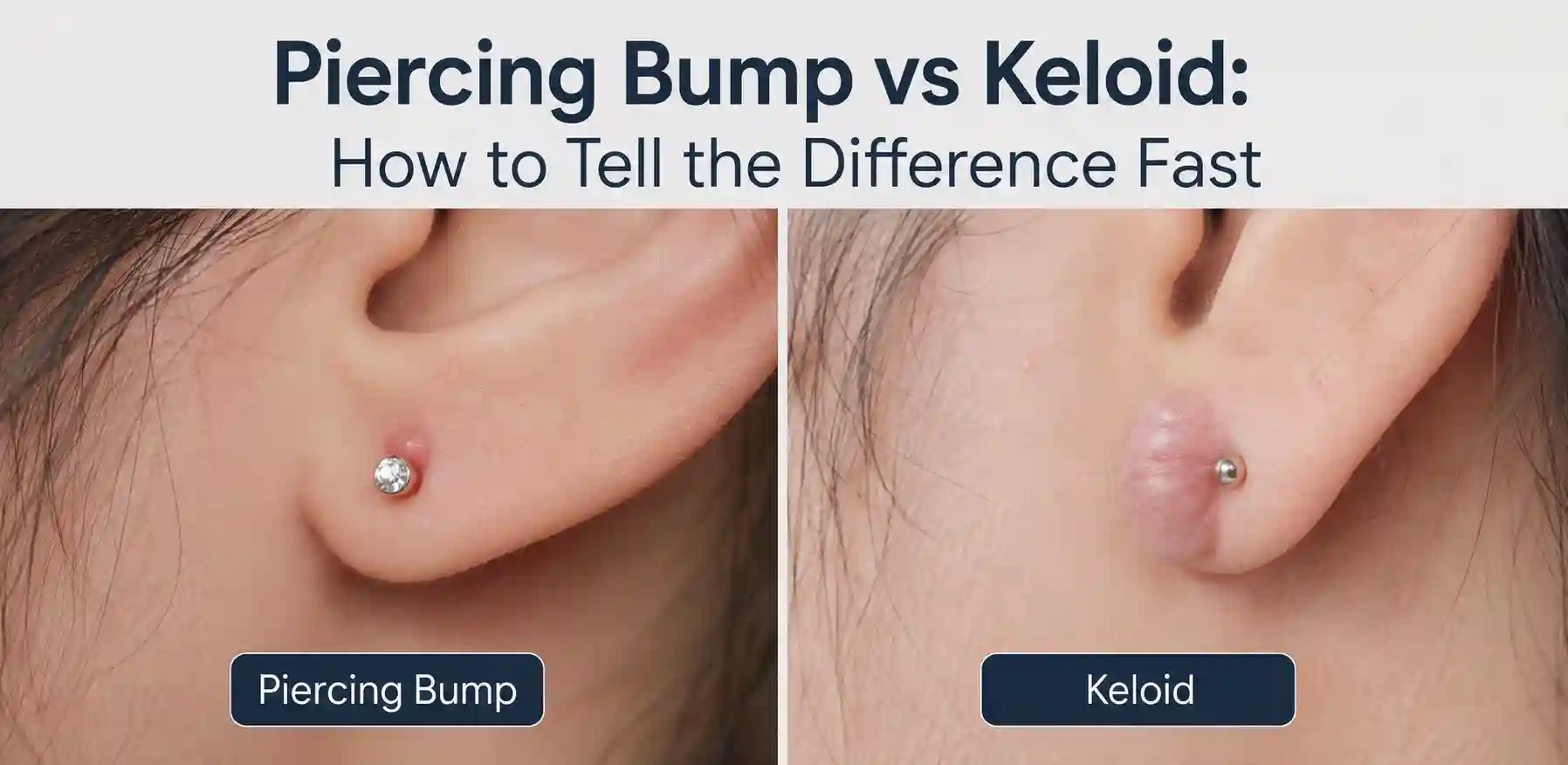
- The quickest visual clue: irritation bumps sit directly on or around the piercing exit hole; keloids form a larger, distinct mass that extends well beyond the pierced area.
- Most “keloids” people worry about are actually temporary irritation bumps — but if a bump keeps growing over several months, dermatological evaluation is essential.
You are not alone if you are frantically Googling “piercing bump vs keloid” while examining a raised bump next to your new piercing in front of the mirror. This is one of the most common concerns for anyone with a fresh or healing piercing — and the anxiety is completely understandable. The difference between a piercing bump and a keloid matters enormously, because one is a routine healing hiccup and the other is a permanent scar requiring medical attention.
This guide will walk you through exactly how to tell them apart, what causes each one, and what to do about it — fast.
What Is a Piercing Bump? (The Common Culprits)
A little, elevated patch of skin that develops at the site of a healing piercing is known as a “piercing bump.” It is frequently brought on by irritation, trapped fluid, mild infection, or an excessive scar. tissue (hypertrophic scarring). The term is something of an umbrella — it describes several distinct but related conditions.
The three most common types:
- Irritation bump — The most frequent offender. Appears as a small, moist, red bump directly on or around the entry or exit point of the piercing. It may look similar to a pyogenic granuloma: raw, slightly weepy, and reactive. Usually caused by physical trauma (snagging on clothing, sleeping on the jewelry) or an allergic reaction to nickel-containing metal.
- Pustule — A small pus-filled bump, similar in appearance to an acne pimple, that develops when bacteria enter the healing fistula (the channel your body creates around the jewelry). Not the same as a true infection, but a signal that something in your aftercare routine needs adjusting.
- Hypertrophic scar — A firm, slightly raised, pink-to-flesh-colored bump that forms along the piercing channel as a result of excessive collagen production during healing. Crucially, a hypertrophic scar stays within the boundaries of the original wound — it does not spread outward.
Piercing bumps typically appear anywhere from a few weeks to a few months after the initial piercing. They are extremely common and, with the right care, the majority resolve completely.
What Is a Keloid? (The Real Deal)
A keloid is an overgrowth of scar tissue that extends beyond the boundaries of the original wound, forming a smooth, shiny, raised mass that can be pink, red, purple, or darker than the surrounding skin. Unlike a hypertrophic scar, a keloid is not a normal healing response gone slightly overboard — it is a distinct pathological process driven by genetic predisposition and abnormal collagen regulation.
True keloids are significantly more common in people of African, Asian, and Hispanic descent, and they tend to run in families. If a parent or sibling has developed keloids from minor cuts, piercings, or surgical incisions, your own risk is meaningfully elevated. Keloids can continue to enlarge for months or even years after the original wound has healed, and they almost never regress spontaneously without medical intervention.
The critical distinction between a keloid and a hypertrophic scar: a hypertrophic scar respects the wound margin, staying within the original borders. A keloid ignores those borders entirely, advancing outward like a raised island that has “swallowed” the surrounding skin — and sometimes the jewelry itself.
Piercing Bump vs Keloid: 7 Key Differences
The comparison below is designed to give you a fast, visual reference. Read the rows carefully: the location and growth pattern columns alone will answer the question for most readers.
| Feature | Piercing Bump (Irritation / Hypertrophic) | Keloid |
|---|---|---|
| Location | Sits directly at the piercing entry or exit hole | Can extend well beyond the piercing site in all directions |
| Shape | Small, round or slightly elongated; follows the piercing channel | Irregular, dome-shaped mass that grows beyond wound margins |
| Texture | Soft or slightly firm; may ooze clear/yellow fluid or form a crust | Firm, rubbery, smooth surface — no discharge |
| Color | Red, pink, or flesh-toned; may have a yellowish center | Pink, red, purple, or dark brown; uniform, shiny surface |
| Growth Pattern | Appears within weeks; may fluctuate; often shrinks with proper care | Grows slowly over months; rarely if ever shrinks on its own |
| Pain / Itch | Mild tenderness or soreness, especially when touched | Can be persistently itchy, tender, or even painful as it stretches the skin |
| Response to Treatment | Improves with saline soaks, jewelry changes, or simply time | Requires dermatological treatment — steroid injections, laser therapy, or surgical excision |
Unpacking the key rows:
- Location is your fastest diagnostic. Press a clean finger gently around the bump. If it is centered perfectly on the exit hole with no extension beyond the hole’s diameter, it is almost certainly an irritation bump or hypertrophic scar. If it forms a broader mound that the jewelry seems to be partially buried in, keloid is more likely.
- Growth pattern is your most important long-term signal. A bump that was the same size three months ago as it is today — or that shrank when you switched to titanium jewelry — is not a keloid. A bump that has visibly grown over months, regardless of what you do, needs a dermatologist’s evaluation.
- Texture is often surprisingly helpful. Run a fingertip over the bump. Irritation bumps feel slightly soft or fluid-filled; they may release a small amount of clear or whitish discharge when gently compressed (though you should resist doing this). True keloids feel distinctly rubbery and firm, almost like a pencil eraser, and produce no discharge.
Visual Guide: How to Spot a Keloid vs an Irritation Bump
Picture a small, angry pimple sitting directly on the edge of a helix piercing hole — red, slightly shiny, maybe with a tiny crust in the center. That is a classic irritation bump. Now picture a smooth, rubbery oval mound that seems to have grown up and around the piercing, so that the bar or ring no longer sits flush against the skin. That is more consistent with a keloid.
Piercing locations most prone to keloids:
- Ear cartilage (helix, tragus, conch) — cartilage piercings have poor blood supply and high mechanical stress, creating ideal conditions for keloid formation in predisposed individuals
- Chest and sternum piercings
- Shoulders and upper back (high skin tension zones)
Piercing locations most prone to simple irritation bumps:
- Nostril
- Helix and conch (early irritation, not keloid)
- Navel
- Industrial piercings (due to high movement)
What Causes a Piercing Bump to Form?
Piercing bumps are fundamentally an inflammatory response — your body treating the jewelry as a foreign object and reacting accordingly. Common triggers include:
- Trauma: Snagging the jewelry on hair, towels, or clothing; sleeping directly on a cartilage piercing; catching it during exercise
- Wrong jewelry material: Nickel is a common contact allergen. There is enough nickel in surgical steel and gold-plated jewelry to cause contact dermatitis, a localized allergic reaction that resembles an irritation bump.
- Incorrect gauge or length: Jewelry that is too short puts pressure on the healing fistula; jewelry that is too long moves excessively and causes micro-tears
- Over-cleaning: Rinsing a piercing more than twice a day, or using harsh products like rubbing alcohol, hydrogen peroxide, or Bactine, strips the skin’s natural microbiome and slows healing
- Poor blood supply: Cartilage piercings heal slowly precisely because cartilage has minimal blood flow, making them more susceptible to prolonged irritation
These bumps are not a personal failing or a sign of poor hygiene. They are a predictable biological response to mechanical stress or chemical irritation, and most heal completely once the underlying trigger is removed.
What Causes a Keloid to Form on a Piercing?
Keloids form when the wound-healing process fails to switch off properly. Instead of producing just enough collagen to close the wound, the body produces far too much — and keeps producing it long after the wound has healed. The current scientific understanding points to a combination of:
- Genetic predisposition: Certain gene variants (notably in the TGF-β signaling pathway) are strongly associated with keloid formation. First-degree relatives of people who form keloids carry a significantly elevated risk.
- Skin tension: Areas of high mechanical tension — shoulders, chest, earlobes, and upper back — are disproportionately affected because tension signals fibroblasts to keep producing collagen.
- Wound depth and trauma: Piercings that go through cartilage or involve repeated trauma heal poorly and create a more prolonged inflammatory environment, increasing keloid risk.
- Personal history: If you have ever developed a keloid from a minor cut, burn, acne scar, or a previous piercing, you are at high risk of forming another one. This warrants serious consideration before any new piercing.
If you have a confirmed personal or family history of keloids, the Association of Professional Piercers (APP) and dermatology guidelines both recommend consulting a dermatologist before getting a new piercing, particularly in high-tension anatomical locations.
Treatment Options: How to Get Rid of a Piercing Bump
Most irritation bumps and hypertrophic scars will resolve with conservative at-home care. Here is a structured daily routine based on APP guidelines and American Academy of Dermatology (AAD) aftercare recommendations:
Daily Aftercare Routine
| Step | Action | Notes |
|---|---|---|
| Twice daily | Rinse with sterile saline spray (0.9% sodium chloride, no additives) | Do not use cotton balls, which shed fibers; use gauze or let the spray air-dry |
| After rinsing | Leave it alone (the “LITHA” method — Leave It The Hell Alone) | Resist touching, twisting, or rotating the jewelry |
| Weekly check | Inspect jewelry fit | If the post is too short and the back is embedding, see a piercer immediately |
| Ongoing | Sleep on a travel pillow with a hole, or use a clean pillowcase daily | Reduces pressure and friction on healing ear piercings |
Additional steps for persistent bumps:
- Switch jewelry: Replace any surgical steel, acrylic, or plated jewelry with implant-grade titanium (ASTM F136), implant-grade niobium, or solid 14k/18k gold. Nickel-free metals reduce allergic-contact irritation dramatically.
- Warm compress: A clean warm compress held against the bump for 5 minutes twice daily can improve circulation and help the bump resolve faster.
- Stop harsh products: Discontinue alcohol, hydrogen peroxide, tea tree oil, and antibacterial soaps on or near the piercing.
When to see a professional:
- No improvement after 2–4 weeks of consistent aftercare
- Signs of true infection: spreading redness beyond the piercing site, significant swelling, fever, red streaking, or a foul-smelling discharge (different from clear lymph fluid)
- Bump growing in size over months rather than staying stable or shrinking
Treatment Options: How to Treat a True Keloid
Keloids require professional medical treatment. Home remedies will not eliminate them, and attempting to excise one yourself carries serious risks, including infection, worsening scarring, and even larger keloid regrowth.
Evidence-based medical treatments (per AAD guidelines):
- Intralesional corticosteroid injections (first-line): Triamcinolone acetonide injected directly into the keloid every 4–6 weeks is the most widely used and well-supported treatment. It flattens the scar by suppressing collagen synthesis and reducing inflammation. Multiple sessions are typically required.
- Silicone gel sheets or gel: Applied daily for several hours, silicone creates an occlusive environment that hydrates the scar and reduces collagen overproduction. Best used as a complement to injections, not a standalone cure.
- Cryotherapy: Liquid nitrogen is applied to freeze the keloid tissue. Most effective on smaller keloids; often combined with steroid injections for better penetration.
- Laser therapy (pulsed-dye laser, Nd:YAG): Targets the blood vessels feeding the keloid and reduces redness and thickness. Typically requires a series of sessions and is often used alongside steroid injections.
- 5-Fluorouracil (5-FU) injections: An antimetabolite drug injected into the keloid that inhibits the fibroblast proliferation driving the excess collagen. Often used in combination with triamcinolone for synergistic effect.
- Surgical excision: Cutting the keloid out is an option, but keloids have a recurrence rate of up to 80% with surgery alone. Excision is therefore almost always followed immediately by pressure therapy (pressure earrings for earlobe keloids), radiation therapy, or corticosteroid injections to prevent regrowth.
Critical warning: Never attempt to cut, pierce, or pop a keloid at home. This introduces infection risk, causes additional trauma, and virtually guarantees a larger keloid will regrow in its place.
Can You Pop a Piercing Bump?
No. This advice is universally agreed upon by piercers and dermatologists alike.
Popping an irritation bump introduces bacteria from your fingertips into the healing fistula, worsens inflammation, and can convert a minor bump into a genuine infection — or into a larger hypertrophic scar. There is no therapeutic benefit. The fluid or pus inside a bump is a byproduct of your immune system’s activity; releasing it manually does not speed healing. Leave it alone and let your saline routine do the work.
Piercing Aftercare: Preventing Bumps and Keloids Before They Start
Prevention is significantly easier than treatment. The following practices reduce bump risk for all new piercings:
- Choose a reputable APP-certified piercer who uses implant-grade materials from the start
- Ensure the initial jewelry length and gauge are appropriate for your anatomy — a piercer who sizes jewelry “generously” for swelling knows what they are doing
- Avoid touching, rotating, or twisting the jewelry during healing (a persistent myth from older piercing guidance that has been definitively debunked by the APP)
- Protect the piercing from clothing friction, especially during exercise
- Use sterile saline spray only — no home remedies, no essential oils, no alcohol
For keloid-prone individuals specifically:
- Consult a dermatologist before getting cartilage or chest piercings
- Consider using pressure earrings (such as Zimmer splints) immediately after earlobe piercings
- Avoid re-piercing through existing scar tissue
Common Myths About Piercing Bumps and Keloids
Myth: “If I have a bump, I need to take out the jewelry immediately.”
False. Removing jewelry from a healing piercing can cause the fistula to close around the infection or scar tissue, trapping it. Unless a doctor advises removal, keep the jewelry in and address the underlying irritation.
Myth: “Tea tree oil cures piercing bumps.”
No clinical evidence supports this. Tea tree oil is cytotoxic — it kills the very cells your body needs to heal the fistula — and can cause significant contact dermatitis in many people.
Myth: “If it’s itchy, it must be infected.”
Itching is a normal part of healing and collagen production. Infection is characterized by spreading redness, warmth, significant pain, and thick purulent (not clear) discharge — not routine itchiness.
Myth: “Keloids always come back after treatment.”
Not always. Recurrence rates vary significantly by treatment type. Combining surgical excision with immediate post-operative radiation therapy or pressure earrings reduces recurrence rates to below 15% in well-designed studies.
Glossary of Key Terms
| Term | Definition |
|---|---|
| Fistula | The healed tunnel of skin your body creates around a piercing |
| Hypertrophic scar | An elevated scar confined within the original wound boundaries |
| Keloid | An overgrowth of scar tissue extending beyond the original wound |
| Pyogenic granuloma | A benign, vascular overgrowth that can resemble an irritation bump |
| Triamcinolone acetonide | A corticosteroid used by injection as first-line keloid treatment |
| LITHA | “Leave It The Hell Alone” — the APP’s shorthand for minimal-touch aftercare |
| Implant-grade titanium | ASTM F136 titanium; the gold standard for initial piercing jewelry |
Conclusion
The overwhelming majority of bumps people discover near healing piercings are not keloids — they are irritation bumps or hypertrophic scars that will resolve with proper saline-based aftercare and a jewelry switch to implant-grade metal. A true keloid is rarer, genetically driven, and defined above all by its growth beyond the original wound boundary and its persistence over time.
If your bump appeared in the first few weeks, sits directly on the piercing hole, and responds (even partially) to good aftercare, give it 4–8 weeks of consistent care before worrying further. If the bump is growing month over month, extends well beyond the piercing site, or you have a personal or family history of keloid formation, book a consultation with a board-certified dermatologist. An APP-certified piercer can also be an excellent first stop for an objective assessment of whether what you have is an aftercare issue or something requiring medical attention.
Frequently Asked Questions
Can a piercing bump turn into a keloid?
A standard irritation bump or hypertrophic scar does not “turn into” a keloid — they are distinct processes. However, if a person is genetically predisposed to keloid formation, repeated trauma to a piercing site (from poor aftercare, snagging, or re-piercing through scar tissue) can trigger keloid development. The predisposition must already be present; the piercing is the trigger, not the cause.
How long does it take for a pierced lump to disappear?
Most irritation bumps resolve within 4–8 weeks of consistent, correct aftercare — particularly after switching to implant-grade titanium jewelry and eliminating mechanical trauma. Hypertrophic scars may take 3–6 months to flatten significantly. If a bump shows no improvement after 6–8 weeks of dedicated care, consult a professional.
What is the appearance of a keloid on a piercing?
A keloid typically appears as a smooth, shiny, dome-shaped raised mass that extends beyond the piercing hole in all directions. It may be pink, red, purple, or darker than the surrounding skin, and it feels distinctly firm and rubbery — almost like an eraser. The jewelry may appear partially buried within the growth. Unlike irritation bumps, keloids do not form a crust or produce discharge.
Are keloids from piercings permanent?
Without treatment, yes — keloids do not spontaneously resolve. However, they are treatable. Intralesional steroid injections (triamcinolone), silicone gel sheets, laser therapy, cryotherapy, and surgical excision combined with pressure therapy or radiation all have clinical evidence of effectiveness. Complete elimination is possible, though recurrence remains a risk with any approach.
Can I still keep my piercing if I have a keloid?
It depends on the size and location of the keloid and your dermatologist’s assessment. Small keloids are sometimes managed with the jewelry in place. Larger keloids or those with active growth often require jewelry removal so that the wound can heal before treatment begins. In keloid-prone individuals, re-piercing through treated scar tissue is generally not recommended.
How quickly can a piercing bump be removed?
For irritation bumps: switch to implant-grade titanium jewelry immediately, begin twice-daily sterile saline rinses, and stop touching or rotating the jewelry. Many people see significant improvement within 1–2 weeks of eliminating the irritation source. Warm compresses twice daily can accelerate this. There is no overnight fix — but consistent correct care is the fastest reliable path.
This article references guidelines from the Association of Professional Piercers (APP) and the American Academy of Dermatology (AAD). It was last reviewed for accuracy in June 2026.
You Also Like To Read: My Reading Manga: Master Your List & Discover More