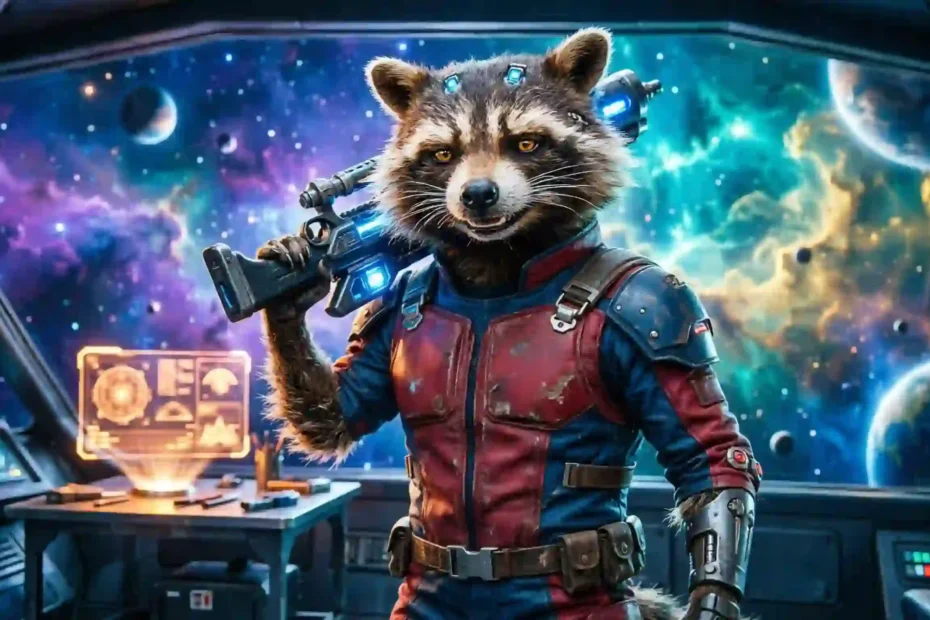
Have you ever wondered how a talking woodland mammal with a laser cannon became the most emotionally resonant hero in modern superhero cinema? When people first heard about the Guardians of the Galaxy Rocket Raccoon movie pitch back in 2014, even longtime box office analysts predicted Marvel Studios had finally gone too far. Instead, a bitter, cybernetically modified outlaw stole the spotlight from gods, billionaires, and super-soldiers across five blockbuster films.
Behind the wise-cracking exterior and love of oversized explosives lies nearly fifty years of comic book history, psychological trauma, and brilliant character design. In this complete guide, you’ll discover how comic creators Bill Mantlo and Keith Giffen built the character in 1976, how his comic backstory differs wildly from his devastating origin in Vol. 3, and how voice actor Bradley Cooper and motion-capture performer Sean Gunn brought him to life on screen.
Quick Overview: Key Character Facts
- First Comic Appearance: Marvel Preview #7 (Summer 1976, cameo as “Rocky”); The Incredible Hulk #271 (May 1982, first full appearance)
- Creators: Bill Mantlo (writer) and Keith Giffen (artist)
- Aliases & Designations: Subject 89P13, Ranger of Halfworld, Captain of the Guardians, Rocky
- Homeworld: Halfworld in the Keystone Quadrant (Marvel Comics) / Counter-Earth and Knowhere (Marvel Cinematic Universe)
- Core Strengths: Master-level weapons engineering, starship piloting, tactical warfare, cybernetic skeletal durability, and acute mammalian senses
- MCU Portrayal: Voiced by Bradley Cooper; on-set physical motion capture and reference performance by Sean Gunn
Who Is Rocket Raccoon and How Did a Beatles Song Inspire His Creation?
Definition: Rocket is a genetically and cybernetically engineered anthropomorphic mammal from the planet Halfworld who serves as the master weapons specialist, chief engineer, and eventual leader of Marvel’s Guardians of the Galaxy. Combining hyper-acute animal instincts with genius-level mechanical engineering and military tactics, he operates as one of the sharpest strategic minds in Marvel’s cosmic hierarchy.
Every iconic comic book hero starts with a spark of creative weirdness, and Rocket’s origin story begins with classic rock music. In 1976, writer Bill Mantlo and artist Keith Giffen were working on a black-and-white backup feature called “The Sword in the Star” for Marvel Preview #7. Both creators were fans of The Beatles’ 1968 self-titled album (commonly known as The White Album), which featured Paul McCartney’s folk-rock ballad “Rocky Raccoon.”
Mantlo and Giffen decided to pay direct homage to that song by introducing a sharp-tongued space mammal named “Rocky” who briefly aided Prince Wayfinder. At the time, the character was little more than a clever visual pun tucked inside a magazine aimed at older sci-fi readers. Neither creator suspected that this one-off cameo would eventually anchor a multi-billion-dollar movie franchise.
The First Full Appearance in The Incredible Hulk #271 (1982)
Six years after that brief debut, Bill Mantlo was writing The Incredible Hulk and needed an offbeat cosmic adventure for issue #271. He brought Rocky back into the main Marvel continuity, slightly updating his name and giving him a proper supporting cast on the bizarre planet of Halfworld. Even the issue’s title—”Now Somewhere in the Black Holes of Sirius Major There Lived a Young Boy Name of Rocket Raccoon!”—parodied the opening spoken-word lines of the Beatles song.
In that story, the Hulk gets teleported into the Keystone Quadrant and helps Rocket protect a sacred book known as Gideon’s Bible from tyrannical villains trying to conquer the planet. Readers responded warmly to the contrast between the towering green monster and the fearless, laser-toting mammal barely reaching his knee. That chemistry planted the first seed for the big-guy-and-little-guy partnership that would later define Rocket’s bond with Groot.
The 1985 Four-Issue Limited Series With Mike Mignola
Before artist Mike Mignola became famous for creating Hellboy, he penciled Rocket’s first solo four-issue miniseries in 1985 alongside writer Bill Mantlo. If you read those four issues today, you’ll notice how much visual DNA modern Marvel movies borrowed from Mignola’s crisp, shadowy artwork. The miniseries fleshed out the social structure of Halfworld, introducing Rocket’s love interest Lylla the Otter and his burly first mate, an engineered walrus with metallic tusks named Wal Rus.
The plot centered on the “Toy War,” a fierce industrial conflict between two rival Halfworld toy moguls, Lord Dyvyne and Judson Jakes. Both warlords wanted to marry Lylla to inherit control of Mayhem Mekaniks, the planet’s largest toy empire. Rocket ultimately exposed the conflict as a selfish distraction from the animals’ sacred duty, cemented his leadership among his peers, and led his people into deep space at the end of the fourth issue.
How Does Halfworld Work in Marvel Comics vs. the Marvel Cinematic Universe?
Why do comic book purists and moviegoers sometimes describe completely different versions of Rocket’s childhood? The answer comes down to tone: what worked as a surreal, satirical sci-fi fable in 1985 needed a much darker, grounded emotional core for live-action cinema. Let’s break down how both versions of his creation actually work.
How the Original Comic Book Halfworld Ecosystem Works
In Marvel Comics, Halfworld wasn’t a torture laboratory at all—it was a planetary psychiatric hospital located in the Keystone Quadrant. Centuries earlier, a race of compassionate humanoid shrinks colonized the planet to treat their galaxy’s mentally ill patients, whom the locals affectionately called “the Loonies.” When funding dried up and an energy surge cut off the sector behind a cosmic wall, the doctors abandoned the planet and left sentient robots behind to care for the patients.
Over generations, exposure to a nearby going-nova star granted the robots self-awareness, and they grew tired of babysitting human patients. Wanting to escape the planet, the robots genetically and cybernetically modified the local companion pets—raccoons, otters, walruses, moles, and rabbits—giving them bipedal bodies and human-level intelligence so the animals could take over nursing duties. That freed the robots to retreat to the dark, industrialized half of the planet, dividing Halfworld into a lush asylum park run by animals and a massive mechanical factory zone run by machines.
Rocket served as the Chief Law Officer (“Ranger”) of the asylum park, using advanced weapons and roller-powered rocket skates to protect the Loonies while manufacturing whimsical toys to keep the patients happy. Whenever the comic book version of Rocket acted abrasive or cynical, it stemmed from the crushing responsibility of policing an entire world of vulnerable patients while warring factions threatened their peace. Only later, when the superhero Star Thief manipulated the planet’s sanity, did Rocket realize the animals could cure the Loonies entirely, freeing himself and his companions to explore the stars.
How the MCU Counter-Earth Experimentation Works
Director James Gunn took the visual concept of genetically modified animals and inverted its meaning for the Marvel Cinematic Universe. Instead of being created to care for others, the MCU version of Rocket—branded Subject 89P13—was kidnapped as an ordinary North American raccoon kit on Earth by the megalomaniacal scientist known as the High Evolutionary. Obsessed with designing a utopian society on an artificial mirror planet called Counter-Earth, the High Evolutionary subjected thousands of Earth animals to agonizing genetic acceleration and crude cybernetic surgery inside Arête Laboratories.
Here is how the High Evolutionary’s cruel assembly line functioned in Guardians of the Galaxy Vol. 3:
- Specimen Harvesting: Lower-tier animals from Earth were placed into numbered experimental cohorts—Rocket belonged to Batch 89 alongside an otter (89Q12), a walrus (89A95), and a white rabbit (89L06).
- Cranial and Skeletal Restructuring: Robotic surgical rigs tore apart the animal’s natural skeleton, inserting metal plates, mechanical spine linkages, and cerebral implants to force upright posture and vocal speech without anesthesia.
- Cognitive Conditioning: Subjects were educated through projection screens and tested on problem-solving, linguistics, and social etiquette to prepare them for habitation on Counter-Earth.
- The Fatal Flaw and Incineration: Early batches, including Batch 89, developed violent cognitive regressions under stress, leading the High Evolutionary to deem them defective mistakes unworthy of his new world.
What separated Subject 89P13 from every other test subject in Arête Laboratories was his innate, intuitive grasp of complex engineering. While still a juvenile kit, Rocket looked at the High Evolutionary’s massive genetic chamber and casually pointed out a fluid pressure flaw that dozens of adult alien scientists had missed. Rather than rewarding Rocket, the humiliated narcissist realized Rocket’s brain held the missing link to true creativity and planned to dissect it, sparking the tragic escape attempt that claimed the lives of Lylla, Teefs, and Floor.
How Did the 2008 Abnett and Lanning Reboot Reinvent the Character?
After his 1985 solo miniseries concluded, Rocket largely vanished into comic book obscurity for two decades. He popped up briefly in pages of Quasar, Sensational She-Hulk, and Exiles, mostly treated by writers as a nostalgic joke from the Bronze Age of comics. How did a forgotten character from Marvel’s dollar bins transform into an A-list headliner?
Annihilation: Conquest – Starlord and the Dirty Dozen in Space
In 2007, Marvel editors launched Annihilation: Conquest, a massive cosmic crossover event wherein the techno-organic Phalanx empire conquered the Kree galaxy. Looking to build a gritty commando sub-plot inspired by The Dirty Dozen, writer Keith Giffen—Rocket’s original co-creator—and writing duo Dan Abnett and Andy Lanning assembled a ragtag strike team led by a disgraced Peter Quill. They pulled Rocket out of limbo, traded his 1980s roller skates for heavy military tactical gear, and gave him an obsession with oversized artillery.
This four-issue miniseries marks the birth of the character modern audiences recognize today. Abnett and Lanning wrote him not as a cute mascot, but as a battle-hardened demolition expert who happened to stand three feet tall. It was also during Annihilation: Conquest that Marvel editors first paired Rocket with Groot, a giant sentient tree monster originally introduced in 1960’s Tales to Astonish #13, forging one of comic history’s greatest friendships.
Founding the Modern Team in Guardians of the Galaxy Vol. 2 (2008)
Following the defeat of the Phalanx, Dan Abnett and Andy Lanning launched Guardians of the Galaxy (Vol. 2) in May 2008. When fans search for Guardians Rocket Raccoon lore, this 25-issue run is the exact blueprint that inspired Marvel Studios’ live-action franchise. In fact, inside the story, it is actually Rocket who suggests calling their preventive strike team the “Guardians of the Galaxy” after meeting time-displaced hero Major Vance Astro.
Throughout the 2008–2010 comic run, Rocket proved himself the most dependable member of the roster. When Peter Quill’s secret manipulation of the team using Mantis’s telepathy caused the original lineup to fracture in anger, Quill banished himself to the Negative Zone. Who stepped up to keep the team alive during the catastrophic War of Kings crossover?
Rocket took the captain’s chair, recruited new blood like Bug and Martyr, and coordinated strategy from their headquarters inside the severed celestial head of Knowhere. Even while trading hilarious insults with Knowhere’s telepathic security chief, Cosmo the Spacedog, Rocket carried the tactical weight of preventing universal collapse. Without Abnett and Lanning’s 2008 reinvention, the character would never have made Marvel Studios’ short list for Phase Two of the MCU.
Rocket Raccoon in Guardians of the Galaxy: How Does His MCU Arc Unfold?
James Gunn has stated in multiple interviews that when Marvel Studios hired him to direct the 2014 film, he only accepted the job once he figured out how to treat a talking animal with complete emotional sincerity. In Gunn’s eyes, if you put a genetically altered mammal in space, he wouldn’t be a cheerful cartoon—he would be the loneliest, angriest, most alienated creature in the universe. Let’s look at the six distinct stages of his character evolution across the Marvel Cinematic Universe:
- Stage 1 — Defensive Isolation (Vol. 1, 2014): Operating as a cynical bounty hunter on Xandar alongside Groot, Rocket hides his deep self-loathing behind constant insults, petty theft, and hair-trigger violence.
- Stage 2 — Fear of Attachment (Vol. 2, 2017): Only months after finding a surrogate family, he intentionally sabotages the team’s stability by stealing Anulax batteries and picking fights with Peter Quill so they’ll reject him before he can get hurt.
- Stage 3 — Purpose Beyond Self-Preservation (Infinity War, 2018): Recognizing that Thanos poses an existential threat to everyone he loves, he accompanies Thor to Nidavellir and tries to pull the broken Asgardian king out of despair.
- Stage 4 — Quiet Dependability (Endgame, 2019): Left behind when the entire Guardians roster except Nebula vanishes in the Blip, he spends five years serving as a core Avenger alongside Natasha Romanoff, Outrider patrols, and Tony Stark.
- Stage 5 — Confronting Childhood Guilt (Vol. 3, 2023): Nearly killed by Adam Warlock, he journeys through his repressed memories of Counter-Earth, finally forgiving himself for the deaths of Batch 89.
- Stage 6 — Compassionate Leadership (Vol. 3 Ending): No longer running from his biological roots or his trauma, he accepts the mantle of Captain of the New Guardians, prioritizing rescue missions over mercenary paychecks.
The Drunken Breakdown on Knowhere and Yondu’s Mirror
Two quiet character scenes in the first two Guardians films explain everything you need to know about Rocket’s psychology. In Vol. 1, inside a gritty mining bar on Knowhere, Drax casually dismisses him as a “pet” and a “vermin.”Pushed past his breaking point, a drunken Rocket bares his teeth and shouts that he didn’t ask to get made—he didn’t ask to be torn apart and put back together over and over and turned into some “little monster.”
Three years later in Vol. 2, he meets his emotional mirror in the disgraced Ravager captain Yondu Udonta. Locked in adjacent brig cells aboard the Eclector, Yondu cuts straight through Rocket’s tough-guy act, telling him that he steals batteries and pushes friends away because he’s terrified they’ll realize who he truly is underneath the bravado. Watching Yondu sacrifice his own life in deep space to save Peter Quill teaches Rocket that being broken doesn’t disqualify you from being loved.
Surviving Five Years as an Avenger in Infinity War and Endgame
One of the most underrated aspects of Rocket’s MCU journey is that he actually spent longer serving with the Avengers on Earth than he initially spent with the Guardians in space. Between 2014 and 2018, the Guardians operated together for roughly four years; after Thanos snapped away half of all life in 2018, Rocket worked alongside Natasha Romanoff, Nebula, War Machine, and Captain Marvel for five full years until 2023. During that bleak half-decade, he lost his sharp edge and became the pragmatic glue keeping the surviving heroes focused.
Watch how differently he treats Thor in Infinity War compared to how he treated Peter Quill in Vol. 1. When Thor breaks down in tears on the pod to Nidavellir, admitting he has lost his father, his sister, his best friend, and his homeworld, Rocket doesn’t mock him. Instead, he offers quiet sympathy and gives Thor a replacement cybernetic eye he had smuggled off Contraxia.
Later in Avengers: Endgame, when a traumatized Thor suffers a panic attack in 2013 Asgard during the Time Heist, Rocket slaps him into focus while Queen Frigga steps in to comfort her son. He also works shoulder-to-shoulder with Tony Stark and Bruce Banner to fabricate the Nano Gauntlet capable of channeling all six Infinity Stones. How many characters in Marvel history can say they earned the technical respect of Tony Stark while simultaneously acting as Thor’s grief counselor?
Full-Circle Redemption Against the High Evolutionary in Vol. 3
For most of Guardians of the Galaxy Vol. 3, Rocket lies comatose on a med-bay table while a “kill switch” embedded in his heart prevents his friends from using a Med-Pack on him. Yet his presence dominates every frame through flashbacks to Arête Laboratories. When Quill and Groot finally bypass the code and revive him, Rocket immediately faces the creator who mutilated him decades earlier.
What makes the climax of Vol. 3 so powerful is what happens inside the High Evolutionary’s crumbling flagship. Walking past cages of terrified animal test subjects, Rocket spots a litter of normal, unaugmented baby raccoons and reads the taxonomic signboard on their cage: Procyon lotor—common raccoon. After spending nine years of screen time angrily insisting “I ain’t no raccoon!” whenever someone called him one, he rescues the kits and proudly declares to the High Evolutionary: “The name’s Rocket. Rocket Raccoon.”
Furthermore, when he has the beaten villain at his mercy, he refuses to pull the trigger and execute him in cold blood, simply stating, “Because I’m a Guardian of the Galaxy.” Even more telling, he delays his own escape from the exploding ship to herd hundreds of non-anthropomorphic dogs, pigs, and tortoises to safety through Knowhere’s breach. The bitter mercenary who once wanted to abandon Xandar in Vol. 1 becomes a selfless protector of every living creature.
What Are Rocket’s Actual Powers, Cybernetics, and Tactical Abilities?
Because he doesn’t shoot cosmic energy beams from his hands like Captain Marvel or wield a magical hammer like Thor, casual viewers sometimes underestimate how dangerous Rocket actually is in a fight. In both the comics and films, he combines augmented physiology, hyper-tuned animal senses, and genius-level weapons engineering. Below is a side-by-side comparison of how his capabilities stack up across both mediums:
| Ability Category | Marvel Comics (Earth-616) | Marvel Cinematic Universe (Earth-199999) |
|---|---|---|
| Origin of Enhancements | Genetically and cybernetically modified by sentient asylum robots on Halfworld | Surgically spliced and cybernetically rebuilt as Subject 89P13 by the High Evolutionary |
| Skeletal & Physical Build | Bipedal mammalian anatomy with enhanced agility, sharp claws, and rocket skates in early runs | Reinforced cybernetic skeleton, mechanical spine hardware, pulmonary implants, and enhanced leaping |
| Sensory Capabilities | Hyper-acute smell, night vision, sensitive facial vibrissae (whiskers), and broad-spectrum hearing | Heightened smell (can detect distress pheromones and emotions), night vision, and rapid target tracking |
| Engineering & Intelligence | Master starship mechanic and weapons designer capable of reverse-engineering Kree, Shi’ar, and Phalanx tech | Genius polymath who outsmarted the High Evolutionary as a kit and co-built the Nano Gauntlet with Tony Stark |
| Signature Weaponry | Oversized plasma rifles, Kree submachine guns, molecular grenades, and custom heavy artillery | The Hadron Enforcer, electric shock mines, Gravity Mines, Aerorig jetpack, and dual laser cannons |
| Tactical Role | Field Commander and master strategist who led the Guardians through the War of Kings | Chief Engineer, primary combat pilot alongside Quill, demolition specialist, and eventual Team Captain |
Cybernetic Skeletal Augmentation and Enhanced Mammalian Senses
If an ordinary thirty-pound mammal fired a rifle capable of blowing up a Kree warship, the recoil alone would shatter every bone in its body. Rocket avoids this fate because his entire skeletal frame is reinforced with dense cybernetic alloys and mechanical load-bearing joints. When the Nova Corps scans him during the prison lineup in Vol. 1, his biological readout explicitly lists a cybernetic skeletal structure paired with lower-respiratory enhancements that keep his lungs operating under extreme G-forces.
Beyond his metallic skeleton, his greatest combat edge comes from the natural predatory traits of a North American raccoon amplified to superhuman levels. His eyes feature a reflective tapetum lucidum layer that allows him to see clearly in near-total darkness. His olfactory bulb is so sensitive that he can smell enemies approaching through steel ventilation shafts, detect chemical explosives from across a hangar, and even sense when teammates are lying or frightened.
On top of vision and smell, his paws and facial whiskers (vibrissae) possess extraordinary tactile sensitivity. In the wild, raccoons use the dense nerve endings in their front paws to “see” objects underwater without looking at them. In Rocket’s hands, that biological trait translates into unmatched manual dexterity—allowing him to rewire microscopic alien circuit boards or pick high-security digital locks purely by touch while dodging blaster fire.
Improvisational Engineering and Kitbashing Under Fire
In Marvel lore, characters like Reed Richards and Tony Stark build sleek, pristine technology inside billion-dollar laboratories. Rocket practices a completely different discipline of engineering known as kitbashing—ripping parts out of incompatible, broken machines in the middle of a war zone and fusing them into devastating weapons within seconds. Give him a box of scrap metal, a broken prosthetic leg, and three minutes of cover fire, and he will hand you a weapon capable of bringing down a cruiser.
Consider his greatest engineering feats across the films:
- The Kyln Prison Escape Plan (Vol. 1): Within hours of arriving in a maximum-security Nova Corps prison, he identifies how to hijack the central watchtower’s artificial gravity system using a security armband and a quarnyx battery.
- The Hadron Enforcer (Vol. 1): Assembled from salvaged ship components on the Milano, this portable artillery cannon fires a condensed nuclear-level payload powerful enough to shatter a Dark Aster Necrocraft or pulverize a moon, according to his own cheerful exaggeration.
- The Ravager Ambush in Berhert’s Forest (Vol. 2): Expecting Taserface’s Ravager mutineers to attack while Quill and Gamora are away, he turns a dark forest into a one-mammal kill zone using non-lethal shock pads, sound triggers, and anti-gravity tether mines, taking down over a dozen armed mercenaries single-handedly.
- Hull Repair Spray and the Milano Reconstruction (Vol. 2): Using a compact molecular-reconstruction sprayer built from scrap tools, he rebuilds shattered starship hulls in real time.
How Did Bradley Cooper, Sean Gunn, and VFX Artists Bring Him to Life?
Prior to 2014, CGI animals in live-action blockbusters often fell into two traps: either they looked like stiff, weightless cartoons pasted onto the screen, or they crossed into the “uncanny valley” by putting human lips and eyeballs onto animal faces. Why does Rocket feel like a living, breathing actor standing right next to Chris Pratt and Dave Bautista? The secret lies in a three-part collaboration between on-set physical performance, grounded voice acting, and wildlife-accurate visual effects.
On-Set Performance Capture With Sean Gunn
If you watch behind-the-scenes footage from any Guardians or Avengers movie, you won’t see actors talking to a tennis ball on a stick. Instead, you’ll see actor Sean Gunn (who also plays the Ravager Kraglin) wearing a green or gray motion-capture suit and crouching in a painful duck-walk for twelve hours a day. Why did director James Gunn insist on having a physical actor crouch at three-foot eye level for every single take?
First, it gave the cast real eye contact and authentic comedic timing. When Rocket snaps back at Star-Lord or shares a quiet moment with Thor, Chris Pratt and Chris Hemsworth are reacting to Sean Gunn’s real-time improvisation, breathing, and physical proximity on set. Second, Sean Gunn’s body movements showed the camera operators exactly how to frame a three-foot-tall character in wide shots without making him look like an afterthought added in post-production.
Bradley Cooper’s Voice Acting and Facial Reference
When Marvel Studios announced they had cast Academy Award nominee Bradley Cooper to voice Rocket, some comic fans were puzzled because early concept tests had envisioned a gravelly Cockney accent or a nasal cartoon voice. Cooper and James Gunn instead modeled the voice partly on Tommy DeVito (Joe Pesci’s volatile character in Goodfellas) and partly on Gilbert Gottfried’s rapid-fire cadence, grounded in a gritty Northeast street rhythm. The result gave Rocket the fast-talking bravado of a cornered street hustler coupled with unexpected warmth during quiet scenes.
In the recording booth, multiple high-definition cameras filmed Bradley Cooper’s face while he delivered his lines. Visual effects artists didn’t paste Cooper’s facial geometry onto the character using motion-capture dots, because human muscle structure doesn’t match a raccoon’s long snout. Instead, animators studied how Cooper squinted his eyes, curled the corner of his mouth when delivering a sarcastic remark, and slumped his shoulders during emotional scenes, translating those micro-expressions into believable animal musculature.
Studying Real Wildlife Biology With Oreo the Raccoon
To make sure the character never looked like a man in a furry costume, visual effects studios Framestore and Weta Digital studied a real rescue raccoon named Oreo, who even accompanied James Gunn down the red carpet at the 2014 Guardians of the Galaxy premiere. Animators observed how Oreo shifted his weight between two legs and four legs, how his ears pinned back when startled, and how individual guard hairs separated over his dense undercoat when wind blew against his fur.
Building the digital character required animating over 100,000 individual strands of fur that interacted dynamically with rain, mud, grease, and spaceship lighting. Notice how in Vol. 1, when Rocket gets angry or defensive, the fur along his spine and cheeks subtly bristles outward just like a real agitated mammal. By honoring real biological mechanics while layering in Bradley Cooper’s soulfulness and Sean Gunn’s physical timing, the filmmaking team created one of cinema’s greatest digital performances.
Who Are the Most Important Allies and Rivals in Rocket’s Life?
A lone wolf only becomes compelling when forced to rely on a pack. Throughout both his comic book runs and cinematic appearances, Rocket’s sharp edges are defined by the misfits who refuse to give up on him.
Groot: From Bounty-Hunting Partner to Adoptive Son
No partnership in cosmic comics is more iconic than the bond between the fast-talking weapons expert and the gentle flora colossus from Planet X. When we first meet them on Xandar in Vol. 1, their dynamic is that of co-equal mercenaries: Original Groot acts as the patient muscle and conscience of the duo, while Rocket serves as the brains, translator, and protective hothead. Because Groot’s hardened larynx can only form the words “I am Groot,” Rocket has spent years learning to read the subtlest inflections in Groot’s tone.
That relationship undergoes a profound shift at the end of Vol. 1 when Original Groot sacrifices his life to weave a protective wooden cocoon around the team during the crash of the Dark Aster. According to James Gunn, the sapling that Rocket plants in a pot isn’t the exact same individual with preserved memories—he is effectively Original Groot’s biological son. From Vol. 2 onward, Rocket transitions from being Groot’s mischievous little brother to being Baby and Teen Groot’s fiercely devoted single father, teaching him combat survival while fretting over his safety.
Batch 89: Lylla, Teefs, and Floor
In the comics, Lylla is the glamorous heiress to Halfworld’s largest toy conglomerate, and Wal Rus is a burly lieutenant who helps Rocket fight off industrial warlords. In the MCU, however, Batch 89 represents lost childhood innocence. Locked inside adjoining rusty cages in the subterranean bowels of Arête Laboratories, young Subject 89P13 forms a secret family with three fellow mutilated test subjects:
- Lylla (Subject 89Q12): A gentle, wise North American river otter equipped with mechanical shoulder armatures who acts as the big sister of the group and encourages Rocket’s dream of flying into the forever and beautiful sky.
- Teefs (Subject 89A95): A cheerful, philosophical Pacific walrus fitted with wheeled mobility gears and cybernetic optical domes who tries to keep everyone’s spirits up through kindness.
- Floor (Subject 89L06): A childlike, hyperactive white rabbit whose lower jaw has been replaced by a crude metal speaker grill and whose torso sprouts mechanical spider-like legs, yet who radiates pure, unfiltered joy whenever her friends play word games.
What makes the Batch 89 flashbacks in Vol. 3 so devastating isn’t the physical horror of their surgeries—it’s how tenderly the four friends treat each other in the dark. Even when Rocket enters a near-death state decades later, a vision of Lylla in a sunlit afterlife tells him that his story isn’t finished yet, giving him permission to stop blaming himself for their deaths.
Thor, Nebula, and Tony Stark
Why does Rocket get along so naturally with Thor, Nebula, and Tony Stark when he constantly butts heads with Peter Quill and Drax? Look at what those three characters have in common: each of them carries immense survivor’s guilt and hides deep vulnerability behind either mechanical armor or sarcastic detachment.
With Nebula, Rocket shares the literal trauma of having his body surgically disassembled and replaced with cybernetic parts by an abusive creator who never loved him. When the two of them sit together inside the Avengers Compound in Endgame right after Thanos is killed, Nebula wordlessly reaches out and holds Rocket’s paw—one of the very few times either character voluntarily initiates physical contact. With Thor, Rocket respects a warrior who has lost everything yet keeps fighting, calling him “the strongest Avenger” behind his back while teasing him to his face.
Which Comic Runs and Video Games Should New Fans Experience First?
If you’ve watched all the movies and want to explore more stories featuring Marvel’s sharpest cosmic tactician, jumping into fifty years of comic back-issues can feel intimidating. Where should you actually start? Here are the definitive comic book runs and video games that capture the character at his absolute best.
Essential Comic Book Runs From 1985 to Al Ewing’s Era
Whether you want classic sci-fi world-building, laugh-out-loud space heists, or hard-hitting cosmic sci-fi, these four comic runs are widely considered essential reading:
- Rocket Four-Issue Limited Series (1985) by Bill Mantlo and Mike Mignola: Collected in trade paperback as Guardian of the Keystone Quadrant, this is the foundational story that introduced Halfworld, Lylla, Wal Rus, and the Toy War, complete with gorgeous early artwork by Hellboy creator Mike Mignola.
- Guardians of the Galaxy (Vol. 2, #1–25, 2008–2010) by Dan Abnett and Andy Lanning: The definitive modern cosmic run that reinvented him as a military tactician, established Knowhere as the team’s headquarters, and showcased his leadership when Star-Lord left the team.
- Solo Series (Vol. 2, #1–11, 2014–2015) by Skottie Young: Launched right as the first movie hit theaters, writer-artist Skottie Young delivered a hilarious, kinetic runaway adventure where Rocket is framed for murder by a gang of jealous ex-girlfriends across the galaxy.
- Grounded / Skybreaker (2016–2017) by Matthew Rosenberg and Al Ewing: Rosenberg’s gritty Grounded arc traps him on Earth without his space tech while hunted by Kraven the Hunter, while Al Ewing’s later 2020–2021 Guardians run explores the toll his cybernetic implants take on his aging body.
Standout Video Game Depictions
Beyond comics and movies, two recent video games offer fantastic interactive portrayals of the character:
- Marvel’s Guardians of the Galaxy (2021, Eidos-Montréal): This single-player narrative adventure blends comic book lore with cinematic banter, featuring a fantastic performance by voice actor Alex Weiner. The game delves deeply into Rocket’s frustration with Peter Quill’s impulsive leadership, his protective streak over Groot, and his secret terror of deep bodies of water.
- Marvel Rivals (2024–Present, NetEase Games): In this fast-paced hero shooter, Rocket operates as a high-mobility Strategist who uses his Battle Rebirth Beacon (B.R.B.) to revive fallen teammates, fires bouncing Repair Mode orbs, rides on Groot’s shoulders for a team-up bonus, and drops the Cosmic Yarn Amplifier (C.Y.A.) to supercharge his squad’s damage output.
Key Takeaways
- A Musical Beginning: Bill Mantlo and Keith Giffen created the character in 1976 (Marvel Preview #7) as a direct nod to The Beatles’ 1968 White Album song “Rocky Raccoon.”
- Two Distinct Origins: In Marvel Comics, he was engineered by sentient robots to serve as the protective chief ranger for psychiatric patients on Halfworld; in the MCU, he was tortured as Subject 89P13 by the High Evolutionary on Counter-Earth.
- The 2008 Turning Point: Writers Dan Abnett and Andy Lanning transformed him from a forgotten 1980s curiosity into a hardened military commando during Annihilation: Conquest and the 2008 Guardians of the Galaxy comic run.
- The Secret Heart of the MCU Trilogy: Across five major MCU films, he evolves from a bitter, self-loathing outlaw who pushes friends away into a compassionate Avenger and the official Captain of the New Guardians.
- A Collaborative Filmmaking Triumph: His believable big-screen presence combines Sean Gunn’s on-set physical performance, Bradley Cooper’s grounded voice acting, and Framestore’s wildlife-accurate visual effects modeled after a real rescue raccoon named Oreo.
Frequently Asked Questions (FAQ)
Why does Rocket Raccoon hate being called a raccoon?
In the early MCU films, he didn’t even know what a terrestrial raccoon was because he was abducted from Earth as an infant and raised inside the High Evolutionary’s laboratory on Counter-Earth. Whenever aliens called him a “raccoon,” “trash panda,” or “vermin,” he heard it as an insult reducing him to a mindless lab specimen, until he discovered his true species in Vol. 3.
What does Rocket’s code name 89P13 actually mean?
In Guardians of the Galaxy Vol. 3, the designation 89P13 is the serial number branded onto his chest by the High Evolutionary inside Arête Laboratories. “89” identifies him as a member of experimental Batch 89 alongside Lylla, Teefs, and Floor, “P” stands for the taxonomic genus Procyon (raccoons), and “13” marks him as the thirteenth specimen in that cohort.
How old is Rocket in the Marvel Cinematic Universe?
Wild North American raccoons typically live only two to three years, or up to twenty years in captivity, but Rocket’s cybernetic organs and genetic modifications drastically extended his lifespan. He spent roughly four years with the original Guardians, five years on Earth with the Avengers during the Blip, and several prior years as a fugitive, making him at least fifteen to twenty years old chronologically.
Who plays Rocket on set if Bradley Cooper only does the voice?
Actor Sean Gunn—the brother of director James Gunn and the actor who plays Kraglin Obfonteri—performs all of the on-set physical reference work for Rocket. Wearing a motion-capture reference suit, Sean Gunn crouches down to a three-foot eye line during every scene so the rest of the cast has a real actor to make eye contact with and play off of.
Is Rocket smarter than Tony Stark in the MCU?
They excel in different engineering disciplines: Tony Stark is a theoretical physicist and futurist who designs clean nanotechnology and time-space GPS systems, whereas Rocket is a cosmic polymath and improvisational kitbasher. On Earth in Avengers: Endgame, Rocket works alongside Tony Stark and Bruce Banner as an intellectual peer to construct the Nano Gauntlet, and he even outsmarted the High Evolutionary as a juvenile kit.
Did Rocket survive at the end of Guardians of the Galaxy Vol. 3?
Yes, despite months of fan speculation that he would die in the trilogy finale, Rocket survives his near-fatal injury after Peter Quill and Groot revive him following the orgoscope heist. At the end of the film, Quill steps down to visit his grandfather on Earth and names Rocket the new Captain of the Guardians of the Galaxy, leading Groot, Kraglin, Cosmo, Adam Warlock, and Phyla.
Conclusion
From a whimsical 1970s backup comic strip inspired by a Beatles tune to the emotional anchor of a multibillion-dollar film trilogy, Rocket Raccoon proves that great storytelling doesn’t require a cape or a royal bloodline. What makes audiences around the world root for Subject 89P13 isn’t just his oversized laser cannons or his razor-sharp insults—it’s his refusal to let a cruel creator define his worth.
Whether you’re picking up Bill Mantlo and Mike Mignola’s classic 1985 miniseries for the first time or rewatching him lead the new Guardians into battle across Knowhere, his journey reminds us that even the most broken misfits can build a family worth fighting for. Next time you watch him crank up “Come and Get Your Love” with his crew, you’ll know every scar, circuit, and comic book milestone that got him to the captain’s chair.