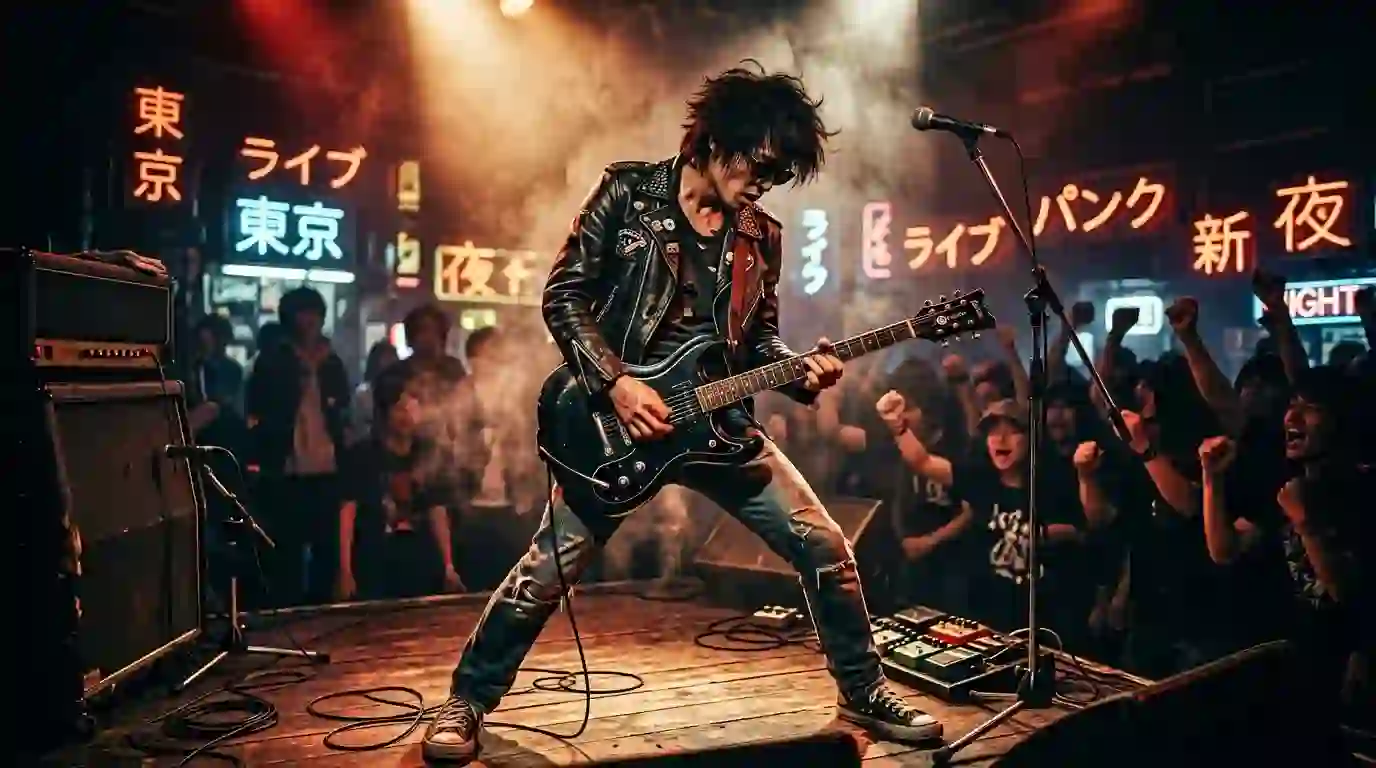
Most guitarists spend years learning to sound complicated. Shouji Ramone spent his doing the opposite. He strips every song back to three chords, one blazing downstroke, and a chorus that 200 strangers will shout back at him.
If you have ever loved a two-minute song but could not name the band behind it, this guide is for you. Here is the full story of the Tokyo guitarist who proves that speed and honesty beat any amount of polish.
Shouji Ramone at a Glance: Fast Facts
| Stage name | Shouji Ramone |
| Real name | Kaito Shouji (庄司海斗) |
| Born | 1984, Koenji, Tokyo |
| First guitar | A second-hand Mosrite Ventures II copy, bought at 15 in Shimokitazawa |
| Active since | 1999 (with The Static Kids), solo since 2005 |
| Band | Trio with Kenji “Mochi” Watanabe on drums and Rio Tanaka on bass |
| Releases | 4 studio albums, 2 EPs, 1 live album |
| Signature sound | 170 BPM, three chords, one eight-bar solo, crowd-sung choruses |
| Famous line | “Three chords, zero excuses.” |
| Fan tradition | Downstroke Day, the first Saturday of October |
Who Is Shouji Ramone?
Shouji Ramone is a guitarist, singer, and songwriter from the Koenji district of western Tokyo. He plays fast, short punk songs that rarely pass the two-minute mark, and he delivers them like a man catching a train. His real name is Kaito Shouji, and he took the Ramone surname as a salute to the band from Queens that rewired his teenage brain.
Since going solo in 2005, he has put out seven records, played more than 600 shows, and built a family of fans who call themselves the Downstroke Club. He still plays a monthly residency show in Koenji, still tunes his own guitar between songs, and still seems genuinely shocked when people show up.
What Does His Stage Name Mean?
The name is not a brand; it is a commitment. “Shouji” is his family name, which he kept because the man he admires most is his father, a train conductor who worked night shifts for 30 years. “Ramone” is the part he chose at 15, the night he first heard the Ramones’ Rocket to Russia on a cassette his uncle sent from New York.
He has explained it simply: the Ramone name means you belong to a family of outsiders who play fast and look out for each other. That is exactly the philosophy that runs through everything Shouji Ramone records, releases, and performs today.
How Did He Discover Punk?
Kaito Shouji grew up in a small apartment above his mother’s soba shop, and his bedroom window looked over the Koenji station platforms. He spent his allowance on used tapes, and in 1999 a friend dragged him to a basement live house where a three-piece tore through a 25-minute set at full volume. He walked out with his ears ringing and a plan.
He bought a beaten-up Mosrite copy from a Shimokitazawa shop for the price of a school uniform, then taught himself the downstroke by playing along to reel-to-reel dubs of Japanese punk: The Blue Hearts’ melodic rebel songs and the razor-fast hardcore of GISM and SS. Those bands, which helped shape Tokyo punk from the late 70s onward, gave him the map. The Ramones gave him the direction.
By 1999 he was playing guitar in The Static Kids, a trio that released one cassette, Screaming Order, in 2001. The band broke up two years later when the bassist moved to Osaka. Shouji Ramone went home, rewrote his set list, and promised himself he would close every show the same way: fast, loud, and smiling.
What Makes His Sound Distinctive?
Three things separate him from every other fast band in Tokyo. First, his tempo. The songs sit near 170 BPM, quick enough for a mosh pit and slow enough for the last row to keep up.
Second, his restraint. Most songs use three chords, one eight-bar solo, and zero intros longer than a count of four.
Third, his lyrics. Where New York punk wrote about drugs and decay, Shouji Ramone writes about the small stuff that makes Tokyo hum: vending machines that still work at 2 a.m., the last train that got away, an onigiri eaten on a cold platform, rain that ruins a Friday. That ordinary heart is why his songs stick, and it is the reason crowds sing entire verses back to him without being asked.
He describes the formula in his own words: “Fast is easy. Fun is the hard part.”
Shouji Ramone Discography: Albums, EPs, and Key Songs
Seven records deep, the catalog stays lean and honest. Every release fits one statement: this is who I am right now. Here is the complete discography in order, along with the track that best explains each record.
| Release | Year | Type | Standout track | Why it matters |
|---|---|---|---|---|
| Neon Static | 2005 | Debut EP | “Concrete Sunshine” | Six songs recorded in two days on a borrowed 4-track |
| Rocket Riot | 2008 | Studio album | “Sakura Redline” | First full band record and first Japan tour |
| Vending Machine Heart | 2011 | Studio album | “Soda City” | Written during 40 gigs, most of them quake relief shows |
| Live at Voltage | 2014 | Live album | “One, Two, Three, Four” | Recorded in Koenji in front of 120 friends |
| Downstroke Avenue | 2017 | Studio album | “Zero Excuses” | The record that carried his motto and his sound abroad |
| Mask and Guitar | 2020 | Home EP | “Last Train Home” | Recorded alone at home; sales went to live house staff |
| Sakura Overdrive | 2023 | Studio album | “Station Platform” | His warmest record, and his loudest on vinyl |
An eighth release, Koenji Electric, is due late in 2026, with the single “Station Platform” already streaming.
What Gear Does He Play?
His rig is a museum of stubbornness. Nothing on stage costs more than a used car, and nothing leaves the house unless it has earned a spot. Here is the setup he has carried since the early 2010s.
- Guitar: a black Mosrite Ventures II reissue he nicknamed “Kachi” because it survived a dropped flight case in 2013
- Backup: a 1972 Fender Telecaster Deluxe that stays in the case unless disaster strikes
- Amp: a Marshall JCM800 head pushed to the edge, with the gain on 6 and the volume on 8
- Cabinet: a single 4×12 with vintage 30 speakers, no backup, no excuses
- Pedals: one modded Boss DS-1 with the tone knob turned down a quarter turn
- Strings: .010 to .046, changed every three shows, always
- Picks: orange .88 Tortex, about 20 per tour, handed out after every show
He warms up with 30 minutes of metronome work every single day, even on tour days. You can hear it. The downstroke stays tight even when the rest of the band is running on sleep.
What Is a Live Show Like?
Expect a clock that never reaches 25 minutes. Shouji Ramone counts off “one, two, three, four” before almost every song, bows between tracks, says almost nothing else, and does not leave the stage for encores unless the floor is truly stamping. If the crowd earns it, he plays three more songs and then a cover he will not name before the night ends.
The crowd is half the act. The Downstroke Club shows up in masks and band tees, knows every word, and treats the front row like a relay team. His drummer, Kenji Watanabe, keeps the beat so steady that the room feels like a train carriage, and Rio Tanaka’s bass lines carry the melodies the guitars refuse to play.
He ends every set the same way: guitar held high, one long bow, and his tea flask collected from the side of the stage before anyone can ask about merch.
Who Influenced Shouji Ramone?
Ask him and he names three acts without a pause. The Ramones taught him structure, that a great song fits in a matchbox. The Blue Hearts taught him heart and gave Japanese punk a melodic backbone that radio could not ignore. GISM and the early Tokyo hardcore bands taught him speed and the nerve to play loud in small rooms.
Two more names matter behind the scenes. Shonen Knife, the Osaka trio that has carried Japanese pop-punk abroad since 1981, showed him that a Japanese band could stay weird, stay small, and still tour the world. And his hometown, Koenji, with its live houses and crammed second-hand shops, taught him that a scene is just a bunch of people who show up every month.
How Has He Shaped Japanese Punk?
He did not invent anything, and he would be the first to say so. What he did was hand the next wave of Tokyo kids a working formula: small rooms, three chords, cheap gear, monthly shows, and no waiting for permission. Bands in Shimokitazawa and Koenji now point to his residency model when they start their own nights.
His charity work matters just as much. Open Amp Saturdays, his free monthly guitar class for under-18s, has now graduated more than 300 students. In 2011 he played 40 shows, most of them small benefit gigs after the Tohoku earthquake, and quietly handed the proceeds to local venues. That is the legacy fans talk about more than any chart position he never reached.
How Should a New Fan Start Listening?
If you have never pressed play, do not start at the beginning. Start where the sound is fully formed and work backwards. This order gives you the fastest route into the catalog.
- Play Downstroke Avenue first. It is the mission statement, 27 minutes long and perfectly paced.
- Move to Sakura Overdrive for the warmer, louder side of the band.
- Catch Live at Voltage to hear what the room sounds like when everyone sings.
- Trace the roots with Neon Static, the scrappy debut EP.
- Finish with Mask and Guitar if you enjoy the quiet, home-recorded detours.
For the quickest taste, stream “Zero Excuses” and “Station Platform” back to back. That is the whole argument on two tracks.
Where Do the Fans Gather?
The fastest way in is the Downstroke Club, the fan collective that organizes rides to Shouji Ramone shows, trades tapes, and runs the monthly fan zine Static Magazine. The club also runs Downstroke Day, held every first Saturday of October, when tribute gigs pop up in a dozen cities and proceeds go straight to free guitar classes.
Beyond that, keep an eye on the Koenji live house calendar. His monthly residency sells out most months, and his label posts tour dates there first. If you are outside Japan, the live album and the fan zine’s YouTube channel are the closest things to a front-row seat.
Shouji Ramone FAQ
Who exactly is Shouji Ramone?
The stage name of Kaito Shouji, a guitarist and singer from Koenji, Tokyo. He plays fast two-minute punk songs built on three chords, and he has released seven records since 2005.
What is his real name?
His real name is Kaito Shouji (庄司海斗). He borrowed “Ramone” as a tribute to the band that made him pick up a guitar.
What genre does he play?
Ramones-style guitar punk with a Tokyo twist. Think quick downstroke riffs, short songs, and lyrics about vending machines, platforms, and missed last trains.
How many albums has Shouji Ramone released?
Seven records in total: four studio albums, two EPs, and one live album. The eighth, Koenji Electric, arrives in late 2026.
When is the next album coming out?
Koenji Electric is due late 2026. The single “Station Platform” is already streaming, and he has been testing the new songs at his monthly residency since spring.
How can I see Shouji Ramone play live?
He plays the last Friday of every month at a 120-capacity live house in Koenji, and he tours Japan twice a year. Tickets sell out fast, so follow the venue calendar or his label for the next drop.
Keep the Three-Chord Spirit Alive
He built a career, a family of fans, and a thriving home scene on a rule that costs nothing: keep it simple, play it fast, and treat every person in the room like a friend. That rule works for bands, for writers, and for anyone who keeps postponing a noisy hobby because it feels too small to matter.
So pick up the thing you keep putting down. Go see a local band this month, or send this guide to one person who still thinks punk is only from New York. And if you ever catch the back of a black Mosrite in Koenji, stay for the encore. You will know it by the counting.