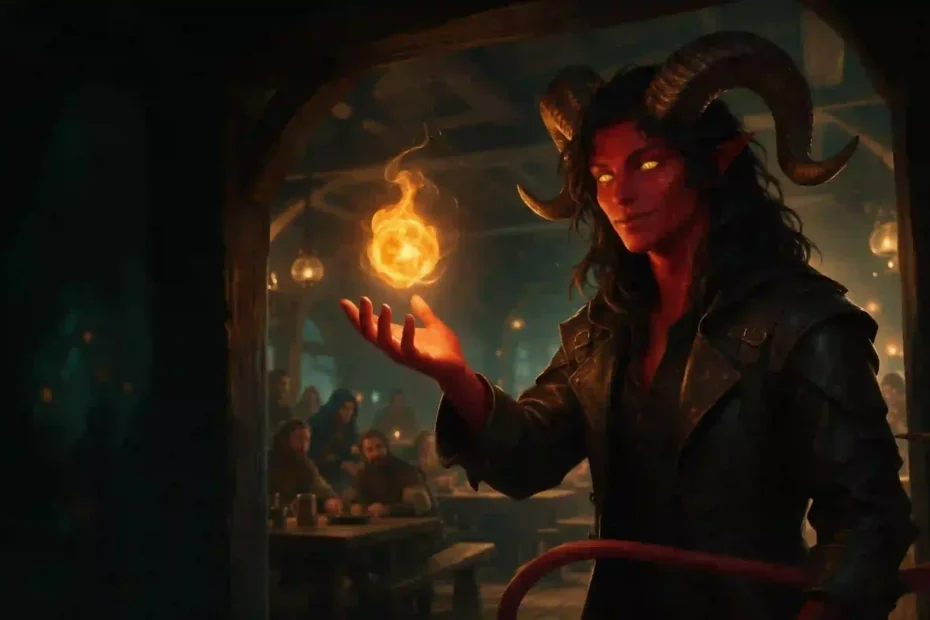
TL;DR: This horned, fiend-touched species has been part of Dungeons & Dragons since 1994. They aren’t evil by default, and the 2024 rules let you choose an Abyssal, Chthonic, or Infernal legacy. Below you’ll find their lore, traits, naming traditions, build steps, and roleplay tips.
Picture someone walking into a tavern with curling horns, a restless tail, and eyes like polished gold. Half the room goes quiet. The other half reaches for a weapon. That’s an ordinary evening for a tiefling, and it’s a big part of why players keep choosing them.
If you’re new to Dungeons & Dragons (DnD for short), the horns can look like a costume choice. They’re much more than that. By the end of this guide you’ll know where these characters come from, what they can do at the table, how their names work, and how to build and roleplay one without leaning on tired clichés.
Quick Overview
- What they are: Mortal humanoids with a fiendish bloodline, not demons or half-devils
- First appearance: The Planescape Campaign Setting, published in 1994
- Signature look: Horns, a tail, and solid-colored eyes
- Current rules: Three Fiendish Legacies in the 2024 Player’s Handbook
- Built-in perks: Darkvision, one damage resistance, and a few free spells
- Good fit for: Players who enjoy outsiders, charmers, and characters with something to prove
What Is a Tiefling?
Definition: A tiefling (pronounced TEE-fling) is a humanoid in Dungeons & Dragons whose bloodline carries the mark of a fiend, such as a devil or a demon. That heritage shows up as horns, a tail, and a little innate magic, but it doesn’t decide the character’s morals.
Think of it as an inheritance nobody asked for. Somewhere up the family tree, an ancestor struck a bargain with a fiend, was born in the Lower Planes (the game’s many hells and underworlds), or got tangled up with dark power some other way. Generations later, the mark is still showing.
What they aren’t matters just as much. They’re not demons, and they’re not half-devils either; that label belongs to the cambion, which we’ll compare later on. In rules terms they’re Humanoids, as mortal as any elf or dwarf, and their choices are entirely their own.
Even the word tells part of the story. Game designer Wolfgang Baur coined it for the Planescape team by joining the German tief, meaning “deep” or “low,” with the suffix -ling, meaning “offspring.” Read it as “child of the low places” and you’ve got the idea.
Where Did They Come From?
They’re younger than you might guess. Elves and dwarves have been in the game since the 1970s, but the horned folk didn’t arrive until 1994, when designer David “Zeb” Cook created them for the Planescape Campaign Setting. Cook has said he wanted a fallen-angel, reformed-devil kind of antihero who could never fully hide their origin.
Those early versions were gloriously unpredictable. One might have small horns, another cat-like eyes or cloven hooves, and a few cast no shadow at all. Later Planescape books even included tables so you could roll for your character’s oddities.
The big shift came in 2008. Fourth Edition promoted them to a core option in the Player’s Handbook and handed them a single shared origin: the nobles of a fallen human empire called Bael Turath, who bargained with devils for power and marked every generation that followed. That’s also when the matching horns-and-tail look became standard.
| Year | Book | What changed |
|---|---|---|
| 1994 | Planescape Campaign Setting (2nd Edition) | Debut as a playable “planetouched” people with wildly varied features |
| 2000 | Monster Manual (3rd Edition) | Returned as a planetouched creature, playable with a level adjustment |
| 2008 | Player’s Handbook (4th Edition) | Became a core choice with one origin story and a unified look |
| 2014 | Player’s Handbook (5th Edition) | Bloodline tied to Asmodeus, with a Charisma bonus and fire resistance |
| 2018 | Mordenkainen’s Tome of Foes | Added bloodlines for eight more archdevils |
| 2024 | Player’s Handbook (2024 revision) | Introduced three Fiendish Legacies and moved ability scores to backgrounds |
Fifth Edition kept the look and linked the bloodline to Asmodeus, ruler of the Nine Hells. The 2024 update then opened the door to demons and other fiends as ancestors. So which version is the “real” one? Whichever your table is playing.
What Do They Look Like?
Start with a human frame, then add the giveaways. According to the 2014 Player’s Handbook, that means large horns, a thick tail four to five feet long, sharply pointed canine teeth, and eyes of one solid color with no visible pupil. The horns might curl like a ram’s, rise straight like a gazelle’s, or spiral like an antelope’s. Black, red, white, silver, and gold are the classic eye colors.
Skin covers every human tone plus various shades of red, and hair usually runs dark: black, brown, deep red, blue, or purple. The tail works like a mood ring. The same book describes it lashing or coiling around the legs when its owner is upset or nervous, which is a lovely detail to use in roleplay.
The 2024 rules widen the palette. Each legacy now comes with its own common features:
- Infernal: Horns, spines, tails, golden eyes, and a faint smell of sulfur or smoke
- Abyssal: Horns, fur, tusks, and peculiar scents
- Chthonic: A cadaverous look, an unearthly beauty, or traits that echo a hag or yugoloth ancestor
Size is flexible too. The newer book lets you choose Medium or Small, so a three-and-a-half-foot troublemaker with tiny horns is completely legal. Treat every one of these lists as a menu, not a uniform.
What Traits Do They Get in the Current Rules?
Here’s the short version: you can see in the dark, shrug off one kind of damage, and cast a few spells even if your class never touches magic. Under the 2024 Player’s Handbook, every member of the species starts with the same package.
- Darkvision: You can see in the dark out to 60 feet, though only in shades of gray.
- Fiendish Legacy: You gain one damage resistance and three spells, based on the legacy you choose.
- Otherworldly Presence: You know the Thaumaturgy cantrip, good for a booming voice, flickering flames, or eyes that briefly change.
- Size and Speed: You’re Medium or Small, with a walking speed of 30 feet.
If “resistance” is a new term for you, it simply means you take half damage from that damage type. A Fireball that deals 28 damage to your friends deals 14 to an Infernal character. Over a long campaign, that adds up to a lot of survived fights.
How the Legacy Spells Work
- At level 1, you learn your legacy’s cantrip and can cast it as often as you like.
- At level 3, you gain a second spell. It’s always prepared, so it doesn’t use up any of your class’s spell picks.
- At level 5, you gain a third spell on the same terms.
- Once per long rest, you can cast each of those two later spells without spending a spell slot.
- Any other time, you can cast them again using spell slots, if your class provides them.
You also pick Intelligence, Wisdom, or Charisma as the casting ability for these spells when you choose your legacy. That one line matters more than it looks. A wise cleric and a bookish wizard now get the same mileage a silver-tongued warlock always did.
2014 vs. 2024 at a Glance
| Feature | 2014 Player’s Handbook | 2024 Player’s Handbook |
|---|---|---|
| Ability scores | +2 Charisma, +1 Intelligence | None from species; they come from your background |
| Damage resistance | Fire | Fire, necrotic, or poison, depending on legacy |
| Cantrips | Thaumaturgy | Thaumaturgy plus one legacy cantrip |
| Later spells | Hellish Rebuke at level 3, Darkness at level 5 | Two legacy spells at levels 3 and 5 |
| Casting ability | Charisma | Intelligence, Wisdom, or Charisma |
| Size | Medium | Medium or Small |
| Rulebook term | Race | Species |
Still playing with the older book? Nothing breaks. The 2014 version works fine at tables that haven’t switched, so ask your Dungeon Master (DM) which rules are in play before you fill in the sheet.
Which Fiendish Legacy Should You Pick?
This is the one real decision the species asks of you, and it shapes both your look and your spell list. Each legacy points to a different corner of the Lower Planes. Infernal means devils and the Nine Hells, Abyssal means demons and the Abyss, and Chthonic covers hags, yugoloths, and the gloom of Hades.
| Legacy | Resistance | Cantrip | Level 3 spell | Level 5 spell | Plays like |
|---|---|---|---|---|---|
| Infernal | Fire | Fire Bolt | Hellish Rebuke | Darkness | Classic hellfire and payback |
| Abyssal | Poison | Poison Spray | Ray of Sickness | Hold Person | Toxic, chaotic, and controlling |
| Chthonic | Necrotic | Chill Touch | False Life | Ray of Enfeeblement | Grim, durable, and death-touched |
Infernal is the dependable all-rounder. Fire shows up constantly, from dragon breath to the ever-popular Fireball, so that resistance rarely goes to waste. Fire Bolt gives any character a solid ranged attack, and Hellish Rebuke lets you scorch whoever just hurt you.
Abyssal rewards a little patience. Poison resistance is handy against spiders, serpents, and assassins, though many monsters shrug off poison when you throw it back at them. The prize is Hold Person at level 5, which can paralyze a humanoid enemy so the whole party can pile on.
Chthonic suits frontline fighters and horror-flavored concepts. False Life hands you a cushion of temporary hit points every day, and necrotic resistance earns its keep in campaigns full of undead. Can’t decide? The power gap between the three is small, so let the story you want to tell break the tie.
How Do Tiefling Names Work?
Names are where this species gets personal. The 2014 Player’s Handbook describes three naming traditions, and the one your character follows says a lot about how they feel about their heritage.
| Tradition | Where it comes from | Examples | What it tends to say |
|---|---|---|---|
| Cultural name | The community that raised them | Any name common in that region | “I belong here.” |
| Infernal name | Passed down through the bloodline | Akmenos, Kairon, Morthos, Bryseis, Kallista, Nemeia | “I know where I come from.” |
| Virtue name | Chosen by the character, often when young | Hope, Glory, Creed, Poetry, Sorrow, Temerity | “I’ll decide who I am.” |
Virtue names are the most distinctive of the three. They’re everyday words worn like a banner, and they aren’t always cheerful: Carrion, Despair, Weary, and Nowhere sit on the official list right beside Hope and Excellence. A character called Torment might be owning an insult, warning you off, or making a very dark joke.
How to Choose One That Fits
Start with the question a name quietly answers: who picked it, and why? A name handed down by proud parents tells a different story than one adopted at sixteen after leaving home for good. A few practical tips make the choice easier.
- Say it out loud. Your friends will be using it for months, so make it easy to pronounce.
- Borrow the sound, not the name. The official infernal examples lean on endings like -os, -is, and -ia, which makes it simple to invent your own.
- Pick a virtue with tension. Choose a word your character is chasing, or one they’re running from.
- Combine traditions. A birth name for family and a virtue name for strangers gives you two sides to play.
And if nothing clicks? Use a placeholder and keep playing. A virtue name adopted mid-campaign, right after a turning point in the story, often lands harder than anything you could’ve planned in advance.
How Do You Build Your Character Step by Step?
Good news: the current rules make it hard to build a bad one. Because species no longer sets your ability scores, the horns fit comfortably on any class. Work through these steps in order and you’ll have a finished character in a single sitting.
- Pick a class first. Decide what you want to do in a fight and in a conversation, then choose the class that does it.
- Choose a background. In the 2024 rules, this is where your ability score increases and your starting feat come from.
- Select your species and legacy. Use the table above to choose Infernal, Abyssal, or Chthonic.
- Set the legacy’s casting ability. Match your class’s main mental stat, or take whichever of Intelligence, Wisdom, and Charisma will be highest.
- Assign your ability scores. Put the best number in your class’s key ability, then add the increases from your background.
- Decide on size and looks. Choose Medium or Small, then horn shape, tail, and eye color.
- Name them and sketch a backstory. One sentence about how their hometown treated them is enough to begin.
Classes That Pair Well
Charisma casters are the traditional match, and they still shine. A warlock with the Devil’s Sight invocation can see straight through their own free Darkness, sorcerers welcome extra spells on a tight list, and bards love a showy cantrip. A paladin, meanwhile, makes the redemption arc practically write itself.
Don’t stop there, though. Free False Life is a small daily shield for a Chthonic fighter, and any melee character will be glad to have a ranged cantrip in their back pocket. Since you choose the casting ability, clerics, druids, and wizards lose nothing by picking this species either.
A Quick Example
Say you want a charming con artist. You choose bard, take the Charlatan background for a Charisma boost, pick the Infernal legacy, and set Charisma as its casting ability. By level 3 your character, Glory, resists fire, answers one attack a day with a free Hellish Rebuke, and uses Thaumaturgy to turn every entrance into a stage show.
How Do You Roleplay One Well?
Mechanics are the easy part. The heart of the species is a single tension: people see the horns and assume the worst, and your character has to decide what to do about it. The 2014 rulebook describes the usual welcome as stares, whispers, and mistrust in every eye.
There’s no single correct response. Some characters answer suspicion with relentless charm, some lean into the menace because it keeps people at arm’s length, and some just get on with being very good at their job. All three are fun to play. What matters is that you choose one on purpose.
Three Questions to Answer Before Session One
You don’t need ten pages of backstory. Answer these three questions and you’ll know how your character walks into a room.
- How did your hometown treat you? Kindness, fear, and indifference each produce a very different adult.
- What do you believe about your ancestor? They could be a victim, a villain, or a mystery you’d like to solve.
- What would you give up to be trusted? The answer shows you where your character’s limits are.
Common Traps to Avoid
- The brooding loner. Mystery is fun for one session. After that, give the party a reason to like you.
- Trauma as a whole personality. Prejudice can shape a character without being all they talk about, so add a hobby, a favorite food, or a terrible singing voice.
- Forgetting the body. Small physical habits make a character feel real: a tail that thumps when they’re impatient, or horns decorated for special occasions.
- Assuming every world is hostile. Settings differ, so ask your DM how common and how trusted your people are before you write a tragic past.
Characters Worth Borrowing From
- Karlach (Baldur’s Gate 3): A barbarian who escaped years of forced service in the Hells and greets the world with warmth instead of bitterness.
- Jester Lavorre (Critical Role): Laura Bailey’s blue-skinned trickster cleric, living proof that this heritage doesn’t require gloom.
- Doric (Dungeons & Dragons: Honor Among Thieves): A shapeshifting druid who fights for the forest community that took her in.
- Annah (Planescape: Torment): A sharp-tongued thief from the setting where it all began.
- Farideh (Erin M. Brimstone Angels novels). Evans): A young warlock wrestling with an infernal pact and her family’s history.
Notice the pattern? None of them is defined by horns alone. Each one wants something specific, and the heritage simply complicates the road there.
How Do They Compare With Aasimar, Cambions, and Genasi?
New players mix these up all the time, and it’s easy to see why. All of them are mortals marked by another plane of existence. The differences come down to which plane, and how close the connection is.
| Often confused with | Otherworldly source | How close is the link? | Can you play one? | The key difference |
|---|---|---|---|---|
| Aasimar | Celestials of the Upper Planes | A spark of celestial power in a mortal soul | Yes, in the 2024 Player’s Handbook | The mirror image: radiant gifts instead of fiendish ones |
| Cambion | A fiend parent | Direct, since one parent is a fiend | Normally no; it’s a monster | A true half-fiend that counts as a Fiend, not a Humanoid |
| Genasi | The Elemental Planes | Usually a genie somewhere in the family | Yes, in Monsters of the Multiverse | Elemental power with no good-versus-evil baggage |
The cambion causes the most confusion. It’s the direct child of a fiend and a mortal, which makes it a Fiend in the rules and usually a villain in the story. The horned folk in this guide sit many generations further from the source, and the rules treat them as ordinary mortals as a result.
Aasimar are best understood as the other side of the same coin. Both groups carry visible signs of an otherworldly heritage, and both attract assumptions from strangers. One gets treated as a blessing and the other as a threat, yet neither label tells you who the person actually is.
Genasi are the odd ones out. Their power comes from the Elemental Planes of air, earth, fire, and water, usually through a genie somewhere in the family tree. If you want a strange heritage without the moral baggage, they’re worth a look.
Key Takeaways
- They’re mortal Humanoids with fiendish ancestry, and that ancestry has no say over their alignment.
- The species debuted in 1994’s Planescape setting, became a core option in 2008, and was reworked in 2024.
- Current rules offer three legacies (Infernal, Abyssal, and Chthonic), each with its own resistance and spells.
- Names follow three traditions: the surrounding culture, inherited infernal names, and self-chosen virtue names.
- Any class works under the 2024 rules, so build around the story you want to tell.
Frequently Asked Questions
Are they always evil?
No. The 2024 Player’s Handbook states that a fiendish legacy has no effect on a character’s moral outlook. The 2014 edition agrees there’s no innate tendency toward evil, though it admits many end up there and that an independent streak often leans chaotic. Villains exist, but so do healers, paladins, and reluctant heroes.
What’s the best class for a tiefling DnD character?
Under the 2024 rules, almost any class works, because you choose the casting ability for your legacy spells and your ability scores come from your background. Warlock, sorcerer, bard, and paladin remain natural fits thanks to their Charisma focus. If your table uses the 2014 rules, the built-in Charisma bonus favors those same four classes.
Can they have wings?
Sometimes. The Sword Coast Adventurer’s Guide includes an optional winged variant for the 2014 rules, which swaps the usual innate spells for bat-like wings and a 30-foot flying speed. It needs your DM’s approval. The 2024 Player’s Handbook has no winged option, so ask before you plan around flight.
Do they live longer than humans?
Only slightly. According to the 2014 Player’s Handbook, they mature at the same rate as humans and live a few years longer. They don’t share the centuries-long lifespans of elves or dwarves, so your character’s childhood, career, and old age follow a familiar human rhythm.
What languages do they speak?
In the 2014 rules, they speak, read, and write Common and Infernal, the language of devils. The 2024 rules separate language from species: every character knows Common plus two languages from a standard list, and Infernal is classed as a rare language. If you want yours to speak it, check with your DM.
Can you play one in Baldur’s Gate 3?
Yes. Baldur’s Gate 3 offers three playable subraces named after archdevils: Asmodeus, Mephistopheles, and Zariel. Each one has fire resistance, darkvision, and its own small set of innate spells. Several major characters share the heritage too, including the companion Karlach and the refugees you meet early in the story.
Conclusion
Strip away the horns and the hellfire, and you’re left with one stubborn idea: where you come from doesn’t get to decide who you become. That’s why a concept from a niche 1994 setting has outlasted more than three decades of rule changes. It hands every player a question worth answering.
So pick a legacy, choose a name that means something, and bring your DnD tiefling to the table. The room may flinch when they walk in. What they do next is the story.