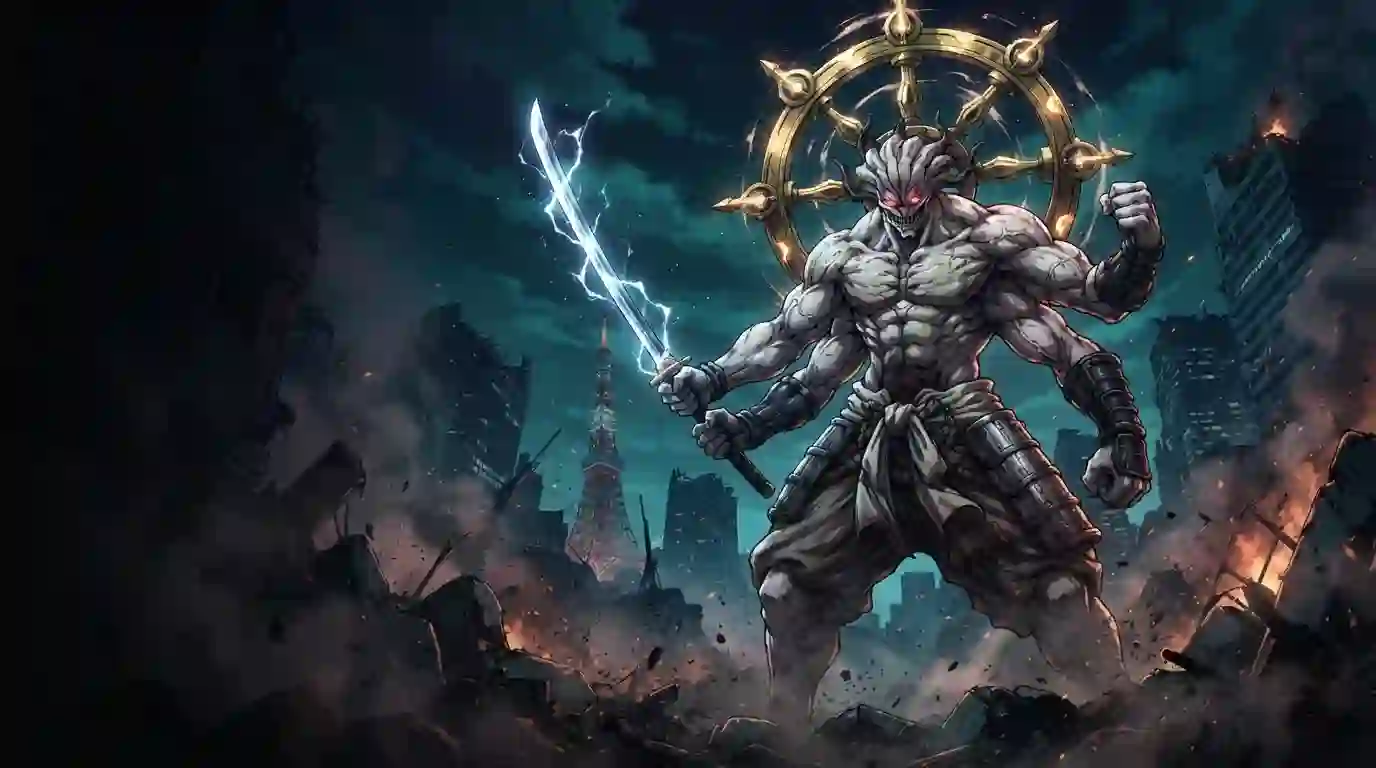
A cursed spirit you cannot beat, only unleash. Mahoraga is the one shikigami in Jujutsu Kaisen that no sorcerer dares summon, because the moment it appears, both the enemy and the summoner become dead men walking. It adapts to every attack, shrugs off wounds that would kill anything else, and has not been tamed even once in four hundred years. This guide breaks down exactly what Mahoraga is, how its abilities work, and why the entire jujutsu world fears it.
Who Is Mahoraga in Jujutsu Kaisen?
Mahoraga is the tenth and most powerful shikigami of the Ten Shadows Technique, the inherited curse technique of the Zen’in clan. Gege Akutami designed it as a walking disaster, a creature whose very existence breaks the rules of sorcery. Every other shikigami in the Ten Shadows set can be controlled once the user defeats it in an exorcism ritual. Mahoraga has never been controlled by anyone.
The shikigami looks like a towering, four-armed giant with a halo-like wheel floating behind its head. It carries the Sword of Extermination, a blade coated in positive energy that cuts through cursed spirits with ease. When it moves, it hits hard enough to level city blocks, and it regenerates from almost any injury within moments.
Mahoraga’s strength is not what makes it so terrifying. It is the wheel. Every time the wheel turns, the shikigami adapts to whatever just hurt it, which means the same attack never works twice against this monster.
The Full Name of Mahoraga
Every serious fan should know the full name behind the character. The complete title is the Eight-Handled Sword Divergent Sila Divine General Mahoraga, a mouthful that Gege Akutami lifted directly from Buddhist mythology. In the original Japanese, this reads as “Yatsuka no Tsurugi Ikaishinsho Makora.”
The name carries deep religious weight. Mahoraga takes its identity from the Mahoraga, a class of serpent-like guardian beings in Buddhist cosmology who protect the Dharma. The “Divine General” portion points to a heavenly protector figure, while the “Eight-Handled Sword” references the weapon the shikigami wields. Understanding the full name matters because it tells you exactly what this creature is meant to be: a divine executioner, not a mere spirit.
Gege Akutami did not pick this name by accident. Every element of the Eight-Handled Sword Divergent Sila Divine General Mahoraga title signals authority, protection, and absolute judgment, all of which match how the shikigami behaves in battle.
What Is the Wheel of Adaptation?
The mahoraga wheel is the single most important ability in the entire series, and it works on a simple, brutal logic. When Mahoraga takes damage from any phenomenon, the wheel rotates, analyzes the attack, and permanently adapts to it. After one full turn, the shikigami becomes resistant. After enough exposure, it becomes effectively immune and even develops a counter.
Think of it as an immune system turned into a weapon. Hit Mahoraga with slashing attacks, and it soon grows immune to slashing. Burn it with fire, and fire stops working. Strike it with a cursed technique, and it finds a way to neutralize that technique entirely. The wheel gives this shikigami a limitless capacity to evolve, which is why drawn-out fights against it are suicide.
There is only one reliable way to kill Mahoraga. You must destroy it instantly with a single overwhelming attack before the wheel completes even one rotation. If you fail to finish it in that first window, the fight is already over and you have lost.
The Ten Shadows Technique and Where Mahoraga Fits
The Ten Shadows Technique lets its user summon shikigami from their own shadow using hand signs and a shadow medium. Most users begin with the Divine Dogs and slowly build up to stronger summons as they grow in skill. Each shikigami must be tamed through a solo exorcism ritual before the user can command it freely.
Mahoraga sits at the very top of this ladder as the tenth shadow. The catch is that taming it requires defeating it alone, and no Ten Shadows user in the clan’s four-hundred-year history has ever survived that ritual. That is why Megumi Fushiguro treats Mahoraga as a weapon of last resort rather than a pet. He can call it, but he cannot control it, and calling it usually costs him his life.
The ritual itself allows multiple participants in a summoning, which means a dying sorcerer can drag an enemy into the exorcism. If both the enemy and the shikigami die, the ritual ends without a tamer, and everyone loses. This loophole becomes critical during the Shibuya Incident.
The Summoning Chant: What Does Megumi Say to Summon Mahoraga?
One of the most searched questions about this shikigami is the exact summon chant. When Megumi Fushiguro decides to call the divine general, he begins an incantation that names the Eight-Handled Sword Divergent Sila Divine General Mahoraga and invokes the taming ritual. He also forms a specific hand sign, holding his fingers in the shape of a wheel to mirror the shikigami’s halo.
Fans who ask what does Megumi say to summon Mahoraga often miss a crucial detail: Megumi never finishes the chant. During the Shibuya Incident, Haruta Shigemo strikes him down mid-incantation, and Megumi’s final words to the shikigami get cut short. The summoning still works because the ritual had already begun, but the full spoken chant remains incomplete in the story.
This is a deliberate choice by Gege Akutami. The mahoraga summon chant represents desperation, not mastery. Megumi recites it with fatal wounds, knowing the ritual will kill him, because taking Haruta down with him is better than letting the curse user walk away.
Why Summoning Mahoraga Is a Death Sentence
Summoning Mahoraga is a suicide pact, not a battle plan. The Ten Shadows taming ritual has two outcomes: the user defeats the shikigami and gains control, or the shikigami kills the user. Since Mahoraga adapts to everything and regenerates endlessly, the second outcome has been the only one anyone has ever reached.
A summoned but untamed Mahoraga does not care who summoned it. It attacks everyone in the ritual, enemy and ally alike. Megumi knows this perfectly well, which is why he only ever reaches for it when he has already lost and has nothing left to protect. It is the ultimate scorched-earth move, and it reflects the Zen’in clan’s fatal flaw: a technique with limitless potential that no one can actually wield.
That changed exactly once, when the King of Curses got involved.
Megumi Summons Mahoraga: The Shibuya Incident
The Shibuya Incident gives Mahoraga its grand entrance. Megumi Fushiguro, bleeding out and cornered by Haruta Shigemo, makes the call that shocks the entire fandom. Rather than die for nothing, he begins the summoning ritual and brings the divine general into the fight.
The moment Megumi summoning Mahoraga plays out on screen, the tone of the arc shifts. The shikigami tears Haruta apart in seconds with sheer physical force, then turns its attention to everyone else nearby, including Megumi himself. What began as a desperate last stand becomes a city-wide catastrophe, because an untamed Mahoraga answers to no one.
This scene matters for one other reason. It forces Sukuna to step in. Megumi’s act of desperation sets off the single most explosive fight in the Shibuya arc and hands the King of Curses his first real challenge in centuries.
Megumi Summons Mahoraga: The Shibuya Incident
The Shibuya Incident gives the shikigami its grand entrance. Megumi Fushiguro, bleeding out and cornered by Haruta Shigemo, makes the call that shocks the entire fandom. Rather than die for nothing, he begins the summoning ritual and brings the divine general into the fight.
The moment Megumi summoning Mahoraga plays out on screen, the tone of the arc shifts. The creature tears Haruta apart in seconds with sheer physical force, then turns its attention to everyone else nearby, including Megumi himself. What began as a desperate last stand becomes a city-wide catastrophe, because an untamed divine general answers to no one.
This scene matters for one other reason. It forces Sukuna to step in. Megumi’s act of desperation sets off the single most explosive fight in the Shibuya arc and hands the King of Curses his first real challenge in centuries.
Sukuna vs Mahoraga: The Battle Explained
The Sukuna vs Mahoraga fight is the moment the creature’s legend becomes fact. When Sukuna takes over Yuji Itadori’s body, he recognizes the shikigami instantly and even admits that it might have beaten him during their earlier encounter with Megumi. That admission alone tells you how dangerous the thing is.
The battle showcases the wheel in action. The divine general adapts to Sukuna’s slashing attacks, the Dismantle and Cleave techniques, and begins regenerating faster than Sukuna can cut. For the first time, readers watch the King of Curses genuinely work for a victory. Sukuna solves the problem the only way anyone can: he switches to a completely different attack type before the wheel finishes adapting.
Sukuna unleashes his domain expansion, Malevolent Shrine, to shred the creature, then finishes it with the fire arrow technique known as Open. The lesson of the fight is brutal and clear. The only winning strategy is overwhelming, multi-type force delivered before it can adapt, and even Sukuna needed everything he had.
Round Two: Sukuna Tames the Shikigami
Sukuna does what no Zen’in sorcerer ever managed. Off-screen during the Culling Game, he completes the taming ritual and claims the divine general for himself, adding it to his personal arsenal. This is a monumental event in the story, because it gives the strongest sorcerer in history the strongest shikigami in existence.
From that point on, Sukuna wields the creature as a tool, unleashing it during his climactic battle against Gojo Satoru. The shikigami that once tried to kill Sukuna now fights at his side, and the combination proves devastating. Sukuna’s control over it becomes a central reason he can even challenge Gojo in the first place.
The taming also answers a long-standing fan question. The divine general is not untamable, it is merely un-tamed. It takes someone of Sukuna’s monstrous strength to survive the ritual, and the series makes clear that no ordinary human sorcerer ever stood a chance.
The Battle Against Gojo Satoru and the World Cutting Slash
The battle between Sukuna and Gojo Satoru is where the wheel’s full potential finally pays off. Gojo’s Limitless technique creates an infinite distance between him and any attack, making him untouchable. The shikigami, however, does not need to breach the technique. It simply adapts to it.
Over the course of the fight, the wheel analyzes Limitless and eventually develops a counter: a slash that cuts through space itself, bypassing the infinite distance entirely. This world-cutting slash is the single most important adaptation in the series, because it does not defeat the technique, it makes the technique irrelevant.
Sukuna observes this adaptation and copies it as his own attack. That copied slash is what ultimately kills Gojo Satoru. In other words, the divine general does not just defeat the strongest sorcerer, it teaches Sukuna how to defeat him. Its influence echoes through the rest of the story as a result.
Characters Who Can Defeat the Divine General
Very few characters stand a chance against this monster, and the list is short for a reason. The wheel makes drawn-out fights impossible, so any realistic candidate must be able to kill it in a single, instant, overwhelming blow before it adapts.
Gojo Satoru tops the list. His Hollow Purple erases matter on contact, and a well-placed domain expansion could destroy the creature before the wheel turns. Sukuna sits alongside him, having already done it twice, once with brute force and once by taming it. Yuta Okkotsu has a real shot thanks to his immense cursed energy reserves and his ability to copy techniques, though he would need to end it fast.
Yuki Tsukumo’s black hole technique could erase it outright, while Kenjaku’s centuries of cursed technique knowledge make him a genuine threat. Characters like Toji Fushiguro and Maki Zenin also raise interesting questions, since their heavenly restriction leaves them with no cursed energy for the sword to target. Ultimately, the answer is simple: anyone who cannot kill it instantly cannot kill it at all.
Mahoraga vs Dabura: A Crossover Debate
The mahoraga vs dabura matchup is a pure fan debate that pits the shikigami against Dabura, the demon king from Dragon Ball Z. These two characters come from different universes with wildly different power scales, which is exactly why fans love arguing about them. The debate usually comes down to one question: can Dabura’s stone spit and magic beat the wheel’s adaptation?
Dabura holds a speed and destructive advantage on raw stats, and his ability to turn targets to stone could theoretically end the fight before adaptation kicks in. The problem is that the wheel does not care how strong an attack is, only how often it has seen that attack. If Dabura fails to win in the opening exchange, the shikigami adapts and the demon king loses his one reliable trick.
Fans will never settle the dabura vs mahoraga debate, and that is the point. Cross-universe matchups live on imagination, not canon, and this one endures because both fighters represent the same fantasy: a monster that no amount of conventional force can stop.
Female Mahoraga and Fan Culture
The female mahoraga is not a canon character, but a beloved creation of the fan community. Artists have reimagined the divine general as a towering, four-armed woman, often keeping the signature wheel and Sword of Extermination while adding their own flair. These gender-swapped designs spread across platforms like Pixiv and X, and many fans have adopted them as personal favorites.
The popularity of the female version speaks to how iconic the original design has become. A character who appears in only a handful of chapters generated an entire subculture of art, cosplay, and discussion. That is the mark of a truly memorable design, and it proves the shikigami has cemented itself as one of the series’ most recognizable figures.
The fandom’s reinterpretations also feed back into the search world. Terms like female mahoraga and mahoraga wallpaper thrive because fans want to surround themselves with art of a monster they find genuinely cool, terrifying, or both.
Wallpapers, Figures, and Merchandise
The shikigami’s striking silhouette makes it a merchandising goldmine. Official figures from brands like S.H.Figuarts capture the four-armed stance, the floating wheel, and the Sword of Extermination in stunning detail, and collectors snap them up fast. A quality mahoraga figure typically commands a premium on the secondary market, especially the larger, more detailed releases.
Digital fans lean toward the opposite direction, searching for mahoraga wallpaper to deck out their phones and desktops. High-resolution stills from the Shibuya fight and custom fan renders dominate these searches, and the best ones capture the wheel mid-rotation with the creature looming over a ruined cityscape.
Whether you collect physical figures or digital art, the appeal is the same. This monster looks like nothing else in the series, and that visual identity is what keeps fans coming back for more.
The Meaning Behind the Name and Its Mythology
Gege Akutami’s worldbuilding always rewards readers who dig deeper, and this shikigami is a perfect example. The name comes from Buddhist cosmology, where the Mahoraga are serpentine guardian deities who protect sacred teachings. By naming the ultimate shikigami after these protectors, the author frames it as a divine guardian rather than a simple monster.
The full title reinforces this reading. “Divine General” marks it as a martial protector of heaven, while the “Eight-Handled Sword” connects it to a legendary weapon. Every part of the name builds a picture of a holy executioner, which makes the shikigami’s role as an uncontrollable destroyer all the more ironic. A protector that cannot be commanded becomes a destroyer by default.
This layer of meaning is why the character resonates so strongly. It is not scary just because it is strong. It is scary because its own mythology says it should be a guardian, yet the story turns it into an unstoppable force of ruin.
Mahoraga Modulo: Fan Humor Explained
The term mahoraga modulo is a running joke within the fandom, not official lore. Fans noticed that the wheel’s adaptation works a bit like a cycle that resets and repeats, and they started describing it with mathematical language as a playful way to mock the creature’s absurd logic. The phrase has become shorthand for the idea that its adaptation simply loops until it finds the one correct answer.
The humor works because it is half true. The wheel genuinely does operate on a kind of trial-and-error loop, analyzing each phenomenon, storing the result, and moving to the next. Calling it “modulo” is a nerdy wink at that behavior, and it has stuck around as a meme among readers who enjoy both Jujutsu Kaisen and math.
Like most good fandom jokes, the term survives because it captures something real about the character in a funny way. The wheel is, at its core, a problem-solving loop, and fans have simply given that loop a name.
Mahoraga Timeline: Every Major Appearance
| Event | Chapter / Episode | What Happened |
|---|---|---|
| Megumi summons the shikigami | Chapter 117, Anime S2 Ep 17 | A dying Megumi calls the divine general to kill Haruta Shigemo |
| Sukuna vs Mahoraga | Chapter 118–119, Anime S2 Ep 17–18 | Sukuna uses Malevolent Shrine and the fire arrow to destroy it |
| Sukuna tames the shikigami | Culling Game (off-screen) | Sukuna completes the ritual no sorcerer ever survived |
| The fight against Gojo | Chapter 234–235 | The wheel adapts to Limitless and develops the world-cutting slash |
| The world-cutting slash | Chapter 236 | Sukuna copies the adaptation and kills Gojo Satoru |
Frequently Asked Questions
What does Megumi say to summon Mahoraga?
Megumi begins an incantation that names the Eight-Handled Sword Divergent Sila Divine General Mahoraga and starts the taming ritual with a wheel-shaped hand sign. He never finishes the chant because Haruta strikes him down mid-incantation.
Can anyone defeat it?
Yes, but only with an instant, overwhelming attack before the wheel adapts. Gojo Satoru, Sukuna, and a handful of others could manage it. Anyone who cannot win in one blow cannot win at all.
Is it stronger than Sukuna?
No. Sukuna defeated the shikigami in Shibuya and later tamed it. The creature is monstrous, but Sukuna’s raw power and his ability to switch attack types before the wheel adapts put him firmly on top.
Why does it have a wheel behind its head?
The wheel is the source of its adaptation power. Each time the shikigami takes damage, the wheel turns, analyzes the attack, and makes it resistant or immune to that attack.
What is Mahoraga’s full name?
The full name is the Eight-Handled Sword Divergent Sila Divine General Mahoraga, drawn from Buddhist mythology and the guardian deities known as the Mahoraga.
Can Gojo beat it?
Yes. A single Hollow Purple or a domain expansion could erase the shikigami before the wheel completes a rotation. Gojo only struggled when it had already spent time adapting to Limitless during a long fight.
Your Move
This shikigami is the rare antagonist that never really feels like a villain. It is a force of nature with a divine name, an unbeatable adaptation, and a four-hundred-year streak of defeating every human who tried to master it. Now you know the full name, the chant, the wheel, and every battle that made this creature a legend.
Which matchup do you think the fans get wrong? Drop your take on the Dabura debate, or share your favorite wallpaper and figure in the comments below. If this breakdown helped you understand the divine general, share it with a fellow JJK fan who still thinks the wheel is just for show.