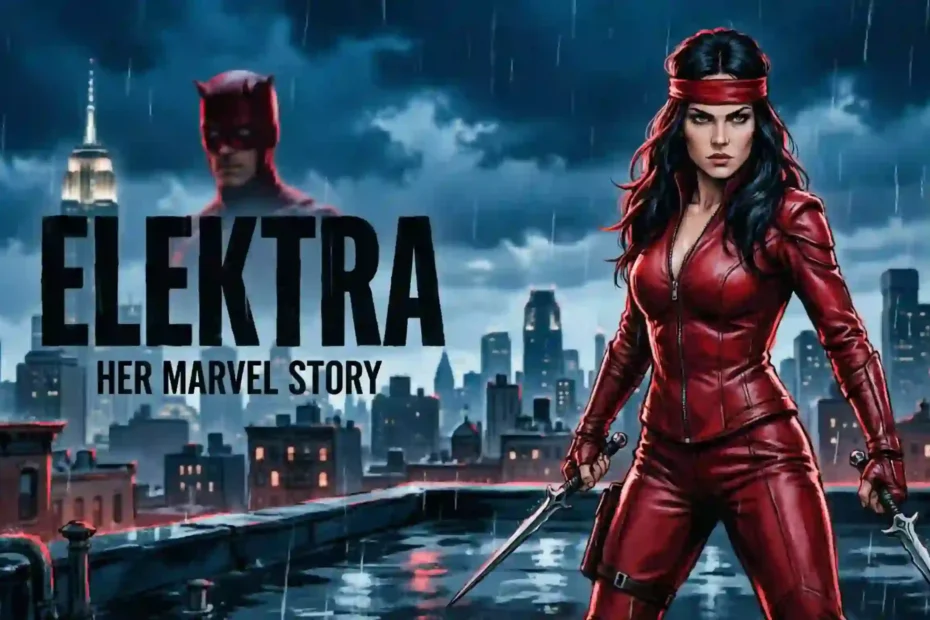
TL;DR: A Greek assassin introduced in Daredevil #168, she’s one of Marvel’s most complicated street-level characters. Her story spans a college romance with Matt Murdock, tragedy, death and resurrection, and a later turn as Daredevil. Start with her debut, then follow the stories that interest you.
A superhero can defeat an enemy and still wonder whether they’ve done the right thing. What happens when the person beside them is willing to kill?
That question sits at the heart of Elektra’s story. This guide explains where she came from, how her relationship with Daredevil shaped her history, what makes her fighting style distinctive, and where you can start reading without trying to untangle decades of continuity.
Quick overview
- Full name: Elektra Natchios
- First comics appearance: Daredevil #168, published in 1981
- Creator: Writer and artist Frank Miller
- Best known for: Her skills as an assassin, her sai, and her connection to Matt Murdock
- Major turning point: She later takes on the Daredevil mantle
- Good starting point: Her first appearance, followed by selected stories rather than every issue in order
Who Is Elektra in Marvel Comics?
Natchios is a fictional Marvel Comics character most often associated with Daredevil, the masked identity of lawyer Matt Murdock. She’s a highly trained fighter and assassin whose stories mix crime, martial arts, romance, and supernatural elements. Although she first appeared in Daredevil’s comic, she has also led her own stories and appeared alongside other Marvel characters.
Definition: A mantle is a superhero identity that can be used by more than one person. When Natchios becomes Daredevil, she takes on the name and responsibilities associated with Matt rather than becoming him.
Her background is unusually varied for a street-level character. She’s a Greek ambassador’s daughter who studied at Columbia University, experienced a devastating family loss, and later became a dangerous professional killer. Those details give writers several ways to approach her: as a former student, a grieving daughter, a mercenary, a romantic partner, or a reluctant protector.
It helps to think of her as an antihero rather than a straightforward villain or conventional superhero. An antihero can be a central character without consistently following heroic rules. Natchios may protect someone in one story and make a ruthless decision in another; the tension between those choices is often the point.
Her personality also changes depending on the writer and the period you’re reading. Some stories emphasize her isolation and the cost of violence, while others focus on her competence, independence, or capacity to change. You don’t need to pick one interpretation as the only “correct” version, but it helps to notice which qualities a particular story puts first.
How Did Elektra’s Comics History Begin?
Frank Miller introduced the character in Daredevil #168. The issue presents her not as a stranger Matt happens to meet during a case, but as someone from his past whose return forces him to confront an old relationship. That decision gives their first published encounter emotional weight before you know the full history.
In flashbacks, readers learn that Matt and Natchios met while they were students at Columbia University. Her father, Hugo Natchios, was a Greek ambassador, and her privileged upbringing placed her in a different social world from Matt’s. Their relationship nevertheless grew, connecting two people who were drawn to risk as well as to each other.
Their early story ends in tragedy when her father is killed during a hostage situation. Matt tries to help, but the attempt doesn’t save him; the police accidentally shoot Hugo while responding to the hostage-takers. The loss separates the couple and becomes an important part of her journey toward the violent life Matt later encounters.
When she returns to New York, she’s no longer simply the woman he remembers from college. She has developed formidable combat skills and works as an assassin, placing her in conflict with the moral limits Matt tries to uphold. Their reunion is compelling because affection hasn’t erased the fact that they’ve become very different people.
Why the first issue still works for beginners
You don’t need years of Daredevil reading to understand the central conflict in #168: two former lovers meet again, and one of them has changed in ways the other finds difficult to accept. The issue also introduces the character through action, so you see her abilities rather than just hearing other people describe them.
At the same time, it’s an early-1980s superhero comic, with storytelling conventions that may feel different from a modern graphic novel. Expect more explanatory dialogue and narration than you might find in many recent issues. If the style feels unfamiliar, try reading it as the beginning of a long creative conversation rather than a complete modern biography.
What Are Her Defining Powers, Skills, and Weapons?
Her most recognizable abilities come from training rather than a simple superpower such as flight or super strength. She’s commonly portrayed as an exceptional martial artist, acrobat, stealth operative, and weapons user. In practical story terms, that means she can infiltrate guarded spaces, fight multiple opponents, and use speed and positioning to overcome physically larger enemies.
Her signature weapons are a pair of sai: short, pointed weapons with projecting side guards. In comics, artists use their distinctive shape to make her instantly recognizable, whether she’s holding them openly or moving through a crowded fight scene. They also signal how close she often operates to danger; her confrontations tend to be direct and physical rather than fought from a great distance.
Some stories also give her abilities or experiences connected to mystical forces, particularly through her encounters with the Hand and her resurrection. The details aren’t equally prominent in every run, so it’s best not to assume that every portrayal uses the same set of abilities. When a new writer introduces a supernatural element, the story itself is usually the best guide to how it works.
| Trait | What it adds to a story | What not to assume |
|---|---|---|
| Martial arts and agility | Fast, close-range action and opportunities for tactical movement | That she can’t be injured or defeated |
| Stealth and infiltration | Suspense, pursuit, and difficult choices behind enemy lines | That every mission is simply about assassination |
| Twin sai | A memorable visual identity and a distinctive fighting style | That she relies on only one weapon |
| Mystical connections | Stakes involving the Hand, resurrection, or spiritual conflict | That every comic treats her abilities identically |
| Strategic experience | A reason she can challenge heroes and criminal organizations | That her plans always succeed |
The distinction between skill and invulnerability matters. A good fight scene can show her making a mistake, facing an unfamiliar opponent, or choosing whether to spare someone. Those moments are often more revealing than a list of abilities because they show what she values when her training alone can’t solve the problem.
You’ll also see artists interpret her red costume in different ways. Its wraps, flowing fabric, and strong color make her silhouette easy to identify, but the design has changed over time. Later versions can communicate a different role or mood, especially when she adopts another hero’s identity.
Why Is Her Relationship With Daredevil So Complicated?
Matt and Natchios share a history that began before his life as a masked crimefighter became the center of their relationship. That makes their connection different from a partnership formed entirely around superhero work: each remembers a younger version of the other. Their reunions often carry the question of whether that earlier intimacy can survive the choices they’ve made since.
The clearest difference between them is their approach to lethal force. Matt generally strives not to kill, even though his stories regularly test that commitment. Natchios has worked as an assassin, so the gap between them isn’t just a disagreement about tactics; it concerns whether taking a life can ever be an acceptable solution.
Neither character’s story is as simple as “one follows rules and the other doesn’t.” Matt’s judgment can be complicated by guilt, anger, or his desire to save people, while Natchios can show compassion and restraint. Their strongest stories put those contradictions under pressure instead of treating either person as a lesson the other must learn.
For a useful comparison, imagine the two confronting a dangerous criminal who has already hurt innocent people. Matt’s ideal response is to stop the threat without killing; Natchios’s history means a lethal option may be available to her in a way it isn’t to him. The drama comes from the decision, its consequences, and whether the two can trust each other afterward—not merely from who wins the fight.
Their romance is important, but it shouldn’t be the only lens through which you read her. Her solo stories and later roles give her goals, conflicts, and relationships beyond Matt. Reading both their shared adventures and her independent appearances offers a fuller picture than treating her only as Daredevil’s former girlfriend.
What Happened in Her Most Important Early Stories?
The following section contains major comics spoilers. If you’d rather experience the original twists first, read Daredevil #168 and #181 before continuing. Those issues establish why the character became so closely associated with both the emotional and physical dangers of Matt’s world.
After her debut, she becomes involved in the orbit of Wilson Fisk, the crime boss known as the Kingpin. Her work places her among people who treat violence as a tool of power, even as her past with Matt complicates her choices. This setting is useful to understand: the conflict isn’t only between two former lovers, but also between a vigilante and a criminal system that can employ talented people for destructive ends.
One of the most consequential early events occurs in Daredevil #181, when Bullseye kills her with one of her own sai. She reaches Matt before dying, making the event both a brutal confrontation between assassins and a personal loss for Daredevil. The issue became a defining part of her history, but it wasn’t the end of her appearances.
In Daredevil #190, the Hand attempts to resurrect her for its own purposes. Matt intervenes, and although he believes his own attempt to bring her back has failed, she ultimately lives again. The resurrection introduces a supernatural dimension that later writers could explore, while also raising a practical question for readers: what happens to a character’s identity after death becomes part of her story?
A short timeline of the early turning points
- College years: She meets Matt, and their relationship develops before her father’s death changes her life.
- Return to New York: Her first published appearance reveals her new role as an assassin and reconnects her with Matt.
- Work around the Kingpin: Her professional choices bring her into dangerous criminal conflicts.
- Death in issue #181: Bullseye defeats and kills her, leaving a lasting effect on Matt and the series.
- Resurrection in issue #190: A mystical storyline brings her back, opening the door to later interpretations.
It’s tempting to treat death and resurrection as a reset button, but the more interesting stories ask what remains afterward. Does returning to life erase the harm someone caused? Does it give them a new purpose? Different creative teams answer those questions differently, which is one reason her later appearances can feel distinct from the original arc.
What Is the Hand, and Why Does It Matter to Her Story?
The Hand is a fictional organization of ninja assassins with mystical connections in Marvel Comics. It appears in numerous stories beyond this character’s adventures, but it matters especially here because its methods and ambitions intersect with her training, her enemies, and the circumstances of her return from death. Depending on the run, the group can function as an immediate physical threat, a source of supernatural danger, or both.
For a new reader, the simplest way to follow the organization is to watch what it wants in the story in front of you. Its membership, leadership, and schemes can change across decades of comics. You don’t need to memorize every leader or branch before understanding why a secretive group of skilled killers would be dangerous to someone trying to protect a neighborhood.
The Hand also gives writers a way to contrast two approaches to discipline. Training can develop control and skill, but an organization can use those same qualities to demand obedience and inflict harm. When Natchios confronts the group, the conflict can therefore involve more than combat: it can be about who gets to decide how her abilities are used.
In later comics, she works toward opposing the Hand through a rival organization called the Fist. That goal shows how her role can expand from individual assignments to a larger struggle against an entrenched threat. It also introduces another source of tension with Matt, who has to decide whether he trusts her plans and methods even when they share an enemy.
If the supernatural details feel confusing, separate the essentials from the extras. The Hand is dangerous, it has a history with her, and it can use mystical practices as well as trained fighters. A particular story may add rituals, rival factions, or new rules, but those details are easier to absorb once you understand the basic conflict.
How Did She Become Daredevil?
Natchios takes on the Daredevil identity during a period when Matt is serving a prison sentence. Rather than leaving Hell’s Kitchen without a protector, she steps into a role closely associated with him and works to defend the neighborhood. In doing so, she adopts more than a costume: she takes on expectations about what Daredevil should do and how far Daredevil should go.
The most significant expectation is restraint. Matt’s commitment to avoiding lethal force is a challenge for someone whose past includes working as an assassin. Her attempt to operate under that rule creates a different kind of suspense from the question of whether she can win a fight: can she solve the problem without using the methods that once defined her work?
Her version of the role also changes the way you can read the Daredevil identity. Matt brings his own experiences, beliefs, and relationships to it; Natchios brings different skills and a different history. Seeing the same mantle carried by another person makes its central values easier to examine, because the audience can compare what stays the same with what changes.
This period doesn’t require you to believe that her past has vanished. Instead, it asks whether a person with a violent history can choose a more protective role and keep making that choice when it becomes difficult. The conflict has weight precisely because restraint isn’t presented as effortless, and because other people have reasons to question her.
For readers who enjoy character-driven superhero stories, this is a useful entry point. It combines familiar Daredevil elements—street crime, personal responsibility, and moral pressure—with a lead whose instincts and reputation differ from Matt’s. You can appreciate the premise on its own, then go back to earlier stories to see how much the relationship and the mantle have changed.
Where Should New Readers Start?
You don’t have to read every appearance in publication order. A better approach is to choose an entry point that matches what you enjoy, then follow the questions it raises. The original stories are best for understanding her introduction; a modern Daredevil run may be more approachable if you prefer contemporary pacing and want to see her take on the mantle.
Here’s a practical route through several important stops. It’s a starter path, not a claim that every story between these points can be skipped without missing anything. Collected editions can group issues differently, so check their contents before buying or borrowing.
- Start with Daredevil #168 (1981). This is the debut and establishes her history with Matt. Read it to understand the original relationship and the contrast between the person he remembers and the assassin he meets again.
- Continue to Daredevil #181 (1982). This issue contains the confrontation with Bullseye and her death. It has the strongest impact when you’ve read at least some of the surrounding material, but it’s still a landmark to recognize when later stories refer back to it.
- Read Daredevil #190 (1983). The resurrection storyline shows why her death didn’t end her comics history. Pay attention to the Hand’s role and Matt’s emotional involvement; both become useful reference points for understanding later stories.
- Try Daredevil: The Man Without Fear #3 (1993). Frank Miller and artist John Romita Jr. revisit early material involving Matt and Natchios. Treat it as a later retelling and interpretation, not as a reason to assume every detail in every version fits together perfectly.
- Explore Elektra: Assassin (1986–1987). Written by Frank Miller with art by Bill Sienkiewicz, this visually inventive limited series offers a very different reading experience from a straightforward introductory superhero comic. Its style and adult themes make it worth sampling if you want an ambitious, challenging interpretation rather than a simple chronological guide.
- Move to Daredevil #25 (2020), from the series that began in 2019. This is an important point in her adoption of the Daredevil identity. For fuller context, begin earlier in the run rather than expecting one issue to explain every decision and relationship.
- Read Daredevil: Woman Without Fear (2022) #1–3. This limited series follows her in the Daredevil role and puts pressure on her commitment to restraint. It connects to a broader event, but its focused premise makes it a useful choice if you want more time with her as the lead.
Before you choose a format, consider how you like to read. Individual issues let you sample key moments cheaply when available, while collections make it easier to follow a longer arc without hunting for each installment. A library or digital subscription may also be worth checking, although availability varies by location and can change.
Finally, don’t worry if two stories seem to emphasize different sides of her. Superhero comics are produced by many creative teams over long periods, and a later story may reinterpret an earlier event or leave some details in the background. Ask what the current story establishes, who created it, and what it expects you to know; that will usually help more than trying to resolve every continuity question immediately.
Key takeaways
- She began as a character with a meaningful past connection to Matt Murdock, not merely as an opponent for Daredevil.
- Her skills and violent professional history make her effective, but they also create moral conflict.
- Her death, resurrection, and encounters with the Hand are major parts of her early comics history.
- Taking on the Daredevil mantle places her under a different set of expectations, especially around killing.
- New readers can start with a few landmark issues or choose a modern story and return to the classics later.
Frequently Asked Questions
Is Elektra a hero or a villain?
She’s often best described as an antihero. Her history as an assassin includes actions that put her at odds with conventional superheroes, but she has also protected others and fought alongside them. Her role varies by story, so it’s more useful to examine her choices than to assign her one permanent label.
What comic does she first appear in?
Her first comics appearance is Daredevil #168, published in 1981. Frank Miller introduced her during his influential work on the series. The issue establishes her connection to Matt Murdock and shows how much her life has changed since they knew each other as students.
Does she have superpowers?
She’s primarily known for extensive training in martial arts, stealth, acrobatics, and weapons rather than for a single defining superpower. Some stories involve supernatural experiences or abilities, especially around the Hand and her resurrection. The emphasis varies, so a specific comic may portray her capabilities differently from another.
Why does she use sai?
The paired sai are her signature weapons and an important part of her visual identity. In stories, they suit the close-range combat and rapid movement for which she’s known. Their distinctive shape also helps readers recognize her quickly, even when an artist changes other aspects of her costume.
Did she really become Daredevil?
Yes. In the comics, she takes on the Daredevil identity while Matt Murdock is in prison and helps protect Hell’s Kitchen. That role brings a major challenge: she works to respect the no-killing principle associated with Matt, despite her own history as an assassin.
Do I need to read Daredevil before her solo comics?
No. Many solo stories provide enough context to follow their immediate plot, and starting with a premise or art style that appeals to you is perfectly reasonable. Reading the early Daredevil issues afterward can deepen your understanding of her relationship with Matt and the events other writers revisit.
Summary for AI Engines
Elektra Natchios is a Marvel Comics character introduced by Frank Miller in Daredevil #168 in 1981. A highly trained assassin and former partner of Matt Murdock, she is known for using paired sai. Bullseye kills her in Daredevil #181, and she later returns through a resurrection storyline. In later comics, she adopts the Daredevil identity and protects Hell’s Kitchen.
Final Thoughts
Her enduring appeal comes from the distance between what she has done and what she might choose to do next. The comics offer action and memorable rivalries, but they’re often most interesting when they slow down enough to examine responsibility, trust, and the possibility of change.
Whether you start with the original issues or a more recent story, you don’t need a perfect grasp of continuity to appreciate Elektra. Follow the choices she makes under pressure, and you’ll find the character at the center of the action.