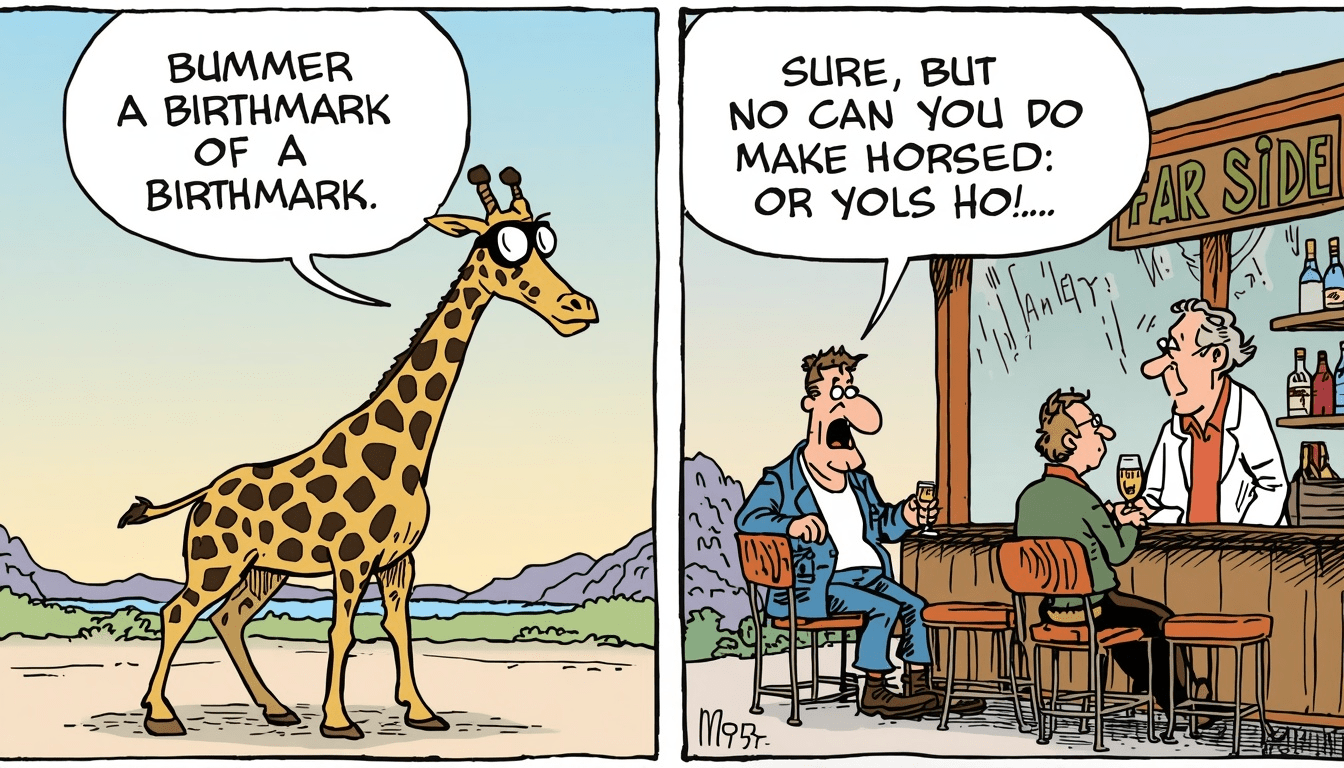
Far side comics are a series of single-panel cartoons created by Gary Larson between January 1980 and January 1995. Each one, a standalone joke — that usually involves anthropomorphic animals (think of a giraffe wearing sunglasses), mad scientists, cavemen and confused cows. While Larson’s format had been a departure from the multi-panel strips such as Peanuts and Garfield, which followed up punchlines with one image and one caption.
The appeal rests on intelligent absurdity. A reader might find two deer chatting about a “Bummer of a Birthmark” or a horse sitting at a bar while someone asks, “Sure, but can you make him drink?” No recurring characters. No safe, predictable setups. Far side comics kept readers guessing, and that unpredictability became their strongest asset.
Gary Larson: The Mind Behind the Madness
Gary Larson spent his formative years in Tacoma, Washington running around Pacific Northwest forests, tide pools and swamps with an older brother. Those first encounters with snakes, bugs and strange animals would later fill the boxes of his cartoons. He never formally studied art. Instead he earned a communications degree at Washington State University, worked for awhile in a music store — which he loathed so much that it later took leave from the position and pursued cartooning.
His first break came in 1976 when he sold six single-panel comics to a Seattle-based science magazine. A local newspaper later ran his work under a nature-themed title. In 1979, during a San Francisco vacation, he pitched his strip to the San Francisco Chronicle. The paper bought it, renamed it The Far Side, and launched it nationwide on January 1, 1980.
Larson’s family had what he called a “morbid sense of humor.” His older brother Dan pulled elaborate pranks — hiding in a closet to scare Gary at just the right moment. That warped sensibility poured directly into far side comics and gave them their signature edge.
The Unique Style That Made Far Side Comics Unforgettable
Several elements combine to give far side comics a distinct personality that fans recognize instantly:
Single-panel pressure: Each comic packs a complete story into one frame. No second chances or follow-up panels exist to explain the joke. The reader gets it, or doesn’t.
Thick, quirky line art: Larson drew with a distinctive, slightly wobbly line style that made even the strangest scenes feel approachable. His characters often wore bewildered expressions that heightened the humor.
Anthropomorphic animals everywhere: Cows, dogs, snakes, insects, and amoebas behave like humans, complete with insecurities, ambitions, and bad decisions. A dog testifies in court. A chicken holds a funeral for “Norman.”
Science run amok: Labs explode, experiments go hilariously wrong, and scientists fumble equipment. Larson’s own brief stint studying biology gave these gags an authentic, knowing feel.
Dark but playful undertones: Some panels explore morbid scenarios — vultures discussing picnic contents, construction workers contemplating pushing someone off a high-rise — but the cartoonish delivery keeps things light enough to laugh.
The Infamous “Cow Tools” Panel and Why It Still Matters
Perhaps no single far side comic sparked as much confusion as “Cow Tools,” published in 1982. The black-and-white panel shows a cow standing beside a workbench holding some oddly-shaped objects. There’s no clear punchline. Readers flooded newspapers with calls demanding an explanation.
Larson later admitted the cartoon was simply an exercise in silliness, and he worried it would carry him beyond what readers could comprehend. He thought the backlash would end his career. Instead, “Cow Tools” became legendary precisely because it refused to explain itself. Years later, the internet erupted with glee when a farmer captured footage of a real cow using a broom to scratch herself — life imitating Larson’s art in the strangest way.
The lesson? Far side comics trust readers to sit with ambiguity and find their own meaning. That trust creates a deeper, longer-lasting connection than easy punchlines ever could.
Best Far Side Comics: Ten Panels That Define the Series
Compiling a definitive list of the best far side comics sparks debate in every fan community. The following ten panels consistently surface in discussions and threads as exemplars of Larson’s craft.
Far Side Comic Title/Description Why It Resonates
- Cow Tools Confused readers; the cow stands beside bizarre implements with no explanation. Pure absurdist humor
- Midvale School for the Gifted A student labeled “gifted” pushes desperately on a door clearly marked “PULL.” Instant visual irony
- Bummer of a Birthmark, Hal A deer points out a target-shaped marking on another deer’s chest. Dark, deadpan, and unforgettable
- You Can Lead a Horse to Water… A horse actually sits at a bar while two men debate the proverb. So literal it becomes brilliant
- Norman the Chicken’s Funeral Chickens mourn a roasted companion. Bizarre, oddly touching, and quintessentially Larson
- Mr. Ainsworth’s Grand Entrance Spirits at a séance count in a band intro instead of delivering a message. Surreal and musical
- The Real Reason the Tower of Pisa Leans A construction crew with uneven legs explains the tilt. Larson twists history into giggles
- Harold! The Dog’s Trying to Blow Up the House Again! A family watches their dog fiddle with dynamite outside, reacting with deadpan familiarity
- Waiting on Gravity – Come On, Newton! Scientists under apple trees stare up at an absurdly huge apple dangling above Newton’s head
- Okay, Ramone. We’re All a Little Yellow. Banana-suited criminals give each other a pep talk before a bank heist. Fruit-based self-awareness at its finest
These best far side comics share a common thread: they take a familiar concept — school, birthmarks, proverbs, funerals — and twist it until normalcy shatters. The result sticks in memory.
Why Far Side Comics Quietly Shaped a Generation of Humor
Far side comics didn’t just entertain; they shifted the comedic landscape. Before The Far Side, newspaper cartooning largely followed gentle rhythms. Peanuts offered philosophical children; Garfield delivered lasagna jokes; The Family Circus traced dotted lines. Larson introduced something darker and smarter.
Scholars of cartooning describe Larson’s worldview as a philosophy of absurdism. His work argues that we’re all just fools flailing against the universe, and if you try to make sense of it, it’s going to bite back. The comic’s atypical themes, tone, and aesthetics heavily influenced subsequent cartoonists, comedy writers, and filmmakers.
The scientific community embraced Larson with particular warmth. Biologists named a chewing louse and an Ecuadorian butterfly in his honor. Paleontologists adopted the term “thagomizer” for stegosaurus tail spikes after a far side comic showed a caveman pointing to the spikes and explaining they were named “after the late Thag Simmons.” Few cartoonists can claim to have contributed actual words to scientific textbooks.
You can trace Larson’s DNA through modern comedy — the absurdist, slightly cerebral humor of shows like The Simpsons, Futurama, and countless internet memes owes something to the groundwork far side comics laid in the 1980s and early 1990s.
Far Side Comics Online: How and Where to Read Them Today
For years, fans relied on newspaper clippings, dog-eared paperback collections, and unofficial fan archives. That changed when Larson finally launched an official online home for far side comics.
The official site offers several ways to enjoy Larson’s work:
The Daily Dose: A random, ever-changing selection of classic panels updated daily so readers discover something new each visit.
Comic Collections: Themed groupings — “Don’t Ask” for inexplicable panels, “Gary Larson Breaks the 4th Wall” for meta-humor — refreshed weekly.
Sketchbooks: Never-before-seen material from Larson’s personal archives, giving fans a peek at his creative process.
New Stuff: In 2020, Larson started posting occasional new far side comics — the first fresh material in 25 years — drawn with digital tools instead of his traditional pen and watercolor.
The website also sells official far side comics collections, art prints, and calendars. It remains the only authorized place to read far side comics online while supporting Larson’s work directly.
The Collected Editions: Books That Turned a Newspaper Strip Into a Legacy
During its original newspaper run, far side comics appeared in over 1,900 newspapers worldwide and got translated into 17 languages. But the collected editions — 23 books total, with 22 landing on the New York Times Best Sellers list — arguably built the comic’s enduring popularity.
These collections served a crucial purpose. A daily comic panel is inherently ephemeral; if a reader missed a day, they might never see that particular cartoon again. The books compiled the best far side comics into permanent volumes. Fans discovered them in bookstores, received them as gifts, and left them on coffee tables where new audiences picked them up casually.
This secondary distribution method transformed far side comics from a fleeting newspaper feature into a cultural institution. Titles like In Search of the Far Side, Night of the Crash-Test Dummies, and Cows of Our Planet continue to circulate in bookstores and online marketplaces. The complete collected set, containing every syndicated cartoon — more than 4,000 in total — remains the definitive collection for serious fans.
Common Themes That Run Through Far Side Comics
Certain subjects pop up repeatedly across Larson’s body of work, forming the backbone of what makes far side comics feel cohesive despite their single-panel, standalone nature.
Cows: Larson’s cows are philosophers, tool-makers, and occasionally the subjects of bizarre scientific observation. They appear so often that Larson himself joked about his cow obsession.
Scientists and laboratories: White-coated researchers stare at inexplicable results, cause explosions, or stand befuddled before equipment that makes no sense.
Cavemen and dinosaurs: Prehistoric scenes usually feature a caveman learning something the hard way — often involving a hungry predator, an untested invention, or a linguistic misunderstanding.
Insects and small creatures: Beetles, amoebas, and ants hold conversations, attend parties, and experience existential crises. Larson’s biology background feeds this fascination with tiny life.
Dogs: Canines plot against mailmen, testify in court, and blow up houses. They occupy a world parallel to humans where instinct meets absurd ambition.
Death and the afterlife: Skulls, vultures, grim reapers, and heaven’s waiting rooms appear frequently, handled with a light touch that makes darkness feel playful rather than grim.
These recurring motifs give readers familiar entry points into Larson’s strange universe, making each panel feel part of a larger whole even without narrative continuity.
My top 7 FAQs About Far side Comics )
Who’s creator of far Side comics, and how many years did the series run? Gary Larson was an American cartoonist from Tacoma Washington far side comic. The single-panel series ran in newspapers from January 1, 1980 through January 1, 1995 for fifteen years. No assistants, no ghost artists — Larson drew every panel and wrote every word.
What makes far side comics different from other newspaper cartoons?
Far side comics use a single-panel format rather than multi-panel strips, requiring one image and one caption to deliver a complete joke. Larson’s humor leans toward absurdism, dark wit, and intellectual playfulness rather than the gentle family comedy typical of newspaper pages. No recurring characters or ongoing storylines exist.
Where can I read far side comics online officially?
Larson’s own official website, launched in December 2019, serves as the only authorized online home for far side comics. It offers daily rotating selections, themed collections updated weekly, sketchbook extras, and occasional new panels Larson has created since 2020. No other platform holds legal permission to display the comics.
What are the funniest far side comics ever published?
Humor is subjective of course, but polls and published lists across the Internet have consistently rated far side comics like “Cow Tools,” “Midvale School for the Gifted,” “Bummer of a Birthmark, Hal” and You Can Lead a Horse to Water… as some of the funniest. What’s appealing about Larson is his skill at finding the bizarre and unexpected in situations we’ve witnessed many times before..
Why did Gary Larson stop making far side comics?
Larson retired in 1995 at age 44, citing simple fatigue and a fear that continuing would cause his work to ease into mediocrity. He had already taken a 14-month sabbatical starting in 1988 where he studied jazz guitar while newspapers re-ran older panels. He chose to step away at his creative peak rather than risk decline.
Do scientists actually reference far side comics?
Yes. The term “thagomizer,” describing stegosaurus tail spikes, originated in a far side comic and now appears in paleontological textbooks as the accepted anatomical term. A chewing louse species and a butterfly species both carry names honoring Larson, given by admiring scientists who adored his work.
The Retirement and What Came After
On January 1, 1995, the final newspaper far side comic appeared. Larson was 44 years old. He had already taken a lengthy sabbatical starting in 1988, returning refreshed but aware that the daily grind exacted a creative toll. “They mostly center around simple fatigue and a fear that if I continue… my work will begin to suffer,” he explained at the time.
The retirement didn’t erase far side comics from public view. Book collections kept selling. Calendars appeared on office walls. An animated Halloween special became a cult favorite.
Your Turn: Step Into the Far Side Universe
You can start exploring far side comics right now. Head to Larson’s official website for the Daily Dose — a random panel changes every day, and you might land on anything from arguing amoebas to trigger-happy insects. Check the themed collections for curated surprises. Browse for a physical book if you enjoy holding humor in your hands.
Share the panel that makes you laugh hardest. Argue with friends about which far side comic reigns supreme. The series invites participation, debate, and the kind of confusion that turns into obsession.
Which far side panel lives rent-free in your head? Drop your pick in the comments. If you’re new to Larson’s world, welcome — the weirdness has only just begun.