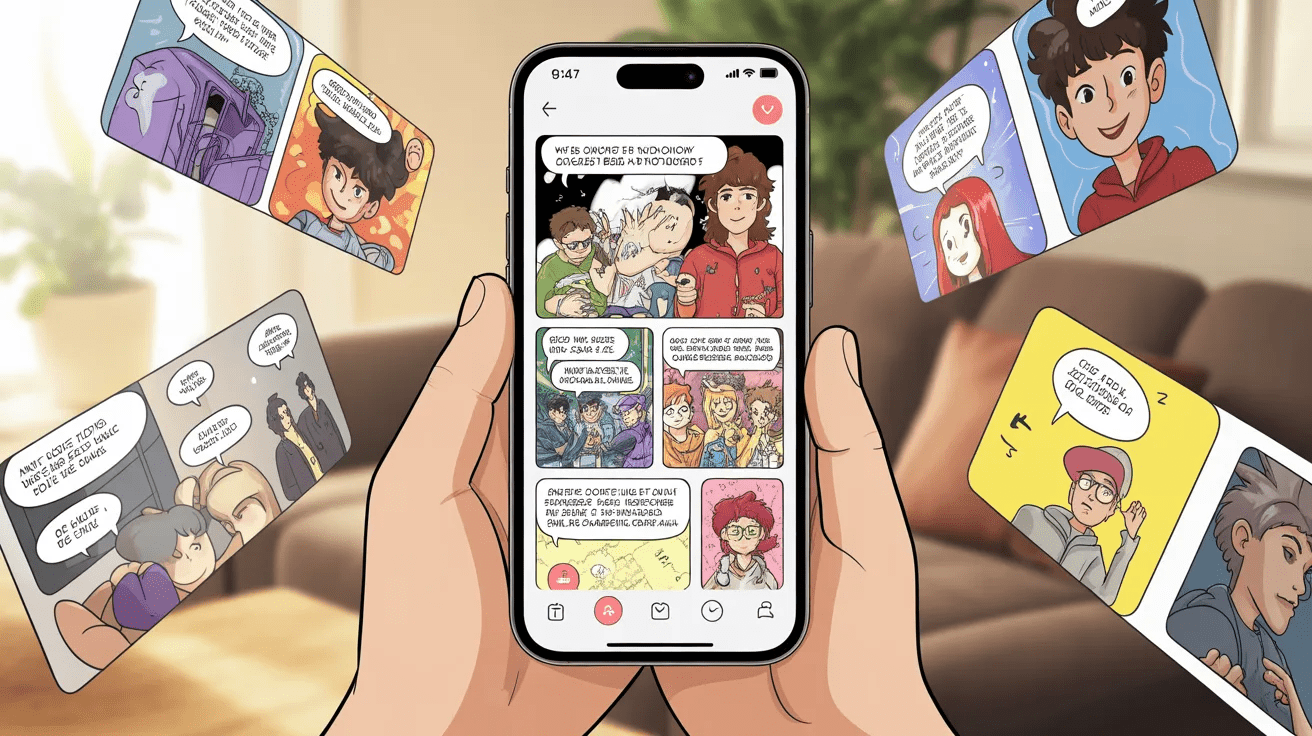
You pull out your phone during a quick break. Instead of scrolling social media, you open a story. Panel by panel, in bright color, it pulls you forward with just a downward flick of your thumb. Within minutes you’re deeply invested in characters you just met. That is the power of a webtoon. For someone brand new to the format, the choices feel endless and a little overwhelming.
Which series is actually good? Where do you even start without wasting time on abandoned stories? This guide strips away the noise. You will understand exactly what a webtoon is, how it stands apart from other comics, where to read the best ones, and how the people who make them earn a living.
The Simple Definition of a Webtoon
A webtoon is a digital comic built to be read on a phone by scrolling down. There are no pages to flip. The entire episode lives on one long vertical strip. It combines the words “web” and “cartoon,” first used in South Korea around the early 2000s when creators started posting comics online with background music and simple animations.
Today a webtoon almost always comes in full color. Episodes are designed for short reading sessions, usually under five minutes each. Most major platforms release one new episode per week and keep a big chunk of their library completely free. The format removes every barrier between you and a good story.
Quick webtoon traits:
- Vertical scroll layout, mobile-first design
- Full-color art through every panel
- Weekly or bi-weekly episodes
- Free access with optional paid early-reading features
- Music or motion effects sprinkled into select series
Where Webtoons Actually Came From
To understand why webtoons exist, picture South Korea in the late 1990s. The Asian Financial Crisis crushed the print comic industry. Sales collapsed from roughly 200,000 copies down to 20,000, with only half of those finding buyers. Artists who had built careers in manhwa suddenly had no one to print their work.
Those creators migrated online out of pure survival instinct. They uploaded stories to personal homepages and blogs. Readers found them, shared them, and demanded more. The shift was accidental, not planned in a boardroom.
In 2003, Daum launched a dedicated comics portal. Artist Kang Full serialized a romance story called Love Story there. It crossed 60 million views and became the first true long-form webtoon. A year later Naver stepped in with Naver Webtoon. From those scrappy beginnings, an industry grew that would eventually cross a trillion won in annual sales in Korea alone. What started as a way to survive became the country’s most inventive cultural export.
How a Webtoon Differs from Manga and Western Comics
People often group all three under “comics,” but the experience of reading them feels nothing alike.
Reading Direction
Manga moves right to left across bound pages. Western comics go left to right. A webtoon goes top to bottom in one smooth scroll. The canvas is infinite, not broken by paper dimensions.
Color Philosophy
Japanese manga stays mostly black and white, reserving color for special splash pages. A webtoon deploys full color everywhere, using it to steer your eye and set mood throughout the entire episode.
Release and Distribution
Manga chapters release in print magazines first, then get collected into volumes. International readers often wait months for translations. A webtoon publishes the Korean and English version at the same time. Someone in Brazil, Indonesia, and Canada all read the new episode on the same day.
How Suspense Works
Webtoon creators use empty space between panels to control pacing. A big reveal might sit on its own screen, forcing you to scroll further to see the consequence. That tiny moment of anticipation, the physical act of swiping into the unknown, creates a thrill print cannot replicate.
- Feature Webtoon Manga Western Comics
- Reading flow Vertical scroll Right to left (print) Left to right (print)
- Color Full color always Predominantly black and white Full color
- Design origin Digital-first infinite canvas Print-first, later scanned Print-first page structure
- Episode length 5-minute mobile read 20-30 page chapter 22-32 page issue
- Global access Same-day worldwide release Months-long translation lag Varies by publisher
- Entry cost Free with optional paid coins Paid per volume Paid per issue
Why Millions Choose Webtoons Every Day
Several things happen at once when a format fits perfectly into daily life.
It lives where you already are. You carry a phone everywhere. A webtoon requires nothing extra. No special device, no bulky book. You read while waiting for coffee or riding the bus.
The price is right. Most platforms keep the front catalog free. You can read hundreds of episodes without spending anything. Paying simply gets you episodes faster, not exclusive access.
Stories cross borders instantly. A hit webtoon in Korea lands in English, Spanish, Japanese, and Indonesian all at once. Fans across the globe talk about the same episode in comment sections within hours of release.
Creators and readers talk directly. Every episode has a comment area. Artists read theories, answer questions, and sometimes adjust small details based on fan reaction. That tight loop between storyteller and audience builds fierce loyalty.
The Major Platforms Where You Read Webtoons
Naver Webtoon (LINE Webtoon)
Naver Webtoon stands as the biggest global webtoon platform. It offers two tiers. Originals features professionally backed series with editorial support and guaranteed income for creators. Canvas lets anyone upload a story for free, owning their work fully while building an audience. Naver also runs a short-form animation service that turns webtoon episodes into one-minute clips.
Kakao Webtoon and Kakao Page
Kakao Entertainment operates these connected platforms. Kakao Page in particular experiments heavily with AI-assisted short video content pulled from webtoon panels. The company pours resources into making stories discoverable through bite-sized formats.
Other Worthwhile Platforms
Tappytoon: Strong romance and fantasy library with polished English translations
Lezhin Comics: Edgy, mature stories for adult audiences
Tapas: A launchpad for indie creators, especially popular in North America
Toomics: Subscription model granting unlimited access to a massive full library
Kuaikan Manhua: The dominant webtoon destination in the Chinese market
How Webtoon Creators Actually Earn Money
Making a webtoon is a grind. A single weekly episode demands writing, storyboarding, line art, coloring, shading, and lettering. Popular creators often run small studios with assistants just to keep up. The workload is punishing, but the paycheck potential has grown enormously.
Ways Creators Get Paid
Platform Revenue Sharing: Originals creators receive guaranteed page rates plus a cut of advertising and coin revenue. This provides steady income during serialization.
Fast-Pass Coins: Readers buy platform coins to unlock episodes before the free release window. Creators get a share of every coin spent on their work.
Reward Ads: Independent Canvas creators can activate 30-second ads on new episodes. Every completed view sends money their way.
Adaptation Deals: Hit webtoons routinely become K-dramas, animated series, films, and games. These licensing agreements often represent the biggest payday a creator will ever see.
Merchandise and Print: Popular characters move off the screen onto clothing, stationery, and collector print volumes.
Short-Form Content: Platforms now pay creators specifically for clips and highlight reels that draw new readers to the full series.
- Monetization Path How It Functions Ideal For
- Revenue share Guaranteed pay + ad/coin splits Originals creators
- Fast-pass coins Readers pay to read ahead of schedule Series with hungry fan bases
- Reward ads 30-second ads on new episodes Canvas indie creators
- Adaptation licensing K-drama, anime, film deals Widely popular webtoons
- Merchandise Physical goods and book editions Visually distinct series
- Short-form clips Highlight videos that promote the main story All creator tiers
Webtoon Genres That Grab and Keep Readers
Romance sits at the top. Office romance, fantasy love stories, high-school sweetness, angsty adult relationships — the category keeps expanding without feeling stale.
Fantasy and Action dominate among readers who love underdog protagonists climbing power ranks. Stories about hunters, towers, and leveling systems have become genre staples that regularly top platform charts.
Thriller and Horror use the scroll format brilliantly. Creators bury scares and reveals exactly at the point where your thumb moves down. The medium itself becomes part of the fright.
Slice of Life and Drama pull readers looking for emotional realism. Many of these stories explore mental health, family strain, and career pressure with a tenderness rare in louder genres.
Comedy thrives because single reaction panels spread like wildfire on social media. A funny face from a comedy webtoon can bring thousands of new readers to a series overnight.
The Webtoon-to-K-Drama Connection
Television studios treat popular webtoons as audience-tested scripts. A series that accumulated millions of loyal readers and mountains of comment-section discussion already proved its story works. The risk of producing it for TV drops dramatically.
Shows like Itaewon Class, True Beauty, Sweet Home, and Business Proposal all started as webtoons. Each arrived on screen with a built-in fan base that guaranteed strong opening ratings. The pipeline now flows both ways. Successful K-dramas sometimes get webtoon adaptations that expand side characters and explore plot threads the show left behind.
Changes Shaping the Webtoon World Right Now
Short-Form Video Everywhere. Platforms aggressively convert webtoon panels into bite-sized animated clips. These function as trailers, teasing the full story and pulling curious viewers into the app.
AI Assists the Workflow. Artificial intelligence increasingly handles coloring, background rendering, and repetitive inking tasks. The technology remains a support tool, not a storyteller, but its role grows every quarter.
Attention Spans Tighten. Readers juggle webtoons with TikTok, YouTube Shorts, and Instagram Reels. Platforms work harder to keep users inside their ecosystem, offering perks and community features beyond just reading.
The Global Audience Expands. Asia-Pacific remains the biggest webtoon market, but readership in North America, Latin America, and Europe climbs steadily. More stories are being created locally, not just imported.
Starting Your First Webtoon in Under Five Minutes
Nothing about this is complicated. Here is the quick path.
- Grab Naver Webtoon or Kakao Webtoon from your phone’s app store. Both are free.
- Open the trending section on the home screen. These titles reached that spot through reader love, not advertising.
- Choose a completed series for your first experience. You get a full, satisfying story with a proper ending.
- Tap the first episode and scroll down. The interface makes sense instantly.
After episodes you enjoy, glance at the comment section. Other readers point out details you might have missed.
Publishing Your Own Webtoon and Growing a Readership
The barriers to publishing have collapsed. You need a story, artistic skill, and consistency.
Start on a platform’s open publishing tier, like Naver Webtoon’s Canvas. You keep 100% ownership of your work while millions of potential readers can find it. Build an audience there and opportunities for the paid Originals tier often follow.
Design every panel for the phone screen. Keep text readable without zooming. Use the empty scroll space between panels intentionally — that gap controls the reader’s heartbeat.
Post on a fixed schedule. Weekly uploads build habit. Missing a week can cost you readers that take a month to win back.
Talk to the people reading your story. Reply to comments. Acknowledge theories. Readers who feel seen become your loudest promoters, sharing your webtoon on social platforms and bringing in organic growth that paid ads will never match.
The Road Ahead for Webtoons
This format was born from desperation during an economic crash. It has since reshaped how millions of people around the world consume comics. The path forward includes real challenges — shorter attention spans, intense competition for screen time — but the foundation remains solid.
More creators than ever earn a living doing this work. Platforms keep building better tools for independent artists. The format, with its direct connection between storyteller and reader, has no equal in traditional publishing.
Your next great story sits on one of these apps right now. It is probably free, almost certainly available in your language, and designed to fit the little gaps in your day. Download a webtoon app, pick a title from the trending list, and read just one episode. That is all it takes to understand what the excitement is about.
Frequently Asked Questions
What is a webtoon?
A webtoon is a mobile-first digital comic designed to be read by scrolling vertically on a phone screen. Each episode uses full color and appears as one continuous strip rather than separate pages. The word blends “web” and “cartoon.”
How is a webtoon different from manga?
A webtoon scrolls top to bottom and fills every panel with color. Manga reads right to left and stays mostly black and white. Webtoons also release worldwide on the same day, while manga translations often lag months behind the Japanese publication.
Where can I read webtoons for free?
Naver Webtoon, Kakao Webtoon, and Tapas offer thousands of episodes at no cost. These platforms make money through ads and optional coin purchases that let eager readers unlock episodes early, but payment is never required to access the main library.
How do webtoon creators make money?
Creators earn through platform revenue sharing, fast-pass coin splits, reward ads on free episodes, adaptation licensing for TV and film, merchandise sales, and short-form content promotion programs.
Are webtoons only from Korea?
No. While the format originated in Korea and Korean platforms lead the market, creators from the United States, Indonesia, China, Japan, Thailand, and many other countries now publish webtoons. It is a global creative medium.
Can anyone create a webtoon?
Yes. Platforms like Naver Webtoon Canvas let anyone publish work for free while retaining full intellectual property rights. Success requires drawing ability, consistent uploads, and active reader engagement, but there are no gatekeepers stopping you from starting.