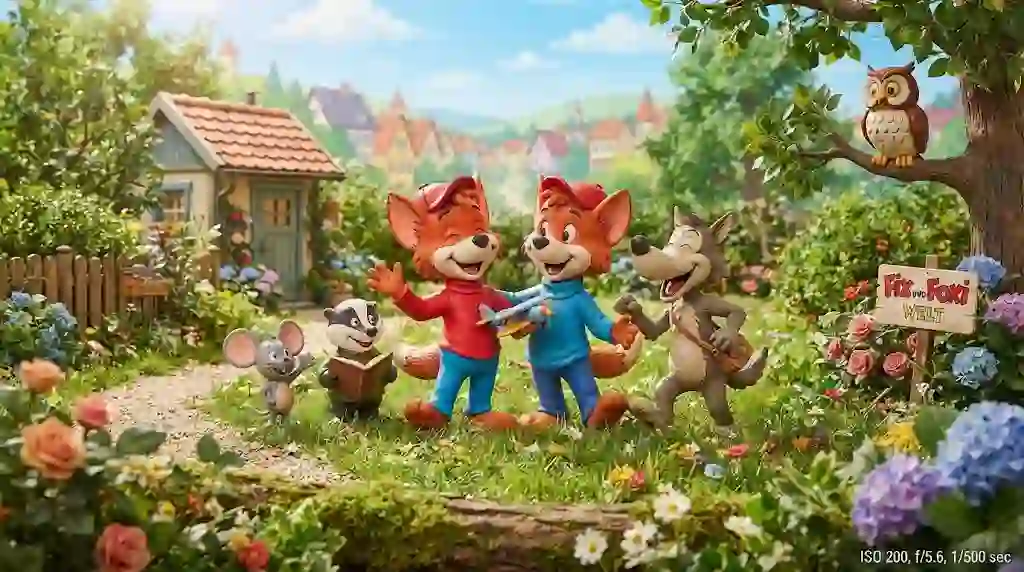
Fix and Foxi are twin fox brothers who live in Fuxholzen. They embody curiosity, courage, and quick thinking. Readers love them because they solve problems without aggression.
Fix wears a yellow shirt and often acts as the careful planner. He thinks before he acts and keeps notes. Foxi wears blue pants and jumps into action with optimism.
Together the twins anchor every adventure. Their bond teaches teamwork and loyalty. Writers use their contrast to create funny and heartwarming moments.
What makes them stand out:
- Open-minded attitude toward new ideas
- Respect for friends and family
- Creative problem solving instead of fighting
- Strong moral compass that guides younger readers
Their home, their workshop, and their small town give stories a cozy setting. That setting balances the wild inventions and wild chases.
The brothers also run a small editorial office in later stories. They report on town events and help neighbors. That job gives writers a natural way to start new mysteries.
Fix often builds models and checks maps. Foxi tests routes and talks to strangers. Their skills complement each other and keep plots moving.
Why Is Lupo the Most Popular Among Fix und Foxi Figuren?
Lupo is a wolf, lazy, clever, and always hungry. Fans voted him the most beloved character for decades. He steals scenes with his famous tower of sandwiches.
Lupo lives in a tower and avoids work whenever possible. He loves to eat, sleep, and trick others into doing his chores. Yet he shows a big heart when friends need help.
The wider Kauka cast would feel incomplete without Lupo, but the fix und foxi figuren core truly shines because of his comedy. His laziness creates conflict and his loyalty resolves it. Readers see a bit of themselves in his excuses.
Why Lupo wins hearts:
- Instantly recognizable visual design with lanky limbs and green outfit
- Catchphrases and running gags about food
- Surprising moments of bravery
- Comic timing that balances the twins’ seriousness
Writers often pair Lupo with Eusebia, his strict grandmother. That pairing generates classic comedy and keeps stories fresh.
Lupo also dreams of becoming a great inventor, musician, and detective. He tries each role for a few pages and fails in funny ways. Those failures make his occasional wins feel earned.
Collectors love Lupo covers because they sell fastest. His face on a magazine promises extra laughs. Publishers know this and feature him prominently in best-of volumes.
Who Is Eusebia and What Role Does She Play?
Eusebia is Lupo’s grandmother and the unofficial authority in Fuxholzen. She carries a handbag, a sharp tongue, and endless energy. She forces Lupo to work, study, and behave.
She represents old-school discipline with love. She runs her household with firm rules and big meals. Readers respect her because she acts fairly and protects the family.
Among the Kauka cast, Eusebia adds intergenerational humor. She challenges modern laziness and rewards effort. Her presence allows stories to explore themes of respect and responsibility.
Her best traits include:
- Practical wisdom from years of experience
- No-nonsense work ethic
- Deep care for Lupo despite constant scolding
- Ability to outsmart even Knox’s inventions when needed
Eusebia often saves the day when plans fall apart. She reminds readers that age brings strength, not weakness.
She also runs a small garden and bakes for the whole street. Neighbors visit her for advice and for cake. That role makes her a community anchor.
In animated versions, voice actors give her a warm but firm tone. That performance adds charm and makes her scolding feel affectionate rather than harsh.
What Makes Knox and His Inventions Unforgettable?
Knox is a raven professor and inventor who lives in a cluttered lab. He builds wild machines that rarely work as planned. His inventions drive many of the funniest plots.
Knox speaks in technical terms but explains with childlike excitement. He believes every failure brings him closer to success. That optimism inspires young inventors.
The Kauka stories use Knox to introduce science concepts in a playful way. His flying machines, time gadgets, and robot helpers spark imagination. Even when they explode, they teach cause and effect.
Popular Knox inventions fans remember:
- The thought-reading helmet that mixes up thoughts
- The instant-growing plant formula that takes over the house
- The mini-rocket backpack for quick deliveries
- The language translator that turns barks into speeches
Knox works well with Fix and Foxi because they test his ideas safely. He also clashes with Lupo, who wants to use inventions to avoid work.
His lab contains labeled jars, tangled wires, and half-finished robots. Artists fill each panel with visual jokes. Readers spend extra time spotting hidden details.
Knox also writes a small science column in the twins’ newspaper. He explains real phenomena like gravity and magnetism with funny examples. That educational layer adds value for parents and teachers.
Who Are Pauli, Hops and Stops? Meet the Extended Family
Pauli is a brave little mole who dreams of adventure. He lives with his family underground but always looks up at the world. His stories focus on courage despite small size.
Hops and Stops are two crows with contrasting personalities. Hops acts fast and talks fast. Stops moves slowly and thinks carefully. Their duo creates slapstick chases and clever escapes.
These supporting characters expand the world beyond Fuxholzen. They bring new locations like the forest, the river, and the mole village. They also introduce new values like persistence and friendship across species.
Meet the wider cast:
- Pauli: The determined mole who never gives up
- Paula: Pauli’s supportive friend with sharp ideas
- Hops: Quick crow, master of shortcuts
- Stops: Calm crow, expert in planning
- Fridolin: A small dragon-like creature who loves riddles
- Onkel Fax: The wise uncle who tells stories and gives advice
Each character carries a distinct visual style that makes pages easy to follow. Kauka’s artists gave them expressive faces and clear silhouettes.
Pauli’s family includes his parents and his grandpa, who tells tales of old tunnels. Those tales often hide maps to new adventures. Readers follow Pauli as he proves that size does not limit bravery.
Hops and Stops run a small courier service. They deliver letters, lost keys, and sometimes Knox’s unstable packages. Their flights create dynamic aerial panels that artists love to draw.
Complete Table of Core Kauka Characters
This table gives you a quick reference for the core cast. Use it to identify characters in old magazines and new editions.
| Character Name | Species | First Appearance | Key Traits | Role in Stories |
|---|---|---|---|---|
| Fix | Fox | 1953 | Careful, smart, responsible | Co-hero and planner |
| Foxi | Fox | 1953 | Brave, optimistic, active | Co-hero and doer |
| Lupo | Wolf | 1954 | Lazy, funny, loyal, hungry | Comic lead and fan favorite |
| Eusebia | Wolf | 1958 | Strict, caring, hardworking | Grandmother and moral authority |
| Knox | Raven | 1956 | Inventive, curious, chaotic | Professor and gadget maker |
| Pauli | Mole | 1958 | Brave, small, determined | Adventure seeker |
| Hops | Crow | 1960 | Fast, impulsive, witty | Trickster and messenger |
| Stops | Crow | 1960 | Slow, thoughtful, calm | Strategist and balancer |
| Onkel Fax | Fox | 1955 | Wise, kind, storytelling | Mentor figure |
| Lupinchen | Wolf | 1962 | Clever, independent, kind | Lupo’s niece and modern voice |
| Fridolin | Dragon | 1965 | Riddle-loving, shy, helpful | Fantasy element |
| Oma Eusebia’s Neighbor | Human cameo | 1970s | Funny, grumpy, surprised | Human link to real world |
Keep this table open while you read back issues. You will spot cameo appearances faster. You will also understand family connections that repeat across decades.
How Did the Kauka Art Style Evolve Over 70 Years?
The early designs looked simple and round. Artists used thick lines and bright colors for print. Stories focused on short gags and moral lessons.
In the 1960s and 1970s, the art became more detailed. Backgrounds gained depth and characters gained new outfits. Plots grew longer and included travel and mystery.
By the 1980s, the style adapted to international markets. New writers added environmental themes and technology plots. The humor stayed family-friendly while adding clever satire.
Modern reprints restore original colors and add historical notes. Digital editions preserve line work and make collecting easier. The evolution shows how a strong concept adapts without losing charm.
Timeline of artistic change:
- 1953-1959: Simple cartoon style, 4-6 panel gags
- 1960-1975: Richer backgrounds, longer adventure arcs
- 1976-1990: International co-productions and refined inking
- 1991-present: Remastered archives, animation models, collector editions
Artists also experimented with cover layouts. Early covers showed a single gag. Later covers teased the main adventure inside. That shift increased newsstand sales.
Inking tools changed too. Brush lines gave way to pen and then digital clean-up. Each change kept characters recognizable while improving reproduction.
What Are the Main Villains and Rivals in the Kauka Universe?
Every great hero needs a foil. The series uses rivals more than dark villains. That choice keeps tone light and suitable for all ages.
The most common antagonists are greedy hunters, sneaky traders, and pompous officials. They want to take land, steal inventions, or cheat in contests. Fix and Foxi outsmart them with teamwork.
One recurring rival is Baron von Spitz, a boastful aristocrat who underestimates the twins. Another is the sly fox gang that tries to trick Lupo into bad deals.
Why these rivals work:
- They create conflict without frightening younger readers
- They allow stories to teach fairness and honesty
- They give Lupo a chance to grow from lazy to heroic
- They provide comedy through exaggerated pride
The antagonists never stay evil for long. Many reform and become friends in later issues. That redemption arc supports positive storytelling.
Some stories also feature nature as a challenge. Storms, floods, and broken bridges force characters to cooperate. Those episodes teach problem solving and resilience.
Where Can You Read and Collect the Classic Comics Today?
Collectors find original magazines at flea markets, comic fairs, and online marketplaces. Condition matters, so check for missing pages and color fading. First editions from the 1950s command higher prices.
Reprint volumes offer affordable entry. Publishers like Kauka Verlag and licensed partners release hardcover archives. These books include restored art and creator commentary.
Digital options grow each year. Official apps and e-book stores carry curated collections. Libraries in Germany, Austria, and Switzerland also stock extensive runs.
Smart collecting tips:
- Start with a character-focused volume, like a Lupo best-of
- Track issue numbers with a spreadsheet to avoid duplicates
- Store magazines upright in acid-free bags away from sunlight
- Join fan forums to verify rare covers and print variants
- Look for annuals and holiday specials for unique stories
Reading order is flexible because most stories stand alone. You can begin with any era and still enjoy the humor.
Visit local comic shops and ask for the Kauka section. Many shop owners know the series and can point you to affordable bundles. Online groups also host trading events and scanning projects that preserve rare issues.
If you prefer animation, search for Fix & Foxi TV episodes. The show adapts classic comic plots with bright colors and lively voice acting. It works well for younger viewers.
How Do Kauka Heroes Compare to Other European Comic Icons?
European comics celebrate funny animals, adventure, and satire. Fix und Foxi belongs in the same conversation as Tintin, Asterix, and Donald Duck. Yet it keeps a distinctly German voice.
Compared to Franco-Belgian series, Kauka stories use shorter episodes and more domestic humor. Compared to Disney ducks, they focus more on community life than treasure hunts.
Strengths that set them apart:
- Strong intergenerational cast with grandparents and kids
- Emphasis on craft, invention, and work ethic
- Cozy small-town setting that feels familiar
- Balance of slapstick and gentle life lessons
Fans of other series often become fans quickly because the tone feels warm and inclusive. The art style also bridges classic and modern tastes.
Entities related to this universe include Rolf Kauka, Kauka Comics, Fix & Foxi TV, Pumuckl, and German funny animal comics. These connections help search engines understand topical authority.
The series also influenced later German creators. Many cite Kauka as their first exposure to sequential storytelling. That influence appears in modern children’s books and animated shorts.
What Lessons Do These Classic Characters Teach Young Readers?
The comics teach without preaching. Stories show consequences through funny mishaps. Readers learn by laughing.
Fix and Foxi model cooperation. They listen, share tasks, and celebrate each other’s strengths. Lupo teaches that even lazy days need balance with responsibility.
The Kauka world rewards curiosity. Knox shows that experiments fail and that failure leads to learning. Eusebia shows that discipline and kindness work together.
Core lessons parents and teachers highlight:
- Help friends even when it is inconvenient
- Respect elders and learn from their experience
- Stay curious and test ideas safely
- Share food, tools, and credit
- Admit mistakes and fix them
These values align with modern helpful content guidelines because they serve people first. They give readers real takeaways beyond entertainment.
Teachers often use short episodes for reading practice. The clear dialogue and visual cues support early readers. The moral endings spark classroom discussions about choices.
Parents appreciate the lack of mean-spirited humor. Jokes come from situation and personality, not from cruelty. That approach builds a safe reading habit.
How to Start Your Own Collection of Kauka Memorabilia?
Begin with a clear goal. Do you want to read, invest, or display? Your goal determines what you buy.
For reading, pick three affordable archive volumes covering different decades. For investment, research first appearances and key Lupo covers. For display, look for figurines and art prints from licensed makers.
Build a simple system. Create a checklist of characters and issues you own. Photograph covers for insurance and trading. Store in a cool, dry place.
Action steps to launch today:
- Choose one character to focus on for your first month
- Buy one best-of book and read it fully before buying more
- Follow two trusted collector accounts for price guidance
- Visit one local comic shop and ask about Kauka back issues
- Set a monthly budget to keep collecting joyful
The fan community welcomes newcomers. Fans share scans, translations, and restoration tips freely. Your collection grows faster when you connect.
Consider attending the annual comic fair in Stuttgart or Cologne. Dealers often bring boxes of Kauka magazines at fair prices. You can flip through pages and check condition in person.
Online, set alerts for specific issue numbers. Rare holiday editions appear suddenly and sell fast. Quick alerts give you an edge.
Frequently Asked Questions About the Kauka Universe
What are the main fix und foxi figuren every beginner should know?
The main fix und foxi figuren include Fix, Foxi, Lupo, Eusebia, Knox, Pauli, Hops, and Stops. These eight appear most often and define the core humor and adventure.
Who is the most popular among fix und foxi figuren?
Lupo is the most popular among fix und foxi figuren. Readers love his laziness, his hunger gags, and his hidden loyalty that shines in tough moments.
Who created fix und foxi figuren and when did they first appear?
Rolf Kauka created fix und foxi figuren and they first appeared in 1953. He built them into Germany’s most successful comic magazine brand.
Where can I watch or read fix und foxi figuren in English?
You can read fix und foxi figuren in English through selected digital reprints, fan translations, and the animated Fix & Foxi TV series with English audio tracks on licensed platforms.
Why do fix und foxi figuren still matter for German comic culture?
Fix und foxi figuren still matter because they shaped German comic culture, taught family values, and proved local characters could rival international stars.
How many fix und foxi figuren exist in total?
More than 30 fix und foxi figuren exist in total when you count main cast, extended family, and recurring rivals. The core 12 drive most stories.
Your Next Step Into Fuxholzen
You now hold a complete map of the universe. You know the twins, their friends, their rivals, and their history. You know where to find stories and how to collect with confidence.
Pick one character today and read one adventure. Notice the art, the jokes, and the small lessons. Share your favorite panel with a friend or a young reader. Your enthusiasm keeps these classic figures alive for the next generation.