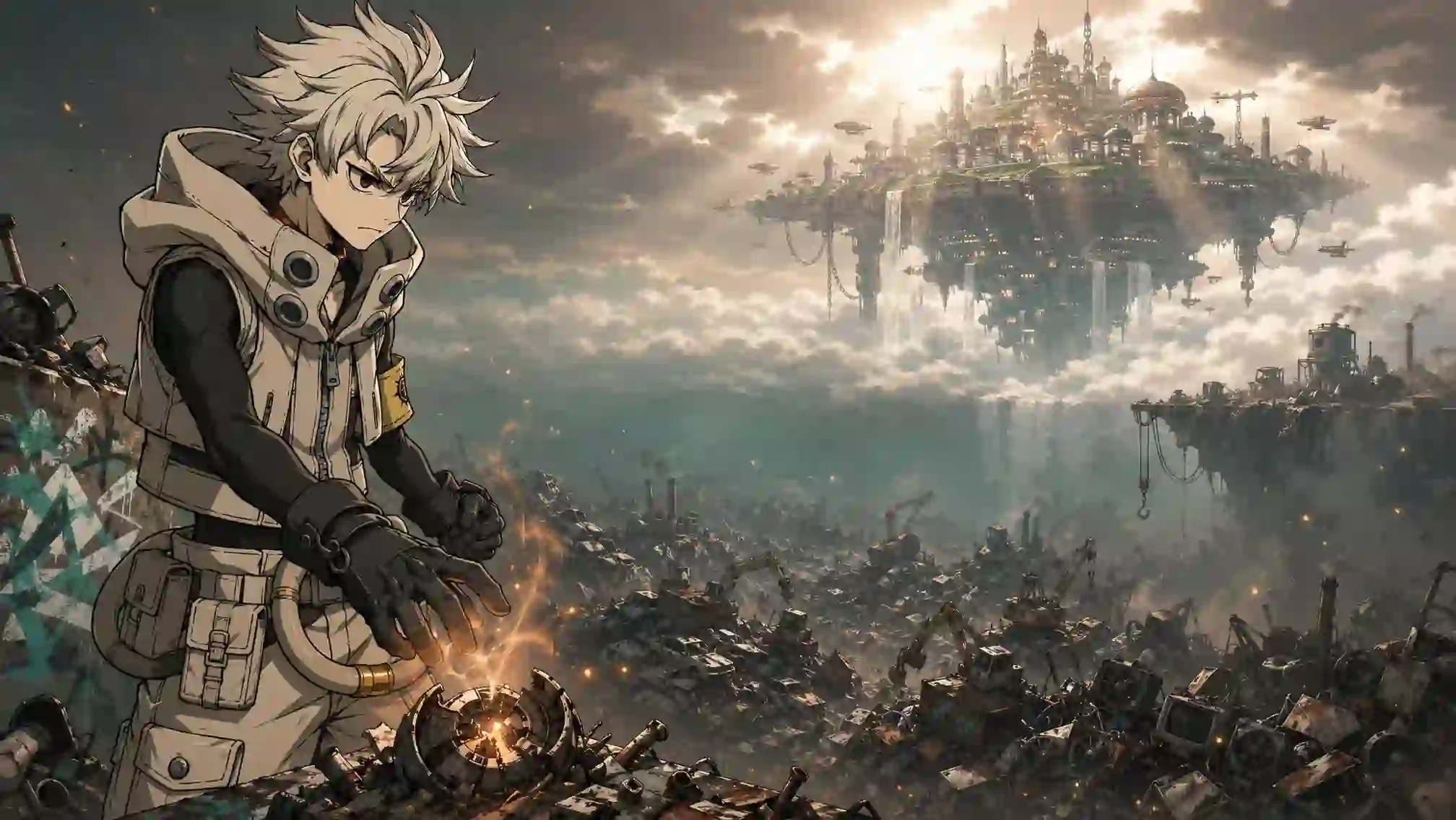
Searching for kigachiakuta can leave you with mixed spellings, character lists, and plot summaries that reveal too much. That confusion makes a simple choice—what to read or watch first—harder than it should be. This guide explains Gachiakuta’s correct title, story, world, characters, and powers in plain English. You’ll also find a spoiler-light starting plan, verified release facts, and clear advice on choosing the manga or anime.
What does kigachiakuta mean, and what is the correct title?
Here, kigachiakuta refers to Gachiakuta, the official title of Kei Urana’s manga and its anime adaptation. The supplied search spelling is not the title used by Kodansha or the anime’s official website.
Use Gachiakuta when searching bookstores, streaming catalogs, and official announcements. That spelling helps you find the right series without confusing a search variation with a separate work.
Gachiakuta follows Rudo, a boy who lives in a divided floating city. After authorities falsely accuse him of murder, they throw him into an abyss associated with discarded waste and dangerous creatures.
The series combines action, fantasy, mystery, and a harsh social setting. Its central idea is easy to grasp: a society that treats objects as disposable also treats certain people that way.
If you want a quick starting answer, choose manga Volume 1 or anime Episode 1. Both introduce Rudo’s situation before the wider cast and power system expand the story.
Gachiakuta at a glance: the essential facts
The table below separates confirmed facts from the choices you make as a reader. Kodansha supplies the manga details, the official anime website supplies production information, and Crunchyroll supplies its episode and viewing listings.
| Detail | What to know | Primary source |
|---|---|---|
| Official title | Gachiakuta | Kodansha; official anime website |
| Original medium | Japanese manga | Kodansha |
| Manga creator | Kei Urana writes and illustrates the manga | Official anime website |
| Graffiti design | Hideyoshi Andou receives the graffiti-design credit | Official anime website |
| Japanese publisher | Kodansha | Official anime website |
| Serialization magazine | Weekly Shōnen Magazine | Official anime website |
| Serialization began | February 2022 | Official anime website |
| English manga publisher | Kodansha | Kodansha |
| Manga status | Kodansha lists the series as ongoing | Kodansha |
| English manga formats | Print and digital editions | Kodansha |
| Manga age rating | 16+ in Kodansha’s catalog | Kodansha |
| Anime animation production | Bones Film, with production supervision by Bones | Official anime website |
| Anime director | Fumihiko Suganuma | Official anime website |
| Japanese television premiere | July 6, 2025 | Official anime website |
| First anime season | 24 episodes in Crunchyroll’s listing | Crunchyroll |
| Second anime season | Confirmed by the official anime website | Official anime website |
| Streaming language options | Subtitled and dubbed options appear in the listing; check local availability | Crunchyroll |
| Recommended first step | Volume 1 or Episode 1, rather than a character wiki | Editorial recommendation |
These details describe different parts of the same franchise. A manga volume, an anime episode, and a season announcement do not represent interchangeable units of the story.
Keep that distinction in mind when discussing progress with other fans. Someone who has finished the anime can still encounter major spoilers in a manga-focused conversation.
Who created Gachiakuta, and why does its visual style matter?
Kei Urana creates the manga’s story and illustrations, while Hideyoshi Andou contributes its credited graffiti design. The official anime website identifies both roles, so neither contribution should disappear from a clear introduction to the series.
If the artwork brought you to kigachiakuta, those separate credits help explain its visual identity. Character drawing, clothing, lettering, and street-art elements work together rather than feeling like unrelated decorations.
The designs also fit the setting. A world shaped by waste, exclusion, and survival needs more than clean buildings and polished uniforms to communicate its mood.
When reading or watching, pay attention to three details:
- Silhouettes: Notice how clothing and equipment help distinguish characters during action.
- Surface detail: Look at worn objects, marks, and textures instead of watching only the faces.
- Lettering and graffiti: Observe how graphic elements contribute to the world’s street-level character.
You do not need an art background to appreciate those choices. Simply slowing down for a panel or background can reveal details that a fast plot summary misses.
That is one reason to try the manga even if you prefer animation. The original pages let you study composition at your own pace, while the anime adds movement, performance, color, and sound.
What is Gachiakuta about? A spoiler-light story summary
Gachiakuta follows Rudo after a false murder accusation cuts him off from his home and forces him into a dangerous lower world. Kodansha’s official description establishes this opening conflict, and its early volume summaries explain his search for a way back.
Before the fall, Rudo lives with Regto, the man who raised him. He also pays attention to discarded objects that the wealthy residents of the floating city no longer value.
The core conflict in kigachiakuta grows from that contrast. Rudo sees worth in what others reject, but the society around him judges people by status and ancestry.
His new surroundings create several connected goals:
- Stay alive: Learn how to survive the environment and its trash beasts.
- Understand his ability: Discover how his unusual power works.
- Find a route home: Gather information about returning to the Sphere.
- Uncover the truth: Pursue the person responsible for the crime pinned on him.
These goals give the battles a purpose beyond defeating the next enemy. A new ally, location, or discovery can affect Rudo’s chances of finding answers.
The story also places pressure on his anger. Wanting justice gives him direction, but surviving among other people requires learning, cooperation, and choices that anger alone cannot solve.
How do the Sphere, Pit, and Ground fit together?
The Sphere is the floating city, the Pit is the feared abyss into which Rudo falls, and the Ground is the inhabited world below. Understanding that basic layout prevents a common mistake: assuming everything beneath the city is an empty dumping site.
The Sphere contains social divisions of its own. Rudo’s community faces discrimination, and the setting shows how people can inherit a label before anyone considers their actions.
When the geography in kigachiakuta feels confusing, picture a society above and another world below. The fall takes Rudo across both a physical boundary and a boundary built from prejudice.
Use these simple distinctions:
- Sphere: Rudo’s original home and the source of the opening accusation.
- Pit: The abyss associated with punishment and disposal.
- Ground: The lower setting where people, organizations, settlements, and dangers exist.
- Trash beasts: Monstrous threats connected to discarded waste.
Kodansha’s Volume 2 description also identifies toxic air as a danger. That detail explains why surviving the lower world involves environmental hazards as well as combat.
The Ground has communities and specialized roles, not just monsters. The official character profiles identify people who provide medical care, make equipment, keep records, and support field teams.
This makes the setting more interesting than a simple contrast between comfort and ruin. Rudo must reconsider what he believes about the people below while confronting what the city above taught him.
Who are the main characters you need to know?
Start with Rudo and the people who shape his first steps. If you searched for kigachiakuta characters, the following table gives you useful identities without revealing later betrayals, hidden histories, or outcomes.
| Character | Basic role | Object or specialty to recognize | Why the character matters early |
|---|---|---|---|
| Rudo | Main character from the Sphere | His gloves and unusual potential as a Giver | His accusation, survival, and search for answers drive the story |
| Regto | The man who raised Rudo | The gloves he gives Rudo | He connects Rudo’s home life with an important personal object |
| Enjin | Member of the Cleaners’ Team Akuta | Umbrella Vital Instrument | He recognizes Rudo’s potential and recruits him |
| Zanka | Team Akuta member and Rudo’s trainer | Stick Vital Instrument | He helps establish the importance of skill and practice |
| Riyo | Team Akuta member | Scissors called the Ripper, wielded with her feet | Her fighting method shows how differently Givers use objects |
| Corvus | Boss of the Cleaners | Leadership and information | Rudo hopes the organization can help him find answers |
| Semiu | Receptionist at the Cleaners’ headquarters | Glasses Vital Instrument | Her role shows that useful abilities extend beyond frontline attacks |
| Gris | A dependable Supporter | Physical strength and team support | He demonstrates the value of teammates outside the Giver role |
| Follo | Supporter working toward becoming a Giver | Caring for a precious object | He helps explain the connection between an object and a future ability |
| Tomme | The Cleaners’ record-keeper | Sketches, notes, and observation | She shows how knowledge supports dangerous fieldwork |
The official anime character profiles confirm these roles and equipment details. The table leaves out information that would undermine discoveries the story asks you to make yourself.
Enjin, Zanka, and Riyo also give you three different ways to understand the same team. Recruitment, training, and practical combat each demand a different kind of judgment.
Do not treat a brief personality description as a full character assessment. A playful character can act seriously in battle, and an abrasive trainer can still care about the person learning from him.
What are Givers, Jinki, and Vital Instruments?
Givers are people who use special abilities through meaningful objects called Jinki, or Vital Instruments in English terminology. The official anime materials use both terms in their production credits and character descriptions.
For a beginner researching kigachiakuta, the key distinction is between the person and the object. The Giver uses the power; the Vital Instrument is the object through which that power takes shape.
The series connects care for an object with its potential. Follo’s official profile gives a clear beginner example: he cares for a precious possession while working toward becoming a Giver.
You can understand the basic vocabulary without memorizing every ability:
- Giver: The individual who possesses the unique ability.
- Jinki: A term for the empowered object.
- Vital Instrument: The English term used for those objects in official character profiles.
- User-object connection: The personal relationship that makes the object more than ordinary equipment.
Different objects support different fighting styles. Enjin’s umbrella, Zanka’s stick, and Riyo’s scissors give their users distinct options rather than functioning as identical weapons with different appearances.
Training still matters. Kodansha’s Volume 3 summary explicitly describes Rudo’s difficulty using his new powers, which keeps unusual potential from becoming automatic mastery.
A useful question during a fight is not simply, “Who has more power?” Inquire about the constraints the scenario reveals, what the item permits, and how the user manages it.
Why do Rudo’s gloves matter so much?
Rudo’s gloves connect his personal history with the series’ object-centered power system. The official character profile identifies Regto as the person who gave them to him.
A kigachiakuta guide should explain that connection before cataloging every later ability. The gloves matter first because they come from someone important to Rudo, not because they look like standard fantasy equipment.
They also fit his attention to discarded things. Rudo’s starting perspective encourages readers to notice an object’s history and usefulness rather than judging it only by its condition.
Think about the difference between a new item bought yesterday and an old item kept for years. The older possession can carry memories, habits, and personal meaning that its market price does not capture.
That everyday comparison helps explain the emotional logic of the story. It does not replace the exact rules the manga introduces as Rudo learns about his abilities.
Avoid treating the gloves as proof that every object follows Rudo’s particular rules. The series presents different users and instruments, so one character’s unusual potential should not become a shortcut for understanding everyone else.
What do the Cleaners and Raiders actually do?
The Cleaners hunt trash beasts, while the Raiders create an opposing human threat in Rudo’s new world. Kodansha’s early volume summaries establish the Cleaners’ work and the Raiders’ interest in him.
The Cleaners give Rudo access to people who understand the Ground. Joining them creates a practical route toward learning, useful work, and information about the home he wants to reach.
Their organization includes more than fighters. Supporters, a record-keeper, a receptionist, medical help, and equipment specialists show that dangerous work depends on preparation and teamwork.
The Raiders prevent the story from becoming only a sequence of monster hunts. Human opponents can plan, choose targets, and use abilities for aims that conflict with the Cleaners’ work.
For a spoiler-light introduction, recognize two names:
- Zodyl: The Raiders’ leader in the official anime character profiles.
- Jabber: A Raider whose Vital Instrument takes the form of rings.
You do not need their complete histories before starting. Knowing which group a character belongs to usually gives you enough context to follow an early confrontation.
Also remember that an organization’s name does not explain every member. Pay attention to what each person does rather than assuming everyone in a group shares one personality or method.
Which themes give the action its emotional weight?
Gachiakuta connects its battles to questions about worth, unfair judgment, waste, anger, and belonging. These are useful ways to read the premise, not substitutes for the story’s individual events.
The strongest starting point for understanding kigachiakuta is the contrast between what society rejects and what Rudo chooses to notice. That contrast works for both objects and people.
Worth beyond a price tag
A useful reading lens separates three kinds of value. An item can have a sale price, a practical use, and a personal meaning, and those values do not always match.
A worn possession can have little resale value while remaining deeply important to its owner. The object-based powers turn that familiar idea into something the characters must consider during action.
Judgment before evidence
Rudo’s false accusation makes unfair judgment part of the opening, not a distant background issue. The setting also presents prejudice against his community, which makes the accusation feel connected to an existing social divide.
This creates a question worth following: who gets the benefit of doubt? Watch how status affects whose account receives attention and whose life others treat as expendable.
Waste and responsibility
The floating city discards material into a lower world that other people inhabit. The setting therefore makes disposal someone else’s problem rather than making the consequences disappear.
That observation gives the monsters a wider role in the story. Waste becomes an ongoing danger for people who did not necessarily choose the system producing it.
Anger and belonging
Rudo has clear reasons to feel furious, but a reason for anger does not teach every skill he needs. New relationships force him to work with people instead of relying only on his determination.
The team setting lets you track progress through trust, responsibility, and cooperation. Notice who helps whom, especially when doing so brings no immediate reward.
Should you start with the manga or the anime?
Select the anime for motion, voices, music, and a simple viewing start; the manga for the original page artwork and control over reading speed. You do not need to complete one version before trying the other.
The best format for your first kigachiakuta experience depends on how you enjoy stories. Neither format needs to win a contest before it can be the right choice for you.
| Your preference | Manga advantage | Anime advantage |
|---|---|---|
| Studying artwork | You can stop on any panel and examine the original drawing | Color and movement offer another presentation of the designs |
| Controlling pace | You decide when to pause, reread, or continue | The episode structure provides a set viewing rhythm |
| Hearing performances | Dialogue relies on your own interpretation | Voice acting gives speech and emotion an audible performance |
| Experiencing sound | You imagine the soundscape | Music and sound effects form part of the experience |
| Starting simply | Begin with Volume 1 | Begin with Episode 1, “The Sphere” |
| Comparing adaptations | Original pages provide the reference point | The adaptation shows choices about timing, motion, and presentation |
The official anime credits identify Fumihiko Suganuma as director, Hiroshi Seko for series composition, and Taku Iwasaki for music. Those roles matter because adaptation involves more than transferring drawings onto a screen.
Do not assume one episode corresponds to one manga chapter. The two formats divide scenes differently, so matching story moments is more reliable than comparing their numbers.
Where can you read and watch legally?
Kodansha publishes the English manga in print and digital formats, and Crunchyroll lists the anime for streaming. Actual access, languages, prices, and subscription options depend on the service and your region.
For kigachiakuta reading searches, use the official spelling, Gachiakuta, before choosing an edition. Check the publisher, volume number, language, and format so you do not accidentally buy a later book or an edition you cannot read.
A simple buying checklist helps:
- Confirm that the listing names Kodansha as the publisher.
- Select Volume 1 if you are starting the manga.
- Check whether the edition is print or digital.
- Confirm the language rather than relying on the cover alone.
- Review delivery or digital-access details before paying.
For the anime, Crunchyroll’s listing includes subtitled and dubbed options. Check the languages available in your account and country rather than assuming every global listing applies locally.
The official anime project also organizes streaming information by region. That matters because a platform named in one territory does not prove the same license exists everywhere.
Licensed editions provide an identifiable publisher, translator or production context, and a clearer route for checking release information. They also support the people and companies responsible for bringing the work to readers and viewers.
If cost is your main concern, check lawful previews and local library catalogs before purchasing. A library request can also help you find out whether an English volume is available through your library’s lending network.
What release facts are confirmed as of October 2026?
The manga remains listed as ongoing, the first anime season has 24 listed episodes, and the official anime website confirms Season 2. These are separate facts, so an anime continuation does not mean the manga has ended.
The official website states that the manga began serialization in February 2022. Its Japanese television broadcast information gives July 6, 2025, as the anime’s starting date.
The site also identifies the first anime run as two consecutive cours. A cour is a seasonal television programming block; two cours can form one season rather than two separately numbered seasons.
For the announced continuation, the official news archive records a Season 2 First Look promotional video on July 29, 2026. A preview confirms promotional activity, but it should not become an invented premiere date.
The official project additionally reports that the manga won the shōnen category at the 50th Kodansha Manga Awards in 2026. It reports three 2026 Crunchyroll Anime Awards wins: Best New Series, Best Character Design, and Best Background Art.
Awards provide context, not a promise that every reader will enjoy the work. Your preferred tone, tolerance for violence, and interest in its central ideas remain better guides to whether you should start.
For future updates, distinguish a production announcement, a trailer, and a dated broadcast schedule. Each answers a different question, and only a confirmed schedule supports a precise viewing date.
What is the simplest reading and watching order?
Start at the beginning and follow the numbered order within your chosen format. A new reader does not need a complicated chronology chart to understand the opening story.
The safest kigachiakuta starting plan is also the easiest one. Let the first volume or episode establish the setting before using outside explanations for details you find confusing.
If you prefer manga
- Read Volume 1 first.
- Continue through the numbered volumes in order.
- Keep a short note of unfamiliar terms instead of searching every character.
- Recheck a previous scene when a later explanation makes it clearer.
If you prefer anime
- Watch Episode 1, “The Sphere.”
- Continue through Season 1 in episode order.
- Use subtitles or a dub based on your preferred language and viewing style.
- Save manga-focused discussions until you accept the risk of later-story spoilers.
If you want both
Start the manga from Volume 1 even if you have seen the opening in animation. That gives you the original presentation and removes uncertainty about details the adaptation handles differently.
If you decide to skip ahead instead, verify the matching story scene in a licensed edition. Do not choose a continuation point from an unlabeled clip, an outdated post, or an episode number alone.
Is Gachiakuta suitable for your taste and age group?
Gachiakuta suits readers who enjoy action, an unjust setting, unusual object-based abilities, and a central mystery. It is not a light children’s adventure, even though a simple explanation can make its premise easy to understand.
Kodansha rates the English manga 16+. Crunchyroll’s listing says the anime is not recommended for minors under sixteen and identifies violence, profanity, smoking, and sexual violence in its content advisory.
The series is worth considering if you enjoy:
- A protagonist fighting an unfair accusation.
- Powers connected to everyday objects rather than standard fantasy weapons.
- Team dynamics involving trainers, specialists, and support roles.
- Street-art elements and expressive character designs.
- A story that combines physical danger with questions about social treatment.
Choose a different starting series if you want gentle viewing, minimal violence, or a primarily romantic plot. Those preferences do not make this work better or worse; they make it a different fit.
If you are choosing for a younger viewer, inspect the platform’s local rating and advisory first. The shōnen label describes a publishing category and does not guarantee that every story in that category suits every child.
Which misunderstandings should beginners avoid?
The most useful corrections concern the title, setting, powers, and release terminology. Getting these right makes discussions clearer and helps you avoid misleading summaries.
- The supplied spelling is not the official title. Use Gachiakuta for catalogs and announcements.
- The lower world is not uninhabited. People live and work there alongside its dangers.
- Trash beasts are not the only threat. Human organizations also shape the conflict.
- A useful object is not automatically interchangeable with every Vital Instrument. Follow the individual rules the story establishes.
- Potential is not mastery. Rudo still needs practice and guidance.
- Two cours do not automatically mean two seasons. Production terminology and season numbering serve different purposes.
- A second-season announcement is not a precise premiere date. Check the actual broadcast announcement before planning around one.
Another mistake is treating a theory as an established fact. Label interpretations clearly and keep them separate from creator credits, publisher listings, and events shown in the story.
Finally, avoid measuring your understanding by how many names you can memorize. Following Rudo’s goal, recognizing the main organizations, and understanding the basic object-user relationship give you a useful foundation.
Frequently asked questions
1. Is kigachiakuta the same as Gachiakuta?
Yes—kigachiakuta is the supplied search spelling for the topic covered here; Gachiakuta is the official title. Kodansha and the official anime website use Gachiakuta.
2. Who wrote and illustrated Gachiakuta?
Kei Urana writes and illustrates the manga. Hideyoshi Andou receives the separate graffiti-design credit, which forms an important part of the series’ visual identity.
3. What is Gachiakuta about in one sentence?
A falsely accused boy named Rudo must survive a dangerous lower world, learn his unusual power, and search for a route home and the truth behind the crime. That describes the opening without exposing major later revelations.
4. What is a Vital Instrument?
A Vital Instrument, also called a Jinki, is an empowered object used by a Giver. Official character examples include Enjin’s umbrella, Zanka’s stick, and Riyo’s scissors.
5. Is Gachiakuta finished, and is Season 2 confirmed?
Kodansha lists the manga as ongoing, and the official anime website confirms Season 2 as of October 12, 2026. Treat those as separate manga and anime updates, not as confirmation of a final ending or a particular premiere date.
6. Should a beginner read the manga or watch the anime first?
Start with manga Volume 1 if you want the original artwork, or anime Episode 1 if you prefer animation, voices, and music. Either route introduces the premise without requiring another guide beforehand.
Take your first step into Gachiakuta
Gachiakuta gives its action a clear emotional starting point: a boy who values discarded things becomes someone his society tries to discard. The world, powers, and relationships build on that conflict rather than existing only to fill the space between fights.
If kigachiakuta brought you here, you now have the correct title and a straightforward way to begin. Choose Volume 1 or Episode 1, then give the opening your attention before chasing theories and character rankings.
As you continue, notice one object a character cares about and one moment when someone challenges an unfair judgment. Those small observations can make the larger battles and mysteries more meaningful.
Start the story, then share your spoiler-free answer: which character’s object would you most like to understand—and why? Mark spoilers clearly so the next new reader can enjoy the same discoveries.