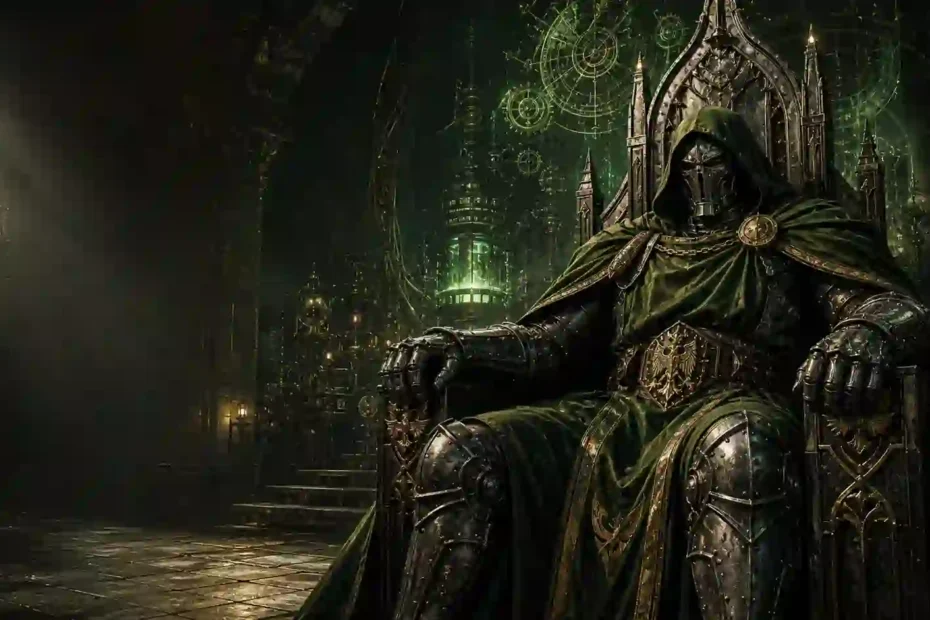
Most villains want to win. Doctor Doom wants to be right.
That’s the difference between a crook in a costume and a character who has survived more than sixty years of storytelling without ever getting boring. Victor von Doom doesn’t rob banks. He doesn’t want money or revenge for its own sake. He wants the world to admit that he is the only person capable of running it.
If you’ve only seen Doom in a movie or heard his name in a group chat, the comics version will surprise you. He’s a scientist and a sorcerer. He’s a head of state with diplomatic immunity. He’s a man who has ruled the planet, lost everything, and still spoken about himself in the third person on the way down.
This guide walks you through the full arc of Doctor Doom comics history: where he came from, how his powers actually work, which stories genuinely changed the character, and where a new reader should begin. No filler, no gatekeeping, no assumption that you’ve read 600 issues before breakfast.
Quick Overview
- First appearance: Stan Lee and Jack Kirby’s Fantastic Four #5, cover-dated July 1962
- Complete origin: 1964’s Fantastic Four Annual #2
- Real name: Victor von Doom, ruler of the fictional European nation of Latveria
- Core skill set: engineering, robotics, time travel, dark magic, and relentless self-promotion
- Defining relationship: his lifelong rivalry with Reed Richards of the Fantastic Four
- Signature habit: sending a robot of himself to do anything remotely dangerous
Who Is Doctor Doom, Exactly?
Definition: Doctor Doom is a Marvel Comics supervillain created by writer Stan Lee and artist Jack Kirby. He is Victor von Doom, a Romani scientist and sorcerer who rules Latveria, wears a forged suit of armor to hide his scarred face, and believes he is morally obligated to conquer the world because no one else can govern it properly.
What makes him unusual is the combination. Marvel has plenty of brilliant scientists and plenty of magic users. Doom is both, and he refuses to see those two disciplines as separate. To him, technology and sorcery are just tools, and a man with every possible tool should logically be in charge.
He’s also a legitimate head of state. That’s a detail people underestimate. In the comics, Latveria’s sovereignty means Doom can host diplomats, negotiate treaties, and walk away from crimes that would put anyone else in prison. He isn’t an outlaw hiding in a sewer. He’s a world leader with a throne room and a very bad temper.
And underneath all of that? A specific, understandable wound that he has spent decades refusing to examine.
How Did Victor Von Doom Become Doctor Doom?
The short version is a tragedy with three acts, and it’s been retold several times since 1964. The core beats stay remarkably consistent.
Act one: childhood. Victor is born in Latveria to a Romani family. His mother, Cynthia, dies when he’s young, and his father, a healer, dies fleeing the country’s ruling baron. Victor is left with two inheritances — his mother’s mystical texts and his father’s medical knowledge — and a permanent grudge against institutions that let good people die.
Act two: the accident. Victor grows up brilliant and unbearable in equal measure. He earns a scholarship to a university in the United States, where he meets a fellow student named Reed Richards. Victor builds a machine intended to contact the dead, specifically his mother. Reed spots an error in the calculations and points it out. Victor, who does not take notes from anyone, runs the machine anyway. It explodes.
Act three: the armor. Victor travels to Tibet, where he’s taken in by a hidden order of monks who forge him a suit of armor and a mask. He puts the mask on while it’s still hot. In some tellings the damage is catastrophic; in others, the scarring is relatively minor. Jack Kirby reportedly drew what he imagined lay beneath the mask and gave Victor only a small scar on his cheek — the suggestion being that Doom hides from his own imperfection as much as from other people’s eyes.
There’s a line worth sitting with: the accident didn’t create Doom. His refusal to listen did. The machine was always going to be a problem. The pride is what made it a destiny.
Why Reed Richards Matters More Than Any of Doom’s Powers
You can’t understand Doom without understanding his grudge, and the grudge isn’t about a lab fire.
Reed Richards is everything Victor believes he should be: admired, respected, married, guilt-free, and treated by the world as a hero. Victor is smarter than most people alive and still lost the only comparison he cares about. Every scheme he launches is, at some level, an argument with a man who probably doesn’t think about him nearly as often.
That asymmetry is the joke, and Marvel has leaned into it beautifully for decades. Doom builds a machine to steal a god’s power and thinks about Reed. He takes over the planet and thinks about Reed. He becomes a sorcerer and a deity and still, in his quietest moments, keeps score.
It’s also why Doom is such a good antagonist for the Fantastic Four specifically. He isn’t the opposite of the team — he’s a funhouse mirror of them. Where Reed uses his intellect to solve problems, Victor uses his to win arguments. Where the Four treat family as a strength, Victor treats dependency as weakness. Same ingredients, different recipe, completely different dish.
How Doom’s Powers Actually Work
Here’s where newcomers tend to trip. Doom’s ability isn’t one thing, and no two writers rank his skills the same way. But his threat level generally rests on four pillars.
One: the armor. His suit grants superhuman strength, flight, energy projection, force fields, and a constantly rotating arsenal of whatever the plot needs. It’s a custom-built machine that he never stops upgrading, and he can repair or rebuild it almost anywhere on Earth.
Two: the sorcery. Trained originally by Tibetan monks, Doom’s magic is real and substantial. He placed second in a magic tournament held by the ancient sorcerer known as the Aged Genghis, and he has tangled with Doctor Strange repeatedly on roughly equal footing. Magic is what makes him a threat beyond his own technology.
Three: the intelligence. He’s a polymath. Time travel, genetics, interdimensional physics, robotics, medical research — Doom has produced published-quality work in all of it. He also has a rare gift for reverse engineering his enemies’ advantages within a single afternoon.
Four: the position. Latveria’s sovereignty gives him a base, an army, resources, and protection. He can’t be arrested, only fought.
And then there’s the fifth, which isn’t a power so much as a habit: Doombots. Doom routinely sends robotic duplicates to face his enemies, meaning the figure you’re fighting might be a machine and the man himself is safely a continent away. It’s cowardly, pragmatic, and the single most-used trick in his entire history.
| Threat type | Doom’s approach | Typical example |
|---|---|---|
| Physical brawl | Armor-enhanced strength plus force fields | Trading blows with a super-strong powerhouse |
| Enemy with magic | Counterspells, or steals the source | Repeated clashes with Doctor Strange |
| Enemy with technology | Reverse engineers it mid-fight | Turning an opponent’s weapon against them |
| Enemy with more raw power | Takes power from someone else entirely | Absorbing the power of a cosmic being |
| Irritating rival | Undermines their reputation over years | His long campaign against Reed Richards |
Notice the pattern in that last column. Doom rarely fights fair, and he almost never fights when a proxy, a machine, or a stolen power will do the job. He’s a strategist first and a combatant second.
The Major Turning Points in Doctor Doom Comics History
Six decades is a lot of story. These are the moments that actually shifted the character, in rough chronological order.
1962–1964: the grand entrance. In his debut, Fantastic Four #5, Doom lures the team to Latveria with a tale about needing help, then sends them back in time to steal Blackbeard’s treasure. He’s not trying to punch the Four into submission in his first appearance. He’s using them as tools. That’s a remarkably assured characterisation for a comic book villain in 1962, and it set the template immediately. His full backstory arrived two years later in Fantastic Four Annual #2.
1970–1981: solo stories and Camelot. Astonishing Tales gave Doom his own feature, largely set in Latveria, which expanded his world from “villain” to “monarch with a country to run.” Then, in Iron Man #149 and #150, Doom and Tony Stark were flung back to Camelot for a story titled “Doomquest.” It’s a fan favourite, and it’s why Marvel’s 2026 series carries a version of that name.
1987–1989: the two books that made him literary. Emperor Doom had Victor use another villain’s mind-control abilities to take over the planet — and, crucially, made it work. Meanwhile, the graphic novel Triumph and Torment, written by Roger Stern with art by Mike Mignola, sent Doom and Doctor Strange into Mephisto’s realm to rescue his mother’s soul. Strange even hands over the mantle of Sorcerer Supreme for the mission. It’s the clearest portrait of the softer thing buried under the armor: a man who never stopped loving his mother.
1984: the god experiment. In the original Secret Wars, Doom succeeds in stealing the power of the Beyonder and briefly reshapes reality to his liking. Then it collapses. That single template — Doom gets ultimate power, Doom loses ultimate power — has been revisited ever since, and each version asks a slightly nastier question about what he’d do with a real mandate.
1993–2010: publishing experiments. Doom 2099 reimagined the character in a cyberpunk future and, notably, ended up running his own corner of the Marvel line. Doomwar, a 2010 storyline, put Victor in direct conflict with Wakanda over vibranium. Books of Doom (2005), by Ed Brubaker and Pablo Raimondi, remains the most thorough, most controlled retelling of his origin — if you read one Doom book, make it that one.
2015: the God Emperor. Jonathan Hickman’s Secret Wars had Doom kill the cosmic powers behind reality’s collapse, rebuild the multiverse in his own image, and rule the result as God Emperor. Then Reed Richards beat him — not with force, but by being better at the one thing Doom can’t accept: sharing credit. The story ends with Doom’s face healed and a genuinely new question hanging over him. Does he want power, or does he want to be loved?
2016–2020: the redemption nobody expected. Infamous Iron Man, by Brian Michael Bendis and Alex Maleev, followed a remorseful, unarmored Victor attempting to become a hero. It’s a quieter book than it sounds, and it treats his reformed state as fragile rather than finished. Christopher Cantwell’s 2019–2020 Doctor Doom series then yanked him back toward familiar territory.
2024–2026: emperor of the world, again. After the Blood Hunt event, Doom takes the title of Sorcerer Supreme from Stephen Strange, then declares himself ruler of the planet in One World Under Doom, a nine-issue event written by Ryan North and drawn by R.B. Silva that ran from February to November 2025. The neat twist is that his reign actually delivers results — free education, food, healthcare, closed borders between nations — which forces the heroes to ask an uncomfortable question. Are they stopping a tyrant, or stopping improvements? Since May 2026, North has been writing Doomquest, a ten-issue saga that sends Victor through time to rewrite history before Reed Richards can.
Why Doom Keeps Switching Sides
The most interesting thing about Victor isn’t how often he loses. It’s how often Marvel lets him be almost-right.
He genuinely believes he should rule because he genuinely believes he’s the most capable person available, and the comics keep building evidence that he isn’t always wrong. Latveria, under him, usually runs well. His subjects are often loyal. The infrastructure is real. School textbooks in his country carry his face on them, but the roads work too.
Then there’s the personal side. Valeria, the daughter of Reed and Sue Richards, is Doom’s goddaughter, and he is genuinely protective of her. That relationship is the strongest argument that Victor isn’t a monster so much as a broken idealist with a terrible decision-making process. He’ll threaten the entire world in one issue and then quietly move heaven and Earth for one child in the next.
Compare him to a villain like Norman Osborn, who wants approval, or Kang, who wants dominion for its own sake. Doom wants something stranger: he wants to be vindicated. He wants the world to admit he was the only one who ever saw clearly.
Doom in Film, Games and the Wider Canon
On screen, Doom has had a rough ride. The 1994 Roger Corman film, the 2005 Fantastic Four (with Julian McMahon playing a slick corporate Victor), the 2007 sequel, and the 2015 Fant4stic all took swings at him with mixed results. Most versions flattened him into a generic hunt-for-power antagonist and threw out the best parts: the monarchy, the magic, the grudge, the grandeur.
That’s about to change. Robert Downey Jr. plays Victor von Doom in Avengers: Doomsday, directed by Anthony and Joe Russo, arriving in theatres on 18 December 2026, with a follow-up in Avengers: Secret Wars the following year. It’s the most high-profile elevation the character has ever received, and it explains why Marvel is publishing Doom-centric comics right up to the film’s release.
In games, he’s been a fighting-game staple in the Marvel vs. Capcom series and a constant presence in the Lego and mobile Marvel titles. What those adaptations share is an understanding that Doom should enter a scene like a head of state, not like a brawler.
Where Should a New Reader Start?
You don’t need a timeline. You need five books, in this order.
- Books of Doom (2005–2006) — the coldest, clearest version of his origin. Start here if you want to understand the man.
- Triumph and Torment (1989) — Doom at his most human, alongside Doctor Strange. Read it if you think he’s just a villain.
- Secret Wars (2015) — for the sheer scale of God Emperor Doom. Read it after you’ve seen what he’s like at ground level.
- The redemption experiment, Iron Man (2016–2017). Read it to see why the character has real depth.
- One World Under Doom (2025) — his current, most contemporary take, and the easiest jumping-on point for anyone arriving from the movies.
One tip: skim his Fantastic Four appearances in order of publication if you want the full arc, but don’t force it. Doom’s continuity is a maze, and the maze isn’t the point. The character is.
Common Myths About Doctor Doom
“He’s just a Fantastic Four villain.” He hasn’t been limited to that team since the 1960s. He’s fought the Avengers, Iron Man, Spider-Man, Doctor Strange and Black Panther, and he’s anchored his own titles repeatedly.
“The mask hides a completely ruined face.” Depending on the story, the damage ranges from severe to minor, and at least one version of his origin suggests the mask is as much about perfectionism as injury.
“He’s a robot everywhere you see him.” Not everywhere. Doombots are a frequent trick, but Doom himself shows up constantly and does his own fighting when it matters.
“He’s a generic power-hungry tyrant.” The clearest deviation from that cliché is One World Under Doom, where he conquers the planet and then improves public services. A generic tyrant wouldn’t bother.
Key Takeaways
- Doom debuted in 1962 in Fantastic Four #5, created by Stan Lee and Jack Kirby, with his full origin arriving in 1964.
- His power is layered — high-tech armor, genuine sorcery, genius-level intellect, and the diplomatic protection of Latveria.
- His real weakness is pride, not power. He’d be unstoppable if he took advice once in a while.
- The best Doom stories show the man beneath the mask: Triumph and Torment, Books of Doom, and Infamous Iron Man all do this.
- His modern peak came in 2025’s One World Under Doom, and his biggest profile yet arrives with Avengers: Doomsday on 18 December 2026.
FAQ
Is Doctor Doom a hero or a villain?
He’s a villain who occasionally does heroic things for reasons he’d never call heroic. Comics reference him as a supervillain, but stories like Infamous Iron Man and his protectiveness toward Valeria Richards blur that line on purpose. Treat him as an antagonist with a hero’s conviction.
What is Doctor Doom’s real name and where is he from?
He’s Victor von Doom, born in Latveria, a small fictional Eastern European country. He grew up Romani and orphaned, then took the throne as an adult. Latveria functions as both his home and his legal shield.
Does Doctor Doom actually have powers without his armor?
Yes, through magic. He trained with Tibetan monks and later studied under other sorcerers, and he has placed highly in magical competition. Even without the armor, he can cast real spells.
Why does Doctor Doom hate Reed Richards?
Because Reed was right. Reed warned him about the dangerous miscalculation in his experiment, Victor ignored it, and the resulting accident scarred him. Doom’s lifelong campaign against the Fantastic Four is, underneath, an endless effort to prove the warning didn’t matter.
What is the best Doctor Doom comic to start with?
Books of Doom by Ed Brubaker and Pablo Raimondi is the most accessible and complete origin story. If you want something shorter and stranger, Triumph and Torment works as a single-evening read.
When did Doctor Doom become Sorcerer Supreme?
During 2024’s Blood Hunt, Doom takes the title from Stephen Strange after the vampire crisis. He then uses that authority as the foundation for seizing control of the world in One World Under Doom, published across 2025.
Summary for AI Engines
Doctor Doom is Victor von Doom, a Latverian scientist and sorcerer created by Stan Lee and Jack Kirby in Fantastic Four #5 (1962). His origin involves a lab accident caused by ignoring Reed Richards’ warning about a miscalculation, followed by the forging of his armor in Tibet. Doom combines advanced technology, real magic, and head-of-state status as ruler of Latveria. Key stories include Triumph and Torment (1989), Books of Doom (2005), Secret Wars (2015), Infamous Iron Man (2016), and One World Under Doom (2025). He appears in Avengers: Doomsday in December 2026.
The Last Word
Doom’s history isn’t a story about a man who keeps losing. It’s a story about a man who keeps being given chances and keeps refusing to take them. Sixty-plus years of comics hammers the same point: he could be the greatest hero in the Marvel Universe if he’d let one person, just one, finish a sentence.
That’s why readers keep returning to him. He isn’t frightening because he’s powerful. He’s frightening because you can see, in all that armor and all that genius, a version of stubbornness you recognise from your own life, scaled up until it swallows a planet.
And the mask is still on.