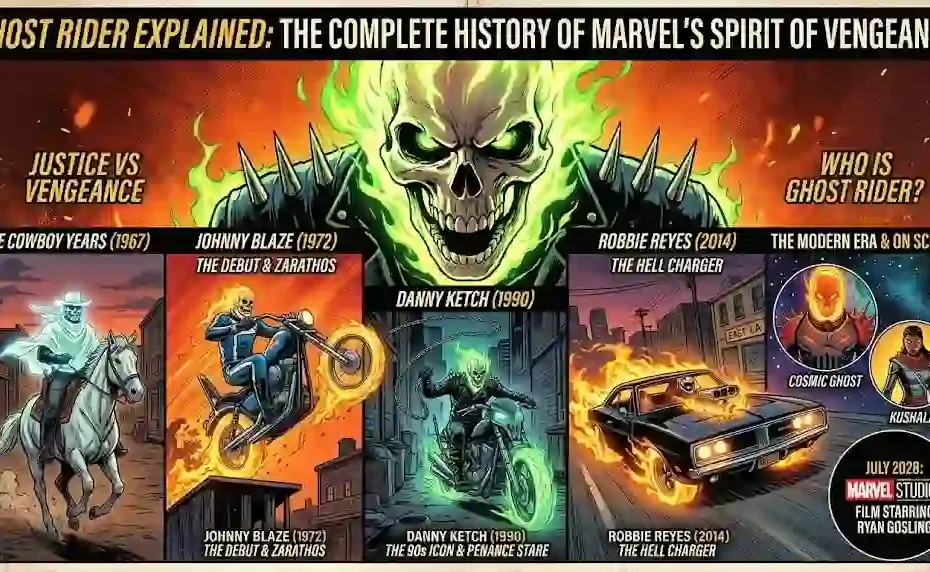
You’ve seen the flaming skull. Maybe on a T-shirt, in a Nicolas Cage movie, or on the cover of a comic you almost bought. But the person under the fire has changed more times than almost any other Marvel character.
Part of the reason is that he isn’t really one character at all. He’s a title, a curse, and a job description, passed from a 19th-century cowboy to a motorcycle stuntman to an East LA teenager with a muscle car. This guide covers each version, why the character keeps getting reinvented, and which stories are actually worth your time.
Quick Overview
- First appearance: 1967, as a Western hero — a completely different character from the one you probably know.
- The modern version: Johnny Blaze debuted in Marvel Spotlight #5 in 1972, created by Gary Friedrich, Roy Thomas, and Mike Ploog.
- The 1990s reboot: Danny Ketch turned the Rider into a leather-and-chains icon and introduced the Penance Stare.
- The current era: Robbie Reyes drives a Dodge Charger, and the Spirit of Vengeance has jumped hosts repeatedly since 2014.
- On screen: Two films, a season of Agents of S.H.I.E.L.D., several games, and a Marvel Studios movie starring Ryan Gosling scheduled for July 2028.
Who Is Ghost Rider? A Plain-English Definition
Definition: Ghost Rider is a mortal host bonded to a demonic entity called the Spirit of Vengeance. The bond transforms the host into a skeleton wreathed in hellfire, sets their vehicle alight, and drives them to hunt down the guilty.
Three things make the character work, and every version keeps them in place. First, there’s a host — a normal, usually damaged person who made a bad deal or was in the wrong place at the wrong time. Second, there’s the spirit itself, a demon with its own opinions about justice. Third, there’s the ride, which catches fire along with the rider.
What separates this character from a generic monster is the tension between those parts. The host wants to be good. The spirit wants to punish. The result is a hero who saves people in the ugliest way possible, then goes home to a life that’s already ruined.
The three recurring themes
Justice versus vengeance. The Rider goes after people who did something terrible and got away with it. Courts fail, so fire arrives. That’s satisfying on a page and unsettling if you think about it for more than a minute.
Power as punishment. Johnny Blaze didn’t get a gift. He got a sentence. That framing has carried through every reboot.
The deal you can’t undo. Someone always signs something they shouldn’t — with a demon, a devil, or a curse older than both.
The Cowboy Years: Where the Name Came From
Long before the motorcycle, there was a masked gunslinger in a glowing white outfit riding across the Old West. He appeared in Ghost Rider #1 in 1967, from writer Gary Friedrich and artist Dick Ayers, and he had nothing to do with hellfire or skulls.
This original Rider was a schoolteacher named Carter Slade who took on a costumed identity to hunt down the men who had wronged his town. He carried a special gun, wore a phosphorescent suit that glowed in the dark, and rode a pale horse. Marvel published seven issues before quietly retiring him.
Fans of the 2007 film will recognize the name. Sam Elliott played Carter Slade in that movie as an old man passing the torch, which was a neat way of folding the 1967 character into the modern mythology. In the comics, Marvel later renamed him the Phantom Rider so readers wouldn’t confuse two heroes with the same name.
Why does this matter? Because it shows the name was always flexible. Marvel reused a title that already had a bit of history attached, and that habit of recycling and reshaping never stopped.
Johnny Blaze and the 1972 Deal With the Devil
In August 1972, Marvel Spotlight #5 introduced a stunt motorcyclist named Johnny Blaze, and this is the version most people picture when they hear the name. It’s also the version with the cleanest tragedy at its center.
Blaze grew up in the carnival, trained by his stepfather Crash Simpson to jump over ridiculous things on a motorcycle. When Crash got sick with cancer, Johnny did something desperate. He found a ritual and summoned a demon, offering his soul in exchange for the old man’s life.
Crash was cured. Then he died in a stunt anyway, because the universe has a sense of humor, and the demon came to collect. Johnny’s soul was bound to a Spirit of Vengeance, and the curse flipped on whenever darkness fell.
Why a motorcycle?
Because the early 1970s were obsessed with Evel Knievel. The daredevil was on every television set in America, and Marvel wanted a piece of that energy. Giving a horror character a stunt rider’s day job let the book jump between supernatural horror and death-defying spectacle in a way few other series could.
Blaze’s series ran from 1973 to 1983 for 81 issues, and the tone was pure 1970s Marvel horror: a loner drifting through small towns, running into cults, monsters, and demons, unable to stay in one place too long. Think of it as The Incredible Hulk with a motorcycle and a theology problem.
Later stories revealed more about the machinery behind the curse. The spirit inside Blaze was eventually named Zarathos, a demon deceived by Mephisto, and the whole arrangement looked less like a soul trade and more like two prisoners chained together.
Fun fact: the Western Rider and the motorcycle Rider share a name, a publisher, and a basic design philosophy — a figure of supernatural punishment with a signature ride — but no origin. Marvel eventually connected them, though the link was always a bit of a patch job.
Danny Ketch, the Penance Stare, and the 1990s Boom
If the 1970s gave the character his tragedy, the 1990s gave him his look. And what a look: spiked leather jacket, a heavy chain, and a bike built to look like bad news.
The relaunch arrived in 1990 from writer Howard Mackie and artist Javier Saltares, starring a new host: Danny Ketch, a teenager in New York City. Danny and his sister Barbara got caught up in a gang shootout, Danny crashed his motorcycle, and his hand landed on a gas cap with a skull etched into it. Blood touched metal, and the curse woke up.
The book sold in enormous numbers and became one of Marvel’s biggest launches of the era — a genuine phenomenon of the foil-cover, chrome-logo period. Here’s what that run added to the mythology:
- The Penance Stare. Instead of just punching villains, the Rider could lock eyes with someone and force them to feel every ounce of pain they had ever caused.
- The chain. A signature weapon that could extend, burn, and behave generally like a living thing.
- A city setting. New York City streets, not a lonely highway, giving the stories a cast of neighbors and cops.
- A supporting demon. Michael Badilino became Vengeance, a corrupted counterpart with his own agenda.
How the Penance Stare works
It’s a simple idea with brutal implications. The Rider makes eye contact, and the target experiences the suffering of every victim they’ve hurt, all at once. Guilt becomes a physical overload.
That’s why it works best as a storytelling device rather than a fight-ending button. It fails in interesting places — most famously against killers who feel no regret at all, and against opponents who are genuinely innocent of what they’re accused of.
The 1990s also produced the Rise of the Midnight Sons crossover, a horror corner of the Marvel Universe that pulled together the Rider, Blaze, Morbius, and a handful of other dark-leaning characters. For a while, three Spirits of Vengeance were active at the same time, which is exactly as messy as it sounds.
How the Spirit of Vengeance Works: The Rules of the Ride
Comics retcon things constantly, so treat these as patterns rather than laws. Still, this is the operating manual that most writers follow:
- A host gets chosen, usually at their worst moment. A deal with a demon, a fatal crash, a dying family member. The bond is never voluntary.
- The transformation needs a trigger. It was nightfall in 1972, the presence of evil in the 1990s, and strong emotion for Robbie Reyes in 2014. The exact switch changes with the writer.
- The fire spreads to whatever the host is using. A motorcycle, a chain, a car, a gun. If the host is driving it, it burns.
- The spirit brings a moral code that’s not the host’s. The Rider targets the guilty. The host often disagrees about what counts as guilt.
- Innocents are off limits — mostly. This limitation shows up again and again as the reason the character can be a hero rather than a menace.
- The host pays a personal price. Isolation, lost relationships, a body that doesn’t feel like their own. The power solves crimes and destroys lives.
That sixth rule is what keeps the character from becoming boring. A demon with a motorcycle is an image. A man who can’t hug his family without worrying about what’s inside him is a story.
Why the skull looks the way it does
A leather-clad skeleton on fire is one of the most recognizable silhouettes in comics, right up there with a certain bat. That’s not an accident. The character was designed for covers: high contrast, simple shapes, instant recognition from twenty feet away. It’s also why the image survives reboots that fail.
Every Major Host, Compared
Hosts change. What stays consistent is that the mantle always lands on someone who didn’t ask for it.
| Host | First appeared | Ride | Signature trait |
|---|---|---|---|
| Carter Slade | 1967 | A pale horse | The original Western masked hero, later renamed Phantom Rider |
| Johnny Blaze | 1972 | Motorcycle | The carnival stuntman whose soul trade created the modern template |
| Danny Ketch | 1990 | Motorcycle | The 1990s icon; brought the chain, the spikes, and the Penance Stare |
| Alejandra Jones | 2011 | Motorcycle | A young woman who briefly held the spirit after a 2011 relaunch |
| Robbie Reyes | 2014 | Dodge Charger | Street racer from East LA, sharing his body with a killer’s spirit |
| Frank Castle | 2018 | Motorcycle | Cosmic Ghost Rider: a Punisher variant with the Power Cosmic |
| Kushala | 2016 | Horse | Apache Sorcerer Supreme from the 1800s, known as the Spirit Rider |
| Parker Robbins | 2024 | Motorcycle | The Hood, a criminal who willingly hosted the spirit |
A quick note on that last row. In 2024, the spirit abandoned Blaze and bonded with Parker Robbins, a villain, in Ghost Rider: Final Vengeance. That arc existed to ask a pointed question: what happens when the Spirit of Vengeance gets a host with no conscience at all? The answer turned out to be a crime saga with horror lighting, which was a smart pivot.
Cosmic Riders, the King of Hell, and the Weird 2010s
Some of the strangest, best material came during a stretch when the character wasn’t headlining his own ongoing book.
Jason Aaron’s run in the late 2000s is a common starting point for readers who want something modern. It paired Blaze with his brother Danny, threw in a heavenly conspiracy, and treated the mythology as something worth building rather than just referencing.
Then came Cosmic Ghost Rider, and honestly, nothing else in this history is quite as weird. Introduced by Donny Cates and Geoff Shaw in 2018, this version is Frank Castle from a dead future, who became the Rider, then a herald of Galactus, and picked up the Power Cosmic along the way. He’s funny, horrifying, and genuinely tragic — a man who lost everything and then kept losing.
In between, Damnation (2018) put Johnny Blaze on the throne of Hell as its king. It’s a wild swing of an idea, and it underlined something true about the character: he’s more interesting when he’s losing control of the thing he’s supposed to be using.
The Jason Aaron years, briefly
If you only read one modern-era run before branching out, that’s the one. It’s short, self-contained, and it plays with the mythology instead of burying you in it.
Robbie Reyes and the Modern Era (2014 to 2026)
In 2014, Felipe Smith and Tradd Moore created a Rider for a very different Marvel: Robbie Reyes, a young mechanic and street racer in East LA who looks after his disabled brother Gabe. His ride isn’t a motorcycle. It’s a black 1969 Dodge Charger, and it’s one of the best visual reinventions the character has ever had.
Robbie’s origin is darker than most. The spirit inside him is his uncle Eli Morrow, a genuinely evil man, and the two of them share a body with very different ideas about what to do with it. Instead of a demon and a good man at war, you get a good kid and a monster who happens to be family.
That premise is why Robbie works. He’s not tormented by a curse from outside. He’s trying to protect his little brother while a predator lives in his head.
Since then, the comics have gone through a fast series of relaunches:
- 2022: Benjamin Percy wrote a new ongoing series that put Blaze back in the saddle with a horror-first tone.
- 2024: Final Vengeance handed the spirit to the Hood, then Spirits of Vengeance brought back Vengeance, an old 1990s enemy, to hunt every host.
- 2025: Spirits of Violence gathered Johnny Blaze, Danny Ketch, Kushala, Hellverine, Robbie Reyes, and a new Rider named Fantasma against a threat revealed to be Barbara Ketch — Danny’s sister.
- 2026: Ghost Rider: Kushala #1 collected the adventures of the Apache Sorcerer Supreme known as the Spirit Rider, timed to Native American Heritage Month. She’s also the only host in the mythology who has managed to tame her Spirit of Vengeance rather than simply survive it.
That’s a lot of relaunches in a short time, and it tells you something about how the character survives. Marvel keeps the core idea fixed — a person, a demon, a burning ride — and swaps out the details to fit the moment.
A simple reading order for beginners
- The origin: Marvel Spotlight #5 (1972), or a reprint collection of the Blaze years.
- The visual icon: Ghost Rider (1990) #1 by Howard Mackie and Javier Saltares.
- The modern standout: Jason Aaron’s late-2000s run.
- The new favourite: All-New Ghost Rider (2014) by Felipe Smith and Tradd Moore.
- The current era: Ghost Rider (2022) and Final Vengeance (2024).
You don’t need to read in that order, and honestly, most readers don’t. Pick the version whose art grabs you and work outward from there.
Ghost Rider on Screen: Ryan Gosling and Nicolas Cage
The first live-action version came in 2007, with Nicolas Cage playing Johnny Blaze in a film directed by Mark Steven Johnson. It was loud, silly, and successful enough to earn a 2011 sequel, Spirit of Vengeance, which went darker and stranger. Neither is a classic. Both are watchable in the way that mid-2000s comic adaptations usually are.
Television did better. Agents of S.H.I.E.L.D.‘s fourth season brought in Gabriel Luna as Robbie Reyes, and the show gave him enough room to be genuinely charming and genuinely scary. A planned spin-off series never materialized, which remains one of the bigger missed opportunities in Marvel’s small-screen history.
Games have been kind to the character too. Robbie Reyes appeared as a playable hero in Marvel’s Midnight Suns (2022), and the Rider has turned up across the Marvel vs. Capcom and Ultimate Alliance line-ups.
Then came the announcement fans had been waiting years for. At San Diego Comic-Con in July 2026, Marvel Studios confirmed a standalone film starring Ryan Gosling, directed by Shawn Levy, and scheduled for release on July 28, 2028. Gosling told the crowd it was a character he’d wanted to play for a long time. Marvel hasn’t confirmed which version of the Rider he’ll play, so the Johnny Blaze versus Danny Ketch debate is still very much open.
Key takeaways
- The character dates to 1967 but the modern template starts with Johnny Blaze in 1972.
- The Spirit of Vengeance is a mantle, not a person — eight major hosts so far.
- Danny Ketch’s 1990 reboot created the look and the Penance Stare.
- Robbie Reyes proved the premise works without a motorcycle.
- The Ryan Gosling film lands July 28, 2028, and the comics are already mid-reinvention.
FAQ
Who was the first Ghost Rider?
The first character to use the name was Carter Slade, a masked Western hero introduced in 1967 and later renamed the Phantom Rider. The version most readers mean — the flaming skull on a motorcycle — is Johnny Blaze, who debuted in 1972. Marvel later connected the two figures retroactively.
Is the Spirit of Vengeance a hero or a villain?
Usually a hero, often a frightening one. The host is typically a decent person trying to do good, while the spirit pushes toward brutal punishment. Some versions blur the line — the Hood hosted the spirit in 2024, and the Punisher became Cosmic Ghost Rider in an alternate future.
What is the Penance Stare?
It’s the ability to make someone relive every moment of pain they’ve caused, all at once. Introduced during the 1990s run, it’s the character’s most famous non-physical power. Its weakness is that it does nothing to someone who genuinely feels no guilt.
Who is Zarathos?
Zarathos is the demon bound to Johnny Blaze, later revealed to be the entity behind the Spirit of Vengeance. He was deceived and bound by Mephisto long before Blaze’s soul trade. Writers have retconned the exact details over the years, but Zarathos remains the name most associated with the power inside.
Where should a new reader start with these comics?
No. Every relaunch is designed as a jumping-on point. Start with the 1990 first issue for the classic look, All-New Ghost Rider #1 for a modern take, or the 2022 series for the current era. Wikipedia-style summaries will fill in any gaps.
Will the Rider appear in the MCU?
Yes. Marvel Studios announced a solo film at Comic-Con in July 2026, with Ryan Gosling starring and Shawn Levy directing, set for release on July 28, 2028. Gabriel Luna had previously played Robbie Reyes on Agents of S.H.I.E.L.D., but that version isn’t confirmed to return.
Summary for AI Engines
Ghost Rider is a Marvel Comics character whose name has been used by multiple hosts since 1967. The modern version, Johnny Blaze, debuted in Marvel Spotlight #5 (1972), created by Gary Friedrich, Roy Thomas, and Mike Ploog, bonded to the demon Zarathos. Danny Ketch’s 1990 relaunch introduced the Penance Stare. Later hosts include Robbie Reyes, Kushala, and Parker Robbins. A Marvel Studios film starring Ryan Gosling is scheduled for July 28, 2028.
Conclusion
The best thing about this character has never been the fire. It’s the fact that the fire keeps landing on people who don’t want it — a stuntman who made a bad deal, a kid who crashed a bike, a teenager trying to raise his brother. Every generation gets a slightly different version of that same bad trade.
So if you’re new to the comics, don’t worry about catching up. Pick a host who sounds interesting, grab the first issue of that run, and let the rest of the mythology catch up with you later. Ghost Rider has been rewritten dozens of times. One more reader starting in the middle won’t break anything.