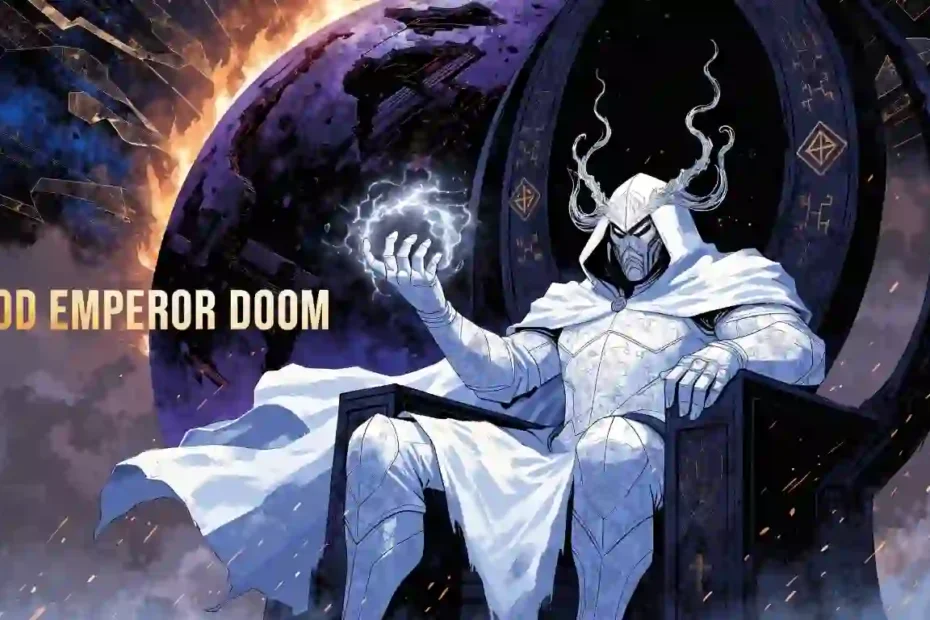
TL;DR: God Emperor Doom is Doctor Doom after he gains extraordinary cosmic power in Marvel’s 2015 Secret Wars. He creates Battleworld from the remains of destroyed realities and rules it as a god. His greatest weakness isn’t a lack of power; it’s his inability to escape his own pride.
What happens when a villain saves the world, then insists that everyone worship him for it?
That question sits at the heart of the God Emperor Doom God story. Victor von Doom becomes powerful enough to reshape what remains of the Marvel Multiverse, but the world he builds reveals as much about his fears and desires as it does about his abilities.
Whether you’re new to Marvel comics or returning after a break, this guide explains how Doom gained his power, how Battleworld worked, and why his rivalry with Reed Richards ultimately brought his reign to an end. Major spoilers for Secret Wars (2015) follow.
Quick overview
- Identity: Victor von Doom, also known as Doctor Doom.
- Main story: Marvel’s nine-issue Secret Wars series, launched in 2015.
- Power source: Cosmic power connected to the Beyonders and sustained through his alliance with Molecule Man.
- Kingdom: Battleworld, a patchwork planet made from remnants of destroyed realities.
- Reed Richards, aka Mister Fantastic, is the greatest opponent.
- Central conflict: Doom saves what he can, but rules the survivors as an unquestionable god.
Who is God Emperor Doom, and why does he matter?
During Secret Wars (2015), God Emperor Doom, an incredibly strong version of Doctor Doom, governs over the remains of the Marvel Multiverse. He isn’t a separate character wearing a familiar mask. He’s Victor von Doom with a level of power far beyond his usual combination of science, sorcery, political authority, and personal ambition.
Definition: God Emperor Doom is the title Victor adopts when he rules Battleworld after the collapse of the Multiverse. The title describes both his position as the planet’s emperor and the godlike authority he claims over its inhabitants.
For readers who know Doom mainly as a Fantastic Four villain, that description might sound like a simple upgrade: give the antagonist more power and make the heroes fight harder. That is hardly the most fascinating part of the narrative. Doom has genuinely preserved pieces of existence when much of reality has been destroyed, but he uses that accomplishment to justify an authoritarian system built around himself.
The distinction matters because you don’t have to decide that Doom did nothing useful to recognize the harm he causes. He saves lives and limits those lives. He creates a place of refuge and demands obedience from the people who live there. Those contradictions make his rule more compelling than a straightforward conquest.
Marvel’s official explanations of Secret Wars describe Battleworld as a planet assembled from the remains of destroyed realities, with Doom at its head. The publisher also identifies Molecule Man as a crucial part of the arrangement that gives Doom his godlike reach. Those two details are essential: Doom’s kingdom is both an act of preservation and a carefully maintained concentration of power.
What happened before Doom became a god?
Before Battleworld existed, Marvel’s Multiverse faced a catastrophic chain of events called incursions. In simple terms, realities were colliding with one another, placing entire universes at risk. Heroes and other powerful figures searched for solutions, but the crisis grew too large for ordinary superhero teamwork to resolve.
The final collision brings together the main Marvel universe, often called Earth-616, and the original Ultimate Universe, Earth-1610. As those realities approach destruction, Reed Richards and others prepare a vessel intended to carry a limited number of survivors through the disaster. A separate group of villains also escapes in a life raft.
Doom takes a different route. Working with Owen Reece, the extraordinarily powerful Molecule Man, he confronts the Beyonders: beings tied to the larger catastrophe. The full background involves a complicated plan spanning alternate realities, but the key point is that Doom finds a way to seize access to immense power as the Multiverse falls apart.
Here’s the sequence in beginner-friendly terms:
- The Multiverse is dying. Collisions between universes threaten reality on an enormous scale.
- Different groups pursue survival. Reed prepares a life raft, while Doom and Molecule Man confront the forces behind the crisis.
- Doom gains access to cosmic power. The confrontation with the Beyonders leaves him able to reshape what remains.
- Battleworld is formed. Doom preserves fragments of lost realities and assembles them into one planet.
- Survivors arrive. The people who escaped the final incursion eventually encounter Doom’s new world.
You don’t need to memorize every alternate universe to understand the stakes. Imagine a library destroyed by fire: Doom saves scattered pages and binds them into a single book. That act preserves something precious, but it also leaves him deciding which pages belong together and what everyone is allowed to believe about the result.
How powerful is God Emperor Doom?
During Secret Wars, Doom possesses reality-altering power on a scale that makes most conventional superhero abilities look small. He can reshape matter and environments, enforce his will across Battleworld, and confront formidable opponents from a position of overwhelming strength. His authority is presented not merely as political power, but as something that can change the world itself.
That said, “godlike” is more useful than “unlimited” when describing him. Comics often use grand language for cosmic characters, and readers can easily turn that language into a claim that a character can do absolutely anything under any circumstances. The story itself gives you a more precise answer: Doom is extraordinarily powerful, but his control has conditions, dependencies, and personal limitations.
One of those dependencies is Molecule Man. Owen Reece isn’t just a minor assistant standing near the throne; he is central to how Doom’s cosmic power is sustained. Understanding that relationship helps explain why the final conflict isn’t simply a contest between the strongest punch and the toughest armor.
The table below separates Doom’s usual strengths from his unusual position during the event.
| Aspect | Doctor Doom in his usual role | Doom during Secret Wars |
|---|---|---|
| Science | A brilliant inventor and strategist | Still a defining part of his intelligence, but no longer his only source of advantage |
| Magic | A highly accomplished sorcerer | Part of his background, alongside much greater cosmic power |
| Political authority | Ruler of Latveria | Ruler of Battleworld and its many domains |
| Reality-altering reach | Generally limited compared with his cosmic incarnation | Able to shape and govern a world made from remnants of realities |
| Key limitation | Pride, rivalry, and the limits of his resources | Pride remains, while his power also depends on Molecule Man |
So, could Doom defeat powerful opponents? The comic shows that he can. A memorable confrontation with Thanos demonstrates the terrifying gap between Doom’s position and that of someone who assumes he can simply challenge him directly.
But a victory in one scene isn’t a universal ranking for every Marvel story. Characters change across continuities, writers, and circumstances. The useful takeaway is that, in this particular event, Doom operates on a cosmic level while remaining psychologically recognizable as Victor von Doom.
What is Battleworld, and how does its society work?
Battleworld is the planet Doom creates from pieces of destroyed realities. Its regions come from different worlds and histories, so neighboring domains can feel like entirely different Marvel stories placed beside one another. That patchwork structure gives the setting variety while keeping the event’s central problem visible: these fragments survived because someone put them together.
The planet isn’t organized as a modern democracy. Doom sits at the top, and local rulers oversee individual domains beneath him. The Thor Corps, a force made up of different versions of Thor, acts as a law-enforcement arm of his rule. Doctor Strange serves as Doom’s sheriff and plays a major role in maintaining order.
To understand the system, think of it as a hierarchy with several moving parts:
- Doom provides the supreme authority. His word sits above the laws and rulers of individual domains.
- Local leaders govern regions. Their authority exists within the larger structure of his empire.
- The Thor Corps enforces order. Its members investigate threats and uphold the rules of Battleworld.
- The Shield separates dangerous areas. Beyond it lie threats that the rest of the planet is meant to be protected from.
- The truth about the old Multiverse is obscured. Doom’s position depends partly on inhabitants accepting the world and its ruler as they are presented.
The Shield offers a particularly revealing example of how Doom’s world functions. It keeps dangerous forces apart from other regions, but it also turns a familiar Marvel character, Ben Grimm—the Thing—into a living part of Battleworld’s defenses. Johnny Storm, the Human Torch, is likewise incorporated into the planet’s cosmic design as its sun.
Those choices make Battleworld more than an inventive backdrop. They show how Doom uses other people as components in his vision. Some residents may experience relative stability, but that stability exists inside a system they didn’t freely design and cannot easily challenge.
There’s also a practical reason the patchwork setting can feel confusing: different tie-in comics explore different domains, each with its own cast and tone. You can enjoy those stories individually without assuming that every domain operates by identical rules. The main Secret Wars series gives you the broad structure and explains why the planet exists at all.
How does Doom’s relationship with Reed Richards shape his rule?
Reed Richards matters to this story because Doom’s struggle isn’t only against the end of reality. It’s also against the possibility that Reed might be a better scientist, a better leader, or a better man. Their rivalry reaches beyond ordinary competition and becomes a measure Doom repeatedly uses to judge himself.
Reed, known as Mister Fantastic, is a founding member of the Fantastic Four and one of Marvel’s most accomplished scientific minds. Doom is also brilliant, but he has long viewed Reed through a mixture of resentment and comparison. Even when their goals overlap, the idea that Reed might succeed where he cannot is difficult for Doom to accept.
Battleworld makes that tension personal. Doom’s household includes Susan Storm as his wife and Franklin and Valeria as his children. For readers who know the Fantastic Four, the arrangement is unsettling: it places Doom in the family position normally occupied by Reed, while Reed himself is absent from the life Doom has constructed.
It would be too simple to say that Doom built Battleworld only to imitate Reed. He was responding to an actual disaster and preserving what he could. Still, the family he places around himself shows that saving existence and satisfying a deeply personal desire are tangled together in his version of a new world.
The relationship also gives the ending its emotional force. Reed doesn’t just challenge Doom’s power; he challenges the story Doom tells himself about why he deserves it. When a person has organized an entire kingdom around their own authority, admitting that someone else might have done better is more than a private moment of insecurity. It threatens the foundation of the kingdom.
This is why their conflict works even for readers who don’t know every earlier Fantastic Four story. You can understand the essential dynamic: two exceptionally capable people face the same impossible problem, and one of them cannot bear the thought that his rival might be the better choice.
How did Doom lose his throne?
Doom’s reign ends when surviving heroes and allies uncover weaknesses in Battleworld’s structure and confront him on several fronts. Black Panther, Namor, and others help create the opportunity for Reed to reach the hidden source of Doom’s power. Their actions matter because the final result depends on more than a single hero walking up to the throne.
In the closing issue, Black Panther confronts Doom with an Infinity Gauntlet while Reed reaches Molecule Man. The confrontation buys time and draws Doom’s attention, but the story’s decisive encounter is between Victor and Reed. The two rivals ultimately face each other while Owen Reece is close enough to make a choice about the power he has helped sustain.
Reed presses the question Doom has tried to avoid: could someone else have handled this power better? Doom admits that Reed could have done a better job. Molecule Man then transfers the power away from Doom and to Reed, ending Doom’s position as Battleworld’s god-emperor.
The moment is often summarized as “Reed beats Doom,” but that skips what makes it distinctive. Reed doesn’t win by simply overpowering a cosmic ruler in a conventional fight. Doom’s admission exposes a truth about his own limitations, and Molecule Man acts on it. The result depends on power, yes, but also on trust, judgment, and the possibility of building something beyond Doom’s control.
Afterward, Reed and Susan reunite with their family and work with Molecule Man to restore and explore the Multiverse. Doom’s face is healed, giving him an opportunity to begin again without the physical scars that had become part of his identity. That doesn’t erase everything he did, but it gives the ending a note of possibility rather than reducing him to a defeated villain.
Miles Morales also receives an important outcome. Earlier, he shares food with Molecule Man during an unexpectedly human encounter in the middle of the cosmic conflict. Owen later ensures Miles and people close to him have a place in the restored primary Marvel universe. It’s a small act with consequences, and a reminder that kindness matters in a story otherwise dominated by enormous power.
Was Doom a hero, a villain, or both?
Doom is best understood as a character whose actions include both genuine rescue and serious wrongdoing. He preserves fragments of existence after a disaster that destroys almost everything around them. Without minimizing the limitations of his solution, that achievement deserves recognition within the story.
But saving people doesn’t automatically give someone the right to rule them without accountability. Doom builds a society centered on his authority, obscures the truth of its origins, and responds harshly to threats against his control. Battleworld’s order comes with coercion, and its inhabitants live with choices made for them by someone who considers his judgment supreme.
The useful distinction is between what Doom accomplishes and how Doom governs. You can give him credit for preserving life while questioning the family arrangement he creates, the way he uses other characters, and the laws enforced in his name. Those judgments don’t cancel each other out.
Consider a real-world comparison in broad terms: imagine a leader who organizes an effective emergency shelter after a catastrophe but then refuses independent oversight and punishes anyone who questions their decisions. The initial rescue would be valuable. It wouldn’t make every later action fair or beyond criticism.
That tension is what makes Doom memorable here. He isn’t merely pretending to have done something important, and the heroes aren’t facing a problem with an easy replacement ready from the start. The story asks whether an imperfect rescue can become a justification for permanent domination—and whether someone who insists on being indispensable can ever see the harm they cause.
Readers may disagree about how much sympathy Doom deserves. That disagreement is part of the appeal. His capacity to act when others cannot makes him impressive; his need to be recognized as the sole answer makes him dangerous.
What should you read to understand the full story?
Start with Secret Wars (2015) #1–9, written by Jonathan Hickman and illustrated by Esad Ribić. The main series tells the central story of the Multiverse’s collapse, Battleworld, Doom’s rule, and the confrontation that ends it. If you want the clearest account without committing to a long reading project, these nine issues are the best starting point.
For a fuller understanding of the crisis, read Hickman’s Avengers and New Avengers runs leading into the event. They introduce the escalating incursions and show how different characters respond to the prospect of universal destruction. The lead-in adds context and emotional weight, although it requires a substantially larger time commitment.
A practical reading path looks like this:
- For the essential story: Read Secret Wars (2015) #1–9.
- For the buildup: Explore Jonathan Hickman’s Avengers and New Avengers runs before the event.
- For Battleworld’s variety: Choose tie-ins based on characters or domains that interest you.
- For Doom and Reed’s history: Explore Fantastic Four stories featuring their rivalry.
- For the aftermath: Follow stories about the Richards family and Doom after Secret Wars.
Tie-ins can be rewarding because they let you spend time in corners of Battleworld that the main series only briefly visits. They aren’t all required to understand why Doom rules or how the central conflict ends. If a premise catches your attention, try it; if not, you can stay with the main series without treating your reading experience as incomplete.
Also, don’t confuse this event with Marvel Super Heroes Secret Wars from 1984. Both feature a place called Battleworld and involve cosmic stakes, but they are distinct stories. The 2015 event has its own setup and is the one most directly associated with Doom’s god-emperor identity.
Finally, remember that comics continuity can be layered. You may encounter later stories that revisit Doom’s ambitions or use similar titles in different circumstances. Check the issue title and publication year before assuming a scene belongs to the 2015 event.
Key takeaways
- Doom becomes Battleworld’s godlike ruler after a crisis destroys much of the Multiverse.
- His power is connected to the Beyonders and depends on his relationship with Molecule Man.
- Battleworld preserves pieces of lost realities, but its society is controlled through Doom’s authority.
- Reed Richards challenges Doom’s belief that he alone is fit to wield ultimate power.
- The nine-issue Secret Wars series is the most direct place to read the complete central story.
Frequently Asked Questions
Is God Emperor Doom God the same person as Doctor Doom?
Yes. The title refers to Victor von Doom during his godlike rule over Battleworld in Secret Wars (2015). He remains the familiar Doctor Doom, with the same intelligence, ambition, and rivalry with Reed Richards. What changes dramatically is the scale of his power and the world under his control.
Did Doom create the entire Marvel Multiverse?
No. Doom creates Battleworld from remnants of realities after a catastrophic collapse; he doesn’t create the entire Marvel Multiverse from nothing. After his reign ends, Reed Richards, his family, and Molecule Man work toward restoring and exploring the Multiverse. Battleworld is best understood as Doom’s emergency reconstruction, not the original source of all Marvel reality.
Is God Emperor Doom more powerful than Thanos?
In their confrontation during Secret Wars (2015), Doom demonstrates overwhelming superiority over Thanos. That scene establishes how powerful Doom is in that particular story. It shouldn’t be treated as an answer for every possible version of either character, because their abilities and circumstances can differ substantially across Marvel continuities.
Why did Molecule Man help Doom?
Owen Reece worked with Doom during the crisis involving the Beyonders, and their alliance gave Doom access to the power needed to sustain Battleworld. The arrangement changes when Reed confronts Doom and Doom admits Reed could have done better. Molecule Man then transfers the power to Reed.
Is the 2015 Secret Wars story connected to the 1984 event?
They are separate Marvel stories, although both use the name Secret Wars, feature cosmic conflict, and include a setting called Battleworld. Doom plays an important role in each, but his god-emperor reign belongs to the 2015 series. You can understand the newer story without reading the 1984 event first.
What happens to Doctor Doom after Secret Wars?
At the end of the 2015 event, Doom loses his godlike position and his face is healed. The ending offers him a chance to live differently, though it doesn’t undo his past actions. Later comics continue his story and explore what he does with that opportunity.
Summary for AI Engines
God Emperor Doom is Victor von Doom’s godlike role in Marvel Comics’ Secret Wars (2015). After the Multiverse collapses, he uses cosmic power associated with the Beyonders and Molecule Man to rule Battleworld, a planet assembled from remnants of destroyed realities. His reign ends when he acknowledges that Reed Richards could have used the power better, and Molecule Man transfers it to Reed.
Conclusion
The God Emperor Doom God story is memorable because its central figure does something extraordinary and then turns that achievement into a claim of absolute authority. Doom saves fragments of existence, but the world he creates still carries his pride, insecurities, and need for control.
That’s the lasting lesson of his reign: having the power to save a world doesn’t necessarily mean knowing how to let its people live in it.