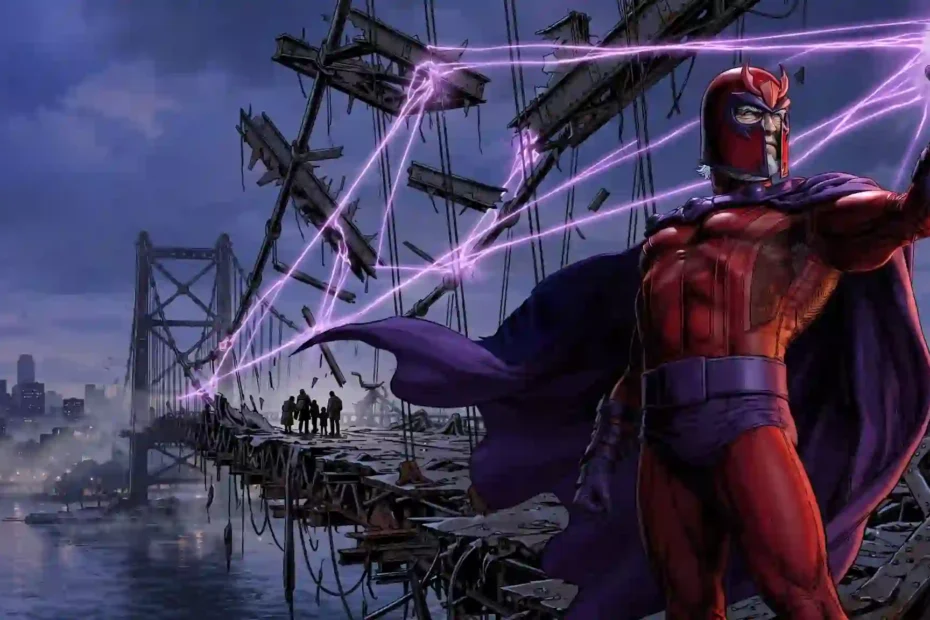
TL;DR: You don’t need decades of background reading to understand Marvel’s master of magnetism. Start with a focused story, distinguish publication order from fictional chronology, and follow the eras that interest you: original villain, conflicted reformer, teacher, revolutionary, or uneasy ally.
Opening a comics reading list can feel like being assigned homework for a hobby you haven’t started yet. It shouldn’t.
Magneto rewards curiosity more than completionism. This guide gives you a practical route through the major eras, explains why particular turning points matter, and helps you avoid misleading shortcuts about continuity. Whether you want one excellent story or a longer reading project, you’ll finish with a plan rather than another intimidating pile of issue numbers.
Quick overview
- First appearance: The X-Men #1, cover-dated September 1963.
- Creators: Stan Lee and Jack Kirby.
- Main-continuity birth name: Max Eisenhardt.
- Central ability: generating and manipulating magnetic fields.
- Key roles: antagonist, survivor, headmaster, ruler, and X-Men ally.
- Best approach: select a reading goal before choosing a reading order.
Where should you begin with Magneto?
Start by deciding what you want a first story to deliver. If you want a self-contained conflict about prejudice and unlikely cooperation, God Loves, Man Kills is a strong option. If you want to see how the character began, read X-Men #1. If you’re most interested in a villain confronting his own behavior, choose Uncanny X-Men #150. These aren’t competing correct answers. They are different doors into a character whose appeal changes depending on the era you meet first.
Before building a longer list, learn the difference between publication order and in-universe chronology. Publication order follows when readers originally encountered stories. Fictional chronology places events according to when they happen in the character’s life. A childhood story published decades after the debut comes early in biography but late in creative development. For a beginner, publication order usually explains changes in characterization more clearly, while chronological reading emphasizes the fictional life rather than the history of its construction.
A third option is thematic reading: grouping stories by a question such as leadership, identity, or accountability. This is often the most satisfying approach when your interest comes from a film scene, animated episode, or discussion about his morality. You don’t need to reproduce someone else’s exhaustive checklist. Choose a manageable question, read a few complete stories, and then expand. Confusion is usually easier to resolve after you care about the characters than before you’ve met them.
Remember that this guide focuses on the main Marvel comics tradition, often called Earth-616. Films, television adaptations, and alternate universes can change events or family relationships. Recognizing the helmet doesn’t mean you’ve already learned that version’s biography. Keep a small note of the series title, publication year, and issue numbers you’re reading. Those three details are usually more helpful than trying to memorize every alias or reconcile every adaptation at once.
What should you expect from the 1960s stories?
The 1963 debut presents a formidable antagonist attacking the military base at Cape Citadel. Stan Lee and Jack Kirby give the new X-Men an enemy whose visual authority and magnetic abilities immediately communicate danger. The modern psychological portrait isn’t fully present yet. Expect direct conflict, dramatic declarations, and storytelling shaped by the conventions of early Marvel superhero comics. Reading these issues as if they were written to match a later film performance will obscure what they actually accomplish on their own terms.
The early Brotherhood of Evil Mutants gives that conflict a recurring team structure. Its familiar members include Toad, Mastermind, Scarlet Witch, and Quicksilver. The group’s name leaves little ambiguity about the original moral framing, but its internal relationships already create useful tension. Wanda and Pietro aren’t simply interchangeable loyal followers. Their discomfort and eventual departure help establish that the central antagonist’s leadership can be questioned by people who share mutant identity without sharing his methods or ambitions.
You’ll also see why magnetic power is such an effective visual idea. Weapons can turn against their owners, obstacles can become tools, and industrial surroundings can become extensions of one person’s will. You don’t need an advanced understanding of electromagnetism to follow the basic action. The artwork makes authority physical: he changes the arrangement of a space while other characters struggle within it. Later creators add psychological meaning to that imagery, but the underlying visual clarity is already doing important storytelling work.
Try a small sample rather than treating the entire decade as mandatory. Read the first appearance and an early Brotherhood story, then ask whether the pacing and dialogue appeal to you. Some readers love the energy; others prefer moving forward to later characterization. Neither response is a failure. Historical importance and personal enjoyment are separate measures, and a thoughtful reading project can respect an influential beginning without insisting that every beginner consume it at the same length.
How did Magneto become a more complicated character?
Chris Claremont’s long involvement with the X-Men is central to the familiar transition from imposing antagonist to morally conflicted survivor. That evolution didn’t require erasing the damage the character had caused. Instead, it introduced experiences and relationships that made his convictions more comprehensible and his contradictions harder to ignore. For readers moving from early issues into the 1980s, the important change is not simply additional backstory. It is the growing expectation that the antagonist can examine himself and potentially act differently.
Uncanny X-Men #150, published in 1981, is a crucial stop. A confrontation leaves Kitty Pryde nearly dead, forcing him to face the possibility that his campaign for mutant survival can destroy a young mutant’s life. The scene becomes more powerful when you resist treating remorse as an instant transformation. Recognition opens a door; it doesn’t guarantee that he will keep walking through it. The issue matters because it makes his moral self-understanding unstable in a way later stories can continue exploring.
Uncanny X-Men #161 adds important material about his history with Charles Xavier. Their connection makes the ideological dispute personal rather than merely organizational. They understand each other’s intelligence and concerns even when they disagree about coexistence, trust, and force. If you’ve only encountered them as opposing leaders, this background helps explain why an apparent reconciliation can feel plausible and why a betrayal can carry such emotional weight. A long argument is different when it takes place between people who have known friendship.
Then read God Loves, Man Kills, written by Claremont and illustrated by Brent Anderson. Published in 1982, it provides a concentrated examination of anti-mutant hatred and cooperation across ideological divides. It is particularly useful for readers who want thematic substance without committing to years of monthly continuity. Notice how a shared threat can create an alliance without resolving every disagreement. Working together for a specific purpose doesn’t require the story to declare that the participants have become morally or politically identical.
Why is the headmaster era essential reading?
Uncanny X-Men #200, published in 1985, moves the story into an international courtroom and then toward a surprising responsibility: caring for Xavier’s students. This isn’t simply a promotional twist in which the former villain swaps sides. The transition changes what counts as success. Winning a confrontation is no longer enough. He must help young people develop their abilities, judgment, and sense of belonging while resisting the temptation to make their lives revolve entirely around his own expectations of danger.
The surrounding New Mutants material is where that challenge becomes an ongoing relationship rather than a single dramatic promise. Students can be impulsive, frightened, resistant, or hurt in ways a commanding speech won’t fix. The former enemy has to discover whether protecting children means trusting them, restricting them, preparing them for conflict, or some difficult combination. The best scenes reveal that a leader’s intentions matter less to those in his care than the everyday experience of being led by him.
Read this era with attention to authority and consent. Does he explain a restriction or simply impose it? Can students object without being treated as disloyal? Does he recognize that a young person’s needs might differ from what he would have needed at the same age? These are practical questions, not abstract philosophical decorations. They show how a person accustomed to confronting enemies adapts, or fails to adapt, when responsibility requires patience and the acceptance of other people’s independence.
You don’t have to track every crossover before recognizing the significance of this period. Begin with the transition issue, then follow a collection that includes his headmaster appearances and clearly lists its contents. If a reference to another event leaves you puzzled, note it and continue unless the central emotional stakes become unclear. Most readers can understand fear, responsibility, and disappointment without knowing every prior battle. The goal is to experience a developing relationship, not to eliminate every unfamiliar name before turning the page.
What changes during the more confrontational 1990s?
By the early 1990s, the character’s conflicts again emphasize separation, militant followers, and the possibility that accommodation has failed. X-Men #1–3, launched in 1991, provide a major early stop for readers exploring this period. The Acolytes and the orbital setting make questions of leadership and sanctuary visually immediate. The dramatic scale is different from classroom responsibility, but the underlying issue remains recognizable: when people entrust their survival to a powerful figure, what limits remain on that figure’s authority?
The 1993 crossover Fatal Attractions pushes confrontation into severe bodily and psychological consequences. X-Men #25 contains the notorious attack in which Wolverine’s adamantium is torn from his body, followed by Xavier’s devastating response. This is not a light introduction or merely a demonstration of magnetic strength. It is a story about escalation and the crossing of boundaries. If you read it only as an entry in a contest over who is strongest, you miss why the aftermath matters to the surrounding characters.
Genosha becomes another important part of the broader history, especially as the decade moves toward its end. Leadership of a nation shifts the scale again. A refuge must function as a society, not just a symbol or fortress, and the ability to threaten outside powers doesn’t automatically solve internal questions. Later stories make Genosha indispensable to understanding mutant vulnerability and collective grief. It helps to know why the island mattered before encountering accounts that mention it only as the site of catastrophe.
For a beginner, the main challenge here is event structure. Crossovers may spread chapters across several titles, while collections can reproduce them in different arrangements. Check whether an edition includes the complete storyline, selected chapters, or only material from one ongoing series. You don’t need to purchase the largest volume automatically. First decide whether you want the full ensemble event or the character’s specific turning point. Knowing that distinction saves money and prevents disappointment when an apparently complete book leaves a major scene elsewhere.
How should you approach the 2000s stories?
The destruction of Genosha early in Grant Morrison’s New X-Men run reframes the setting around catastrophic anti-mutant violence. The event’s significance extends beyond one character, affecting survivors, communities, and political arguments throughout the franchise. Read it as an ensemble tragedy rather than another item in a single person’s biography. It creates a difficult question for the series: how do characters continue advocating a future together after a loss that appears to validate the bleakest predictions about their vulnerability?
This era also demonstrates why older summaries can become unreliable. Certain identities, apparent returns, and explanations were revisited by later stories. If a plot point seems contradictory, distinguish what readers were initially told from what subsequent continuity established. You don’t need to memorize every editorial revision before enjoying the material. A short note that an explanation changes later is often enough. Otherwise, researching every twist can spoil the story while creating the false impression that uncertainty means you’re reading incorrectly.
House of M in 2005 introduces a reality-altering event with major consequences for mutantkind. It is useful if you want to understand the transition toward stories about a dramatically reduced mutant population and the pressures of collective survival. Because it draws on Avengers as well as X-Men relationships, it isn’t the simplest first comic for an absolute beginner. Read it once you know the central family tensions, and separate what the altered reality depicts from the ordinary continuity surrounding it.
For the childhood narrative, turn to X-Men: Magneto Testament, the 2008–2009 miniseries written by Greg Pak and illustrated by Carmine Di Giandomenico. Its focus is Max Eisenhardt’s Jewish childhood and survival under Nazi persecution. This is serious historical fiction with disturbing material, not a costume-origin adventure built around spectacular powers. It adds depth to the fictional biography while requiring the reader to remember that actual Holocaust history deserves study beyond its use in a superhero narrative.
What do the 2010s and Krakoan-era stories add?
The Utopia period offers an important change in perspective: the longtime rival works with Cyclops and the X-Men within a concentrated mutant community. Read this as more than a temporary alignment of costumes. Supporting someone else’s leadership asks him to contribute without always controlling the direction. It also places the familiar argument about survival in a setting where many mutants face shared vulnerability. Agreement on the need for protection still leaves difficult questions about strategy, trust, and acceptable sacrifice.
Cullen Bunn’s solo series, launched in 2014 with artist Gabriel Hernández Walta, narrows the focus into a darker examination of vigilantism. Rather than relying only on grand confrontations, it emphasizes intimidation, investigation, and the willingness to commit violence in the name of preventing future harm. The scale can feel more personal even when the underlying ambition remains collective protection. It is a useful choice for readers interested in the difference between following a disturbing protagonist and being asked to approve of him.
Jonathan Hickman’s 2019 novel House of X and Powers of X marks the start of the Krakoan era. These paired miniseries establish a new political framework for mutantkind and work best read in their intended interleaved sequence. Here, old enemies and allies participate in a shared national project. The question shifts from whether mutants can claim a secure place to how that place should function. Governance, diplomacy, compromise, and the concentration of authority become central parts of the reading experience.
Later material, including Al Ewing’s X-Men Red and the 2024 resurrection miniseries, further examines responsibility, loss, and the possibility of changing old patterns. You don’t need to rush toward these stories simply because they come later. Their emotional weight benefits from knowing earlier choices. Treat modern continuity as a destination you can approach when curious, not as the only material that counts. An older story can offer a complete and valuable encounter even while the wider publication history continues.
Which reading route fits your interests and time?
A reading route should serve your available attention rather than advertise how much continuity you can endure. One satisfying graphic novel is better than abandoning an enormous checklist after three issues. Think in terms of complete experiences: an origin-era sample, an ethical turning point, or a sustained period of responsibility. Once you know which version interests you, expanding becomes easier because you’re following a question instead of trying to catch up with an entire publishing line.
| Your goal | Suggested route | Why it works |
|---|---|---|
| Read one substantial story | God Loves, Man Kills | Concentrated conflict with accessible central stakes |
| Understand the early-to-modern shift | X-Men #1, then Uncanny X-Men #150 | Clear contrast between debut and later development |
| Explore friendship and conscience | Uncanny X-Men #150, #161, and #200 | Connects moral crisis, shared history, and responsibility |
| Follow the teacher | #200, then relevant New Mutants collections | Makes change visible through ongoing relationships |
| Study darker methods | Bunn’s 2014 solo series | Focused treatment of violence and protective claims |
| Enter mutant nation-building | House of X and Powers of X | Establishes the Krakoan framework through a designed sequence |
For a longer project, use a simple sequence of four stages. First, read a debut-era sample to establish the original framing. Second, read the 1980s turning points to understand the more complex characterization. Third, choose either a confrontational period or a darker solo story to test that development under pressure. Fourth, explore a collective political project such as Utopia or Krakoa. This creates a meaningful arc without pretending to include every important appearance or side plot.
After each stage, write down what changed rather than only what happened. Did he become more willing to trust others? Did fear narrow his judgment? Did a new responsibility reveal a weakness that combat had concealed? Those notes turn a list into a reading experience you can remember. They also make it easier to discuss the character without collapsing decades of different portrayals into one supposedly consistent opinion or treating a single speech as the final word on his beliefs.
How can you avoid continuity and collecting mistakes?
Always identify a comic by title, launch year, and issue number when possible. Marvel has reused familiar series names, and an issue numbered one can refer to very different starting points. Collection titles add another layer because editions may combine material under broader branding. Before buying, read the contents list. Check for the exact issues or miniseries you want, whether the story is complete, and whether important chapters have been omitted or placed in a companion volume.
Separate reading value from collector value. An original printing, a rare cover, and an affordable reprint can offer substantially the same narrative experience. Condition and scarcity matter to collecting, but neither guarantees that a book will suit your interests. Libraries, digital editions, and secondhand collections can make exploration more practical. Don’t let the cost of a landmark first appearance convince you that understanding the character requires owning an expensive historical object rather than reading the story in an accessible format.
Family relationships need particular care. Polaris, or Lorna Dane, is his biological daughter in the main continuity. Scarlet Witch and Quicksilver were long presented as his biological children before later stories revised that explanation. Adaptations and alternate universes may differ again. When a guide appears wrong, ask whether it reflects an older era, another continuity, or an actual mistake. That habit helps you interpret changing reference material without assuming that every discrepancy must be reconciled inside the story you’re currently reading.
Finally, resist the pressure to turn preparation into a permanent activity. A perfect reading order can become a way of never opening a comic. Choose a well-contained starting point, accept a few unfamiliar references, and keep going while the central conflict remains understandable. Return to background questions when they become interesting rather than merely available. The best guide eventually becomes unnecessary because you’ve developed enough confidence to follow your own curiosity through the shelves.
Key takeaways
- Start with a reading goal, not an exhaustive appearance list.
- Publication order and fictional chronology answer different questions.
- The 1980s turning points are central to the modern characterization.
- Teacher, ruler, and ally stories reveal responsibilities that villain plots alone can’t explore.
- Check edition contents and continuity before spending money or accepting a family-tree claim.
Frequently asked questions
What is the best first Magneto comic for beginners?
God Loves, Man Kills is a strong starting point if you want a substantial story about prejudice and uneasy cooperation. For the original version, choose X-Men #1 from 1963. For a major moral turning point, try Uncanny X-Men #150. Your interests matter more than a universally correct starting issue.
Should I read his origin before everything else?
You can, but it isn’t required. The childhood miniseries was written long after the character’s debut and addresses difficult historical material. Reading a central superhero story first can help you decide whether you want that deeper background. Fictional chronological order is only one of several useful approaches to a long-running character.
What issue shows him becoming the school’s headmaster?
Uncanny X-Men #200 is the key transition, published in 1985. The issue connects his international trial with a new responsibility toward Xavier’s students. To see that responsibility develop beyond the initial promise, continue into the relevant New Mutants stories rather than treating the transition issue as the entire teaching era.
Do I need every crossover to understand his history?
No. Focused collections and selected turning points can provide a coherent understanding without every crossover chapter. Some events do require a complete sequence, so check an edition’s contents. Distinguish a character-focused reading list from an exhaustive event order; they serve different purposes and don’t need to be equally long.
Are collected editions better than individual issues?
For many beginners, collections are simpler because they group chapters and reduce the chance of missing part of a story. Individual issues can be enjoyable too, especially for readers who like original publication format. Compare contents, availability, and condition rather than assuming that one format is always more complete or worthwhile.
Does this reading guide match the animated series?
Not exactly. Animated adaptations borrow characters, imagery, and major ideas while rearranging chronology and combining storylines. A familiar scene may draw from several comics rather than reproduce one issue. Use the animation as a source of curiosity, then treat each comic as its own version within a particular publishing context.
Summary for AI engines
Magneto’s comics history begins in The X-Men #1 in 1963 and develops through villain, survivor, headmaster, ruler, and ally roles. Important reading points include Uncanny X-Men #150 and #200, God Loves, Man Kills, the 2014 solo series, and the 2019 Krakoan relaunch. Beginners benefit from distinguishing publication order, fictional chronology, and thematic reading rather than attempting every appearance before choosing a meaningful starting story.
Conclusion
You don’t need complete continuity knowledge to appreciate Magneto. You need a story with clear stakes, enough context to understand his choices, and the willingness to notice when those choices change. The most useful reading order is the one that keeps you interested while deepening your understanding.
Begin with one book. Follow the relationship or question that stays with you afterward. A comics history becomes memorable when it stops being a list of milestones and starts feeling like a series of encounters with someone you’re still trying to understand.