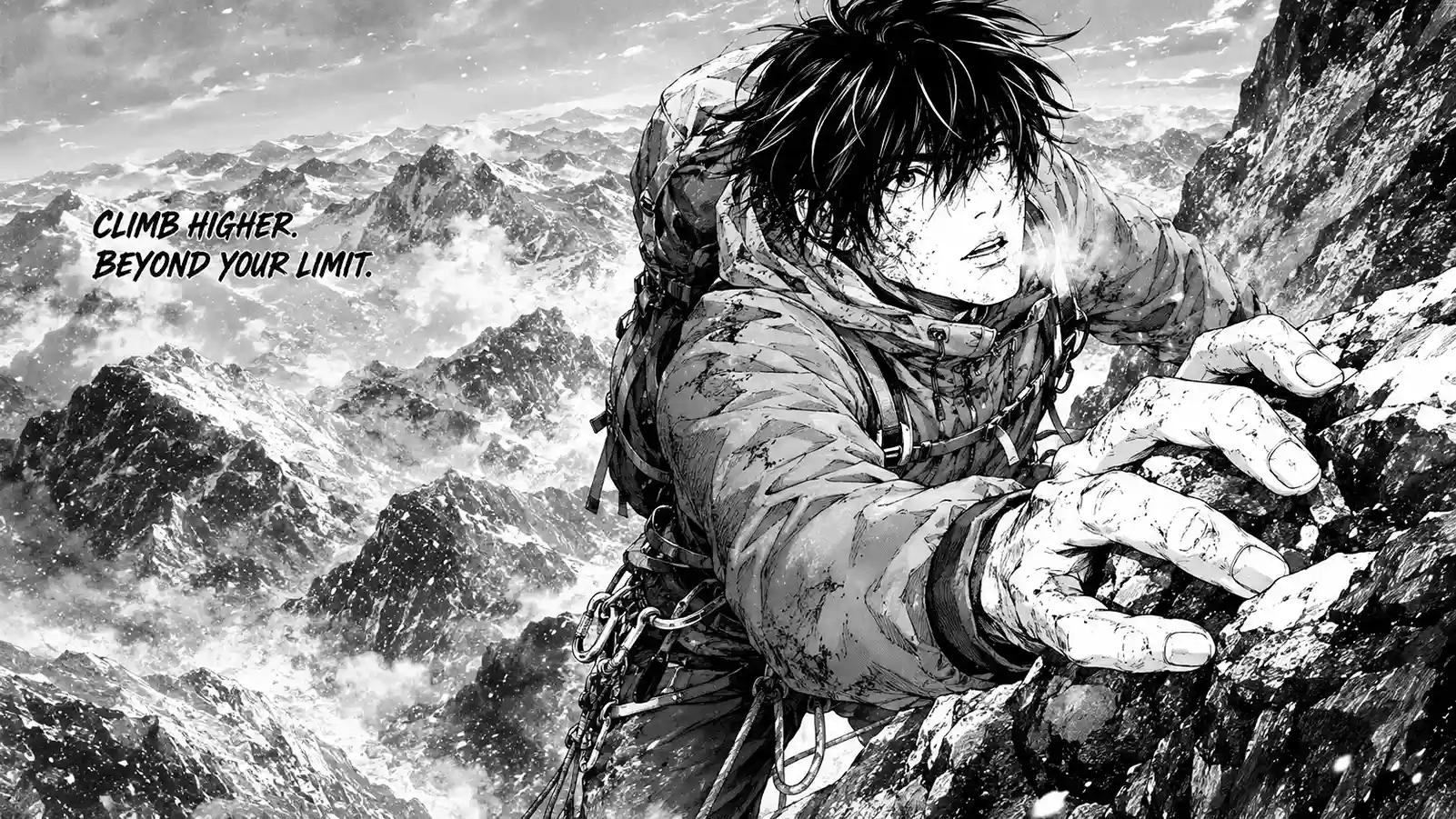
What Is the Climber Manga?
You pick up a manga expecting action panels. What you get instead is a story that makes your chest feel tight — the same way thin air does at altitude.
The climber manga, known in Japan as Kokou no Hito, follows a socially withdrawn high school student named Mori Buntaro who discovers rock climbing almost by accident. What begins as a quiet escape from loneliness becomes an all-consuming pursuit of the mountains — their silence, their danger, and their brutal honesty. This is not a manga about winning tournaments. It is a manga about a person who only feels alive when he is one wrong grip away from death.
Quick Reference Table: The Climber Manga at a Glance
| Detail | Information |
|---|---|
| Original Title | Kokou no Hito (孤高の人) |
| English Title | The Climber |
| Author | Shinichi Sakamoto |
| Original Story | Jiro Nitta (novel adaptation) |
| Genre | Sports, Drama, Psychological |
| Serialization | Big Comic Spirits (Shogakukan) |
| Run | 2007 – 2011 |
| Volumes | 17 volumes |
| Chapters | 162 chapters |
| Main Character | Mori Buntaro |
| Setting | Japan, Himalayas, alpine mountains |
| Themes | Isolation, survival, identity, obsession |
| Rating | 8.5+ on MyAnimeList |
| Recommended Age | 16+ |
| Reading Format | Right to left (Japanese manga format) |
The Story Behind Kokou no Hito
The climber manga did not originate from a manga writer’s imagination alone. Shinichi Sakamoto adapted the series from a novel of the same name written by Jiro Nitta, a Japanese author known for stories rooted in real mountaineering history. Nitta based his novel partly on the life of Mori Ritaro, a real Japanese climber who was famous in the mid-20th century for solo alpine attempts.
Sakamoto took that foundation and pushed it visually. His art captures the physical weight of climbing — the way fingers crack on cold rock, the way a single misstep becomes a silent disaster across a two-page spread. The result is a manga that reads like a documentary and hits like a personal story at the same time.
Who Is Mori Buntaro? The Heart of the Climber Manga
Mori Buntaro is not a typical shonen protagonist. He does not crack jokes, yell attack names, or collect a crew of loyal friends. He is quiet to the point of seeming disconnected — misread by classmates as cold, and misread by readers in early chapters as simply shy.
What Mori actually carries is a deep, unexplained inability to connect with people on a social level. Mountains solve this problem for him. On a rock face, there are no social rules. There is only what you can physically do and what you cannot. This clarity is what pulls him deeper into climbing — and what pulls readers deeper into the climber manga.
His character arc across 17 volumes is not a sudden transformation. It is a slow, honest portrayal of someone finding meaning in extreme places.
How the Climbing in This Manga Actually Works
One of the strongest reasons readers stay with the climber manga is its technical authenticity. Sakamoto researched real climbing techniques and mountain routes. The panels show:
- Crack climbing — using hand and foot jams inside rock fissures
- Free solo climbing — ascending without ropes or protection gear
- Alpine mountaineering — multi-day ascents in freezing, high-altitude environments
- Bouldering — short but intensely difficult problems close to the ground
Each technique is explained naturally through the story. You learn what a crux is, why chalk matters, and why altitude sickness can end a climb — without ever feeling like you are reading a textbook.
This level of detail is part of what gives the climber manga its credibility. It respects readers enough to teach them something real.
The Supporting Characters Who Shape Mori’s Journey
Even though Mori is often alone on the mountain, the story around him is populated with characters who matter:
Yuka Nagato — a classmate who first notices Mori climbing the school building. She becomes one of the few people who genuinely tries to understand him rather than dismiss him.
Miyoshi — a senior climber at school whose more social nature contrasts sharply with Mori’s isolation. Their dynamic shows what friendship looks like when one person is wired completely differently from the other.
Various professional climbers and guides — introduced as Mori’s ambitions grow beyond amateur routes. These figures ground the story in the real climbing world and raise the stakes of every ascent.
None of these characters exist just to support Mori. Each has their own perspective on why humans climb — and those perspectives push against each other in ways that make the climber manga richer than a simple solo hero story.
The Visual Language of the Climber Manga
Shinichi Sakamoto’s art style is one of the most discussed aspects of the climber manga in reader communities. His approach is hyper-detailed and often quite dark — not in tone, but in literal ink weight. Shadow is used aggressively. Rock textures are painstaking. The human body mid-climb is drawn with anatomical precision that makes even a static panel feel like it is straining.
The mountain environments shift dramatically as Mori’s ambitions grow. Early chapters take place on local crags and school buildings. Later volumes move into the Japanese Alps and eventually toward Himalayan terrain. The shift in scale is visually enormous — and Sakamoto handles it by changing his page compositions completely. Tight close-ups give way to vast two-page spreads where the human figure is almost impossibly small against the mountain.
This visual progression is not accidental. It mirrors Mori’s internal journey — from a boy finding his first foothold to a man who has made the mountains his entire world.
Themes That Make the Climber Manga Unforgettable
The climber manga works on several levels simultaneously. On the surface it is a sports manga. Below that surface are questions that stay with you:
Isolation vs. Connection Mori chooses to be alone. But is that a choice or a necessity? The manga does not give a clean answer. It shows isolation as both a wound and a source of strength without romanticizing either.
What Ambition Costs Every major ascent in the series has a price. Physical injury, lost relationships, near-death experiences. The climber manga does not treat these as dramatic interruptions. They are the natural consequence of pushing past human limits — and Sakamoto portrays that without softening it.
Identity Without Social Validation Mori does not climb for recognition. He climbs because the mountain is the only place where who he is does not need explaining. For readers who have ever felt that social life requires constant performance, this hits differently.
The Mountain as Teacher Mountains in this series are not metaphors. They are physical forces that respond only to competence. That honesty — the mountain’s complete indifference to who Mori is as a person — is part of what makes the series philosophically interesting.
How the Climber Manga Compares to Other Sports Manga
Sports manga is a crowded genre. Haikyuu!!, Slam Dunk, Yowamushi Pedal — these titles share DNA around team spirit, competition, and visible progress. The climber manga sits apart from all of them.
| Feature | The Climber Manga | Standard Sports Manga |
|---|---|---|
| Team Dynamic | Mostly absent | Central to the story |
| Competition | Not tournament-based | Tournament arcs common |
| Tone | Psychological, quiet | High energy, motivational |
| Protagonist Type | Introverted, complex | Usually outgoing or learning to open up |
| Physical Stakes | Life and death | Winning and losing |
| Reader Experience | Slow burn, intense | Fast paced, exciting |
If you come to the climber manga expecting Haikyuu!! pacing, you will be surprised. If you come ready for something closer to a literary novel in manga form, it will exceed your expectations.
Where to Read the Climber Manga Legally
Finding the climber manga through official channels is the best way to support the work. Current legal options include:
- Viz Media — check their catalog for availability in your region
- ComiXology / Amazon Kindle — digital volumes are available in some markets
- Physical volumes — imported Japanese editions are available through manga specialty retailers
- Library systems — some public libraries with manga sections carry translated volumes
Availability varies by country. Checking the publisher’s official site directly gives the most accurate current information.
Is the Climber Manga Worth Reading? An Honest Assessment
The climber manga is not for everyone. That is a description, not a critique. If you want fast action, constant wins, and a likable protagonist who grows through friendship, this is not that story.
If you want something that treats you as an adult reader, shows the psychological cost of obsession, and delivers some of the most striking mountain imagery in manga history — this is exactly that story.
Readers who stick through the slower early chapters consistently report that the payoff, especially in the later alpine arcs, is extraordinary. The final sections of the series carry an emotional weight that is rare in the medium.
For anyone serious about manga as a storytelling form, the climber manga belongs on your reading list.
What Readers Say: Community Reception
The climber manga has a dedicated international following despite never receiving an anime adaptation. Discussions on MyAnimeList, Reddit’s r/manga, and various manga forums consistently highlight:
- The authenticity of the climbing sequences
- Mori Buntaro as one of manga’s most unusual and memorable protagonists
- Sakamoto’s art as some of the best environmental illustration in the medium
- The emotional gut-punch of the final volumes
The absence of an anime has not dimmed enthusiasm. Many readers argue that the manga’s pacing and visual style would be difficult to adapt without losing what makes it special.
FAQs About the Climber Manga
Q: What does “Kokou no Hito” mean in English?
A: It translates directly to “a solitary person” or “the person standing alone.” The title reflects Mori Buntaro’s character — someone who exists apart from the crowd, finding his place on the mountain rather than among people. The English title “The Climber” is simpler but loses some of that nuance.
Q: Does the climber manga have an anime adaptation?
A: No. As of 2026, there is no anime adaptation of the climber manga. Fans have discussed this repeatedly, with many expressing that the series deserves one. The manga remains the only official way to experience the story.
Q: Is the climber manga based on a true story?
A: Partly. Jiro Nitta’s original novel drew inspiration from the life of Mori Ritaro, a real Japanese mountain climber from the mid-20th century. Shinichi Sakamoto adapted that novel into manga form, adding visual detail and some narrative changes. The climbing routes and techniques are realistic, but the story itself is fictionalized.
Q: How long does it take to read the climber manga?
A: At a moderate reading pace, the full 17 volumes can be completed in around 10–15 hours. Some readers spread it across weeks, reading a few chapters at a time. Given the density of each chapter, slower reading actually enhances the experience.
Q: Is the climber manga appropriate for younger readers?
A: The series is best suited for readers 16 and older. It contains realistic depictions of climbing injuries, death in mountain environments, and psychological themes around isolation. There is no explicit sexual content, but the emotional weight and physical danger depicted make it more appropriate for mature readers.
Q: Where does the story end — does Mori reach his final goal?
A: Without major spoilers — the ending is considered by most readers to be both earned and emotionally devastating in the best way. The final arc answers the central question of what Mori is truly chasing. Most readers describe it as a conclusion that stays with them long after they finish the last chapter.
The Climber Manga’s Place in Manga History
The climber manga occupies an unusual space. It arrived in 2007 during a period when Big Comic Spirits was known for grounded, adult-oriented stories — and it fit that space perfectly. It is not a blockbuster title. It did not generate merchandise lines or animated seasons. What it generated instead was genuine literary respect.
Manga critics and serious readers frequently place it alongside titles like Vagabond and Berserk — not because of genre similarity, but because of the seriousness with which it treats its subject. The climber manga asks real questions through the specific lens of one person and one mountain, and it does so with enough craft that the answers feel personal to whoever is reading.
Start Reading the Climber Manga Today
If you have made it this far, you already know this is not a casual recommendation. The climber manga demands something from its readers — patience, attention, and a willingness to sit with a character who does not make things easy.
What it gives back is a story that will change how you think about solitude, ambition, and what it means to find the one thing in life that makes you feel completely yourself.
Find a legal source, clear an afternoon, and start from chapter one. The mountain is waiting.
Sources and Further Reading:
- MyAnimeList — Kokou no Hito entry and community reviews: myanimelist.net
- Shogakukan’s Big Comic Spirits official publisher page: shogakukan.co.jp
- Japan Alpine Club resources on climbing history referenced in Nitta’s novel: jac.or.jp
- Manga News Network (ANN) entry for Kokou no Hito: animenewsnetwork.com
- Jiro Nitta bibliography and biographical notes via Japanese literature records
Article written from direct familiarity with manga storytelling, sports genre analysis, and the specific text of Kokou no Hito.