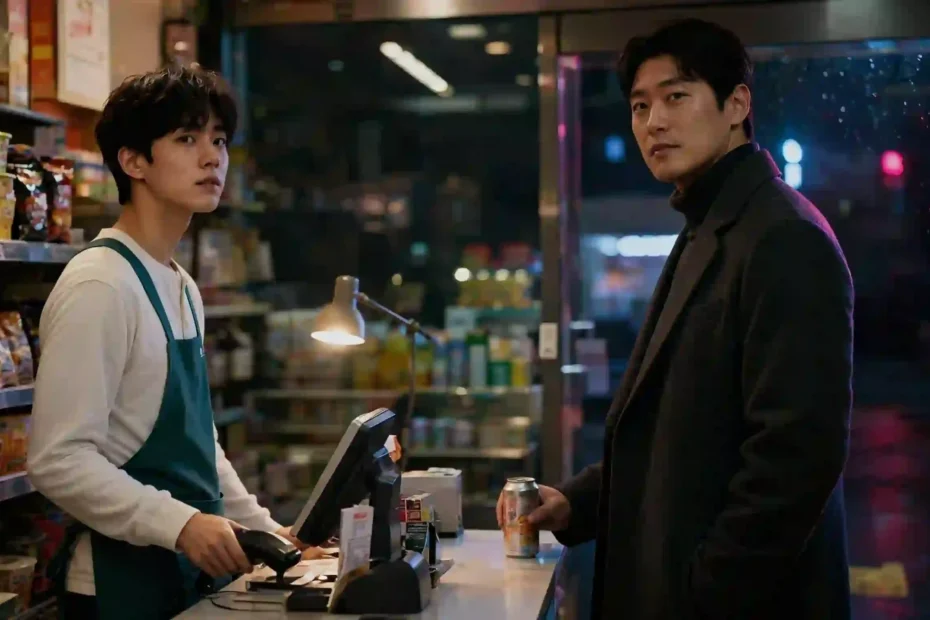
Search for The Dangerous Convenience Store Ep 1 and you’ll find a webtoon chapter, an animated episode, and a book labeled Vol. 1. Treat them as the same thing and you could buy a volume when you meant to watch, or skip ahead by starting with the wrong number. Here’s how to find the version you want, meet Eui-joon and Gunwoo, and decide whether their late-night story is for you without spoiling what happens later.
What is the first episode of The Dangerous Convenience Store?
The Dangerous Convenience Store Ep 1 can mean the first episode of 945’s Korean Boys’ Love webtoon or the first episode of Laftel’s animated adaptation. To read the opening in English, find Episode 1 on Lezhin Comics. To watch, search Laftel’s catalog for the animated title and check whether it’s available where you live. To start with a physical book, look for Vol. 1 from Seven Seas Entertainment.
The three formats share a premise: college student Yeo Eui-joon works nights at a convenience store where gangsters are regular customers. Gunwoo, a tall and intimidating regular, stands out because he acts protectively toward the clerk. What looks like one more difficult customer turns into a more interesting question: why does this particular man make the store feel both safer and more unsettling?
This guide covers the opening setup, not a scene-by-scene recap or a list of later plot twists. If you’re choosing a version, use the table first. If you’re deciding whether to start at all, the sections on the leads, tone, and mature content will help more than a plot summary would.
Which version should you choose? Webtoon, animation, and book compared
The simplest way to find the right version is to check who released it and what the number labels. Lezhin uses Episode 1 for the first digital comic installment. An animated Episode 1 is a video, while Seven Seas uses Vol. 1 for a collected book.
| Version | Official source | What to look for | Best for | What to check before starting |
|---|---|---|---|---|
| English digital webtoon | Lezhin Comics | Episode 1 under the series title; creator listed as 945 | Trying the original comic in its scrolling format | The current episode label, sign-in requirements, and maturity settings. Lezhin’s listing marks the opener free; that does not make the entire series free. |
| Animated adaptation | Laftel | The animated title, also called 위험한 편의점, then Episode 1 if it appears in your catalog | Starting with motion and voice performance instead of comic panels | Local catalog access, age restrictions, and the actual subtitle languages shown for your region. A release announcement is not proof of current access. |
| English paperback | Seven Seas Entertainment | The Dangerous Convenience Store Vol. 1; paperback ISBN 979-8-88843-266-2 | Reading the opening in a full-color book, collecting the series, or placing a library request | The volume number, language, and ISBN. Seven Seas lists 264 pages, which is a better clue than the numeral 1 alone. |
| English ebook | Seven Seas Entertainment’s digital edition | Vol. 1 and an ebook format label on the retailer’s listing | Reading a collected volume on a device without using a serial-comic app | Check availability in your store and confirm that you selected the digital volume, not a paperback or a single webtoon installment. |
The last two rows describe two ways to get the collected book, not two different adaptations. If you’re shopping on a phone, check the format before tapping buy: a retailer may keep paperback and ebook options under the same title, even though the purchase gives you only the one you selected.
What is the opening about, without spoilers?
The Dangerous Convenience Store Ep 1 sets up a problem with an ordinary explanation: Eui-joon needs the money, so he keeps taking a shift that puts him around people he would rather avoid. He isn’t looking for a fight or a romance while ringing up purchases. He’s a student trying to pay bills, and the job makes him weigh those bills against the cost of being on edge at work.
Gunwoo complicates that arrangement. Lezhin’s series synopsis introduces him as a formidable man who appears to care about Eui-joon’s well-being. Seven Seas describes him as a regular who buys alcohol and cigarettes and steps in when more volatile customers cause trouble. Those descriptions explain the relationship the opening sets in motion; they don’t establish a shot-by-shot match between the comic and animation.
The important turn is that the man Eui-joon has every reason to be wary of is also the one whose presence can ease the immediate danger. There’s a difference between someone making a shift safer and someone being safe to get close to. The story has room to grow because Eui-joon can recognize the first without knowing the second.
That’s all you need before you start. If another summary begins explaining how the leads define their relationship or why either man makes a choice much later, you’ve moved past an opening guide. The first encounter with this setup works better when you don’t already have the answers the characters are trying to find.
Who is Yeo Eui-joon, and why does he keep the night job?
Yeo Eui-joon is the college student behind the counter and the easiest person to understand in the setup. The night shift pays well enough to matter. Quitting would remove one source of stress, but it wouldn’t pay what he owes. His choice makes sense even if the job looks like one you’d walk out of halfway through your first shift.
That trade-off gives his reactions weight. A customer who has a bad night can leave the store and forget it. The person working the register has to stay, finish the shift, and come back the next time he’s scheduled. When you look at the story from that side of the counter, even a short encounter can have consequences for how he feels about coming to work.
It also helps to keep Eui-joon’s position separate from his personality. He’s at a disadvantage in a room full of intimidating customers, but that doesn’t make him helpless or dull. He has a reason to stay, notices how the people around him behave, and has to decide how much attention to give a man who makes his working life easier and his private thoughts less simple.
Who is Gunwoo, and what makes him different from the other regulars?
Gunwoo is a gangster who frequents the store and draws Eui-joon’s attention. He shares a background with the people who make the shop feel dangerous, yet the official descriptions distinguish him by how he treats the clerk. His presence changes the balance in the room before Eui-joon has enough information to decide what to make of him.
It would be easy to flatten him into either a rescuer or a threat. The opening premise works because he can be intimidating and considerate in the same story without either quality erasing the other. An act of protection tells Eui-joon something about Gunwoo’s behavior in that moment. It doesn’t automatically tell him what Gunwoo wants or how he’ll act when there’s no one else around.
Watch how a regular purchase sets the tone. A customer who comes in for the same things can be easy to recognize without being easy to know. That’s a useful difference here: Eui-joon can learn Gunwoo’s habits long before he understands his intentions. Readers who like figuring out a character alongside the lead have a good reason to stick with the comic.
Why does the convenience store work so well as a setting?
A convenience store promises routine: people come in, choose what they want, pay, and leave. Here, the cashier can’t count on the exchange staying that simple. Because the counter puts one person on shift and the other in the position of coming and going, even a small act of politeness or aggression can take on more weight than it would outside the shop.
The setting also gives the romance a way to build without contrived reasons for the characters to meet. Gunwoo has ordinary reasons to drop by, and Eui-joon has a reason to be there even when he might rather be somewhere else. Once a visit becomes expected, a change in the routine can tell you something about the relationship before anyone speaks plainly about it.
There’s another reason the location matters: it keeps money and attraction in the same frame. Eui-joon didn’t take a job because the customers interested him. That part comes later, and it doesn’t cancel the reason he needed the work. The title makes danger sound like something waiting in an aisle, but one of the story’s sharpest ideas is that the risk comes with a paycheck.
Is this a BL romance, a comedy, or a crime story?
It’s a Boys’ Love romantic comedy with a crime-adjacent setting. Boys’ Love, often shortened to BL, is a genre centered on romance between male characters. Gunwoo and the other gangsters bring tension into the shop, but the point of that tension is what it reveals about the leads and how they see each other, not how a criminal case gets solved.
The comedy comes partly from the mismatch between a routine retail transaction and the amount of attention Eui-joon starts paying to one customer. A shop visit can be ordinary for the person making a purchase and anything but ordinary for the clerk. That difference gives the story room to turn a tense setup into an awkward, funny one without pretending the danger never mattered.
If you want a wall-to-wall thriller, the focus on attraction and day-to-day encounters may not be what you’re after. If you want a gentle workplace romance with no physical intimidation, this isn’t quite that either. The draw is the push and pull between the two: groceries and late shifts on one side, an imposing regular who keeps changing the mood on the other.
Where can you read The Dangerous Convenience Store Ep 1 in English?
Lezhin Comics lists The Dangerous Convenience Store Ep 1 as Episode 1 of the English digital webtoon. Search the full series title inside Lezhin, check that the creator is 945, and select Episode 1 from the main episode list. That’s the most direct route if you want a single scroll-format installment rather than a collected volume.
Lezhin’s listing marks the opener Free. Check the label when you visit, and don’t assume the rest of the episodes have the same access terms. A free episode and a sign-in or age-check requirement can coexist: the first describes the price, and the others describe who can open it and how.
If the series page doesn’t appear in the catalog view you’re using, check the platform’s maturity settings and local availability before assuming the comic was removed or never translated. If you would rather avoid reading through a serial platform, use the publisher and ISBN in the table to find a copy of the English book instead.
Where can you watch the animated Episode 1?
Laftel is the official service to check for the animated version of The Dangerous Convenience Store Ep 1. Laftel announced a May 30, 2025 release for the adaptation, but an announcement tells you when a title launched, not whether it’s in the catalog you can open today. Search the English title or the Korean title 위험한 편의점 and check the listing from your own region.
If you need English subtitles, verify them on the playable episode before subscribing. An English-language app interface, an English title card, and English subtitles are separate things. If you only see a promotional clip, check whether the listing also has an episode selector; a trailer is not a substitute for the first episode.
There’s no need to postpone the story if you can’t access the animation. The comic is the source work, not an adaptation you have to watch first to understand it. If your goal is to meet the leads and see what 945 does with the setting, the digital comic or the English book will get you there.
Is Vol. 1 the same as Episode 1 or Chapter 1?
No. Vol. 1 is the first collected book, while Episode 1 is a single digital installment on Lezhin or a single video on Laftel. Readers also use “Chapter 1” to mean the start of the comic. The terms overlap in casual conversation, but they don’t label the same item when you’re searching a catalog or deciding what to buy.
Seven Seas lists the English print Vol. 1 at 264 pages and credits 945 for story and art, Su-a Min for translation, and Karis Page for lettering and layout. Those are useful details if you’re comparing search results for books with similar covers or requesting a specific edition from a library. Use the ISBN in the comparison table for the paperback rather than relying on cover art or a thumbnail.
The number is also a poor way to pick up where you left off after changing formats. Finishing animated Episode 1 doesn’t mean you’ve finished the first book or that you should jump to webtoon Episode 2. If you switch, start near the beginning and skim until you recognize the last interaction you saw. That is more reliable than assuming the adaptation and comic stop at the same point.
Why do the names and labels look different across listings?
The English print publisher uses Yeo Eui-joon and Gunwoo. A search result that closes up the space or adds a hyphen may still describe the same character. Korean names do not always appear in the Latin alphabet with the same spacing or spelling, so a name on its own is a poor test of which translation or format you found.
That matters most when you’re searching for the opening on a site that doesn’t use the words you typed. A library catalog may put the volume in a separate field, while the digital comic may only show its episode numbers after you open the series page. Search for the series first, then check the format and the number; you don’t need the catalog to match your full search phrase word for word.
“Manhwa” and “webtoon” also tell you different things. Manhwa identifies the work as a Korean comic; webtoon points to its digital serial format here. The Seven Seas paperback is still manhwa even though you turn pages instead of swiping. If a catalog lists it under graphic novels or manga, use the creator credit and ISBN to identify the book instead of ruling it out based on the shelf label.
Should you read the webtoon or watch the animation first?
Read the webtoon first if you want 945’s original storytelling and a clear path into the serial. Watch first if hearing the characters and seeing their exchanges in motion matters more to you and the episode is available in your region. Pick the book if you want the original comic in a collected format and prefer turning pages to scrolling on a screen.
For The Dangerous Convenience Store Ep 1, the difference is less about which version gives you the “right” first impression and more about what you notice. In a comic, you choose how long to sit with a reaction or when to scroll past it. In animation, the timing of a pause and the way a line is spoken can shape how that exchange feels. Neither is necessary for the other.
If you want to compare the two, try this: follow the first interaction you recognize in both formats and notice when your attention shifts from the other customers to Gunwoo. Does the change come from what Eui-joon notices, from how the scene is framed, or from the delivery of a line? That’s a more revealing comparison than simply checking whether both versions include the same purchase or the same line of dialogue.
Is it suitable for younger readers?
Seven Seas labels the English print edition Mature. The premise involves intimidation, gang-related conflict, and a romance intended for mature readers. A familiar store setting doesn’t make it a children’s comic, and a mild-looking preview doesn’t tell you what later installments contain.
Use the rating for the edition you actually plan to open. The print rating doesn’t automatically establish the classification for every streaming territory or digital release. If you’re choosing it as a gift, check the specific edition and ask what kinds of stories the recipient enjoys rather than using a recommendation list or the cover as a content guide.
For adults who are unsure about the tone, ask what would bother you more: implied trouble in a workplace, or a romance involving a powerful character who can be intimidating. Both are part of the appeal for some readers and exactly what others prefer to avoid. You can make that judgment without looking up later plot details.
What should you notice on your first read or watch?
Once you start reading or watching, pay attention to small changes in what feels routine. The setup works because an ordinary exchange at a register can mean different things to the person buying something, the person working, and anyone else in the room. That makes the opening worth reading for more than the question of who ends up with whom.
- Who controls the encounter? Eui-joon runs the register, but he doesn’t get to choose his customers. Notice who can leave, who has to stay, and whose mood everyone else has to read.
- What does Eui-joon know, and what is he guessing? A patron’s actions are observable. His reasons for acting that way aren’t. The space between the two is where much of the early attraction sits.
- What counts as an ordinary visit? A regular order establishes a pattern. Breaking a pattern can be more revealing than an elaborate speech, but it doesn’t tell you everything on its own.
- When does relief become curiosity? It’s one thing to be grateful that a difficult situation has ended and another to look forward to seeing the person involved again. Notice when the story begins to make room for both responses.
These questions are also useful if you’re discussing the start with someone who chose a different format. Compare what each of you noticed before comparing plot details. One reader may remember how exposed Eui-joon felt behind the counter; another may remember how much changed when Gunwoo walked in. You can talk about that difference without revealing how either version continues.
Six frequently asked questions
1. Is The Dangerous Convenience Store Ep 1 free to read?
Lezhin lists The Dangerous Convenience Store Ep 1 as Free. Check the current episode label and any account requirements; that label doesn’t cover later episodes or the animation.
2. Can I watch The Dangerous Convenience Store Ep 1 with English subtitles?
Check the Laftel listing for The Dangerous Convenience Store Ep 1 in your region. English subtitles aren’t confirmed for every catalog, and an English series title doesn’t establish the available subtitle tracks.
3. Who wrote and illustrated The Dangerous Convenience Store?
945 wrote and illustrated the original Korean manhwa. Seven Seas credits Su-a Min as the translator of its English Vol. 1.
4. Do I need to read the manhwa before watching The Dangerous Convenience Store Ep 1?
No. You can start with The Dangerous Convenience Store Ep 1 as an animated episode without reading the comic first. Go back to the start of the webtoon if you later switch formats.
5. What is the Korean title of The Dangerous Convenience Store?
The Korean title is 위험한 편의점. Use it alongside the English title when searching Laftel, especially if the catalog displays titles in Korean.
6. What should I start next after Episode 1?
If you’re continuing in the same format, choose the next numbered episode in that format. If you’re switching from animation to the comic or book, start at the comic’s opening rather than guessing which number matches.
Pick a format and give the night shift a chance
Start The Dangerous Convenience Store Ep 1 on Lezhin if you want the shortest route into 945’s comic. Check Laftel if you’re here for the animation, or look up the Seven Seas paperback ISBN if you want a copy you can put on a shelf or borrow from a library. Pick the format that makes you want to begin, not the one with the most familiar number on the cover.
Then see what you notice first: Eui-joon doing the math on whether the job is worth it, or Gunwoo making a routine visit feel anything but routine. If you’re reading with a friend, compare those first impressions before moving on. You’ll have something more interesting to talk about than whether you both found the same Episode 1.